Introduction
For Muslim consumers living in the United States, buying halal meat is not just a preference—it is a religious obligation. With large poultry brands like Perdue Chicken dominating grocery stores, many Muslims often ask a critical question: Is Perdue chicken halal? The confusion exists because Perdue products are widely available, clearly labeled, and marketed as high-quality chicken, yet halal status depends on far more than just ingredients or brand reputation.
In this article, we conducted deep research into Perdue’s ingredients, slaughter methods, manufacturing practices, halal certification status, and official brand statements. We also compare Islamic guidelines with U.S. poultry industry standards so Muslim consumers can make an informed decision based on evidence, not assumptions.
Quick Answer: Is Perdue Chicken Halal?
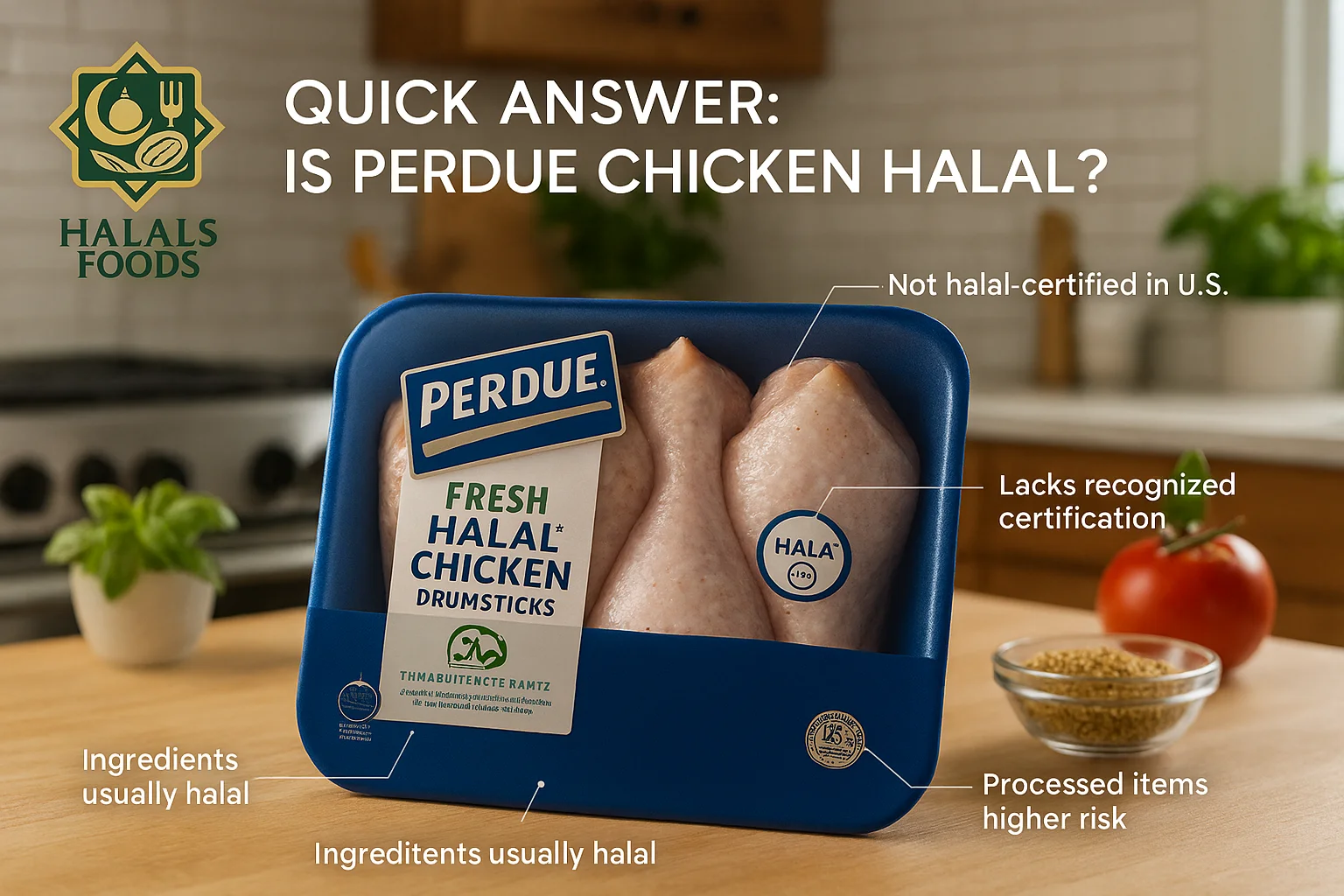
Short answer: ❌ Perdue chicken is generally NOT halal-certified in the United States.
While Perdue chicken products often contain halal-friendly ingredients, the brand does not consistently follow Islamic slaughter (Zabiha) requirements, nor does it hold recognized halal certification for most U.S. products. According to Islamic guidelines, meat must be slaughtered according to specific rules, which Perdue does not officially guarantee. Therefore, most Muslim scholars and halal authorities do not consider standard Perdue chicken halal.
Ingredient Breakdown: Are Perdue Chicken Ingredients Halal?
When assessing whether Perdue chicken is halal, ingredients alone are not enough, but they are still an important starting point.
Core Ingredients in Plain Perdue Chicken
We reviewed multiple Perdue product labels, including fresh chicken breasts, thighs, and drumsticks. The most common ingredients listed are:
-
Chicken
-
Water (sometimes added for moisture)
-
Salt (in marinated or seasoned products)
-
Natural flavorings (in some processed items)
On the surface, these ingredients appear halal. There is no pork, alcohol, or obvious haram substance listed in plain, unseasoned Perdue chicken.
Processed Perdue Products: Higher Risk
Problems begin when we examine processed Perdue products, such as:
-
Breaded chicken nuggets
-
Chicken strips
-
Ready-to-cook seasoned items
These may contain:
-
Modified food starch
-
Natural flavors
-
Enzymes
-
Yeast extract
-
Preservatives
Why “Natural Flavors” Matter in Halal Analysis
“Natural flavors” is a legally broad term in the U.S. According to FDA regulations, it may include extracts derived from:
-
Plants (generally halal)
-
Animals (source often undisclosed)
-
Alcohol-based solvents (problematic in Islam)
Without explicit halal certification, Muslims cannot verify whether these flavorings comply with Islamic law.
Enzymes and Additives
Some processed poultry products may use enzymes during processing. Islamic rulings on enzymes depend on:
-
Source (microbial vs. animal)
-
Method of extraction
-
Whether the animal source was halal-slaughtered
Perdue does not disclose enzyme sourcing publicly, which creates uncertainty (shubha).
E-Numbers and Preservatives
Perdue products sold in the U.S. rarely list E-numbers directly, but common preservatives may include:
-
Sodium phosphates
-
Potassium lactate
These are generally halal if synthetically derived, but again, without halal certification, certainty is lacking.
Key takeaway:
Even though Perdue chicken ingredients are mostly halal-friendly, ingredients alone do not make meat halal under Islamic law.
Manufacturing Process & Cross-Contamination Concerns
How Perdue Chicken Is Processed
Perdue operates large-scale poultry processing facilities across the United States. According to publicly available industry information:
-
Chickens are slaughtered using high-speed automated systems
-
Stunning is commonly used
-
Thousands of birds are processed per hour
This industrial model prioritizes efficiency, not religious compliance.
Stunning and Islamic Slaughter
One of the biggest halal concerns is pre-slaughter stunning.
Islamic guidelines generally require that:
-
The animal must be alive at the time of slaughter
-
Death must occur from the cut, not stunning
-
The name of Allah must be pronounced
Perdue does not confirm that:
-
Birds survive stunning consistently
-
Each bird is slaughtered with tasmiyah (Allah’s name)
-
Muslim slaughtermen supervise the process
This creates a major conflict with halal principles.
Cross-Contamination Risks
Perdue facilities also process:
-
Non-halal meats
-
Conventionally slaughtered poultry
-
Various seasoned and processed products
Potential issues include:
-
Shared equipment
-
Shared processing lines
-
No halal segregation protocols
For Muslims, cross-contamination with non-halal meat invalidates halal integrity, especially in the absence of certified controls.
5. Halal Certification Analysis
Is Perdue Chicken Halal Certified?
After reviewing official Perdue sources and halal certification databases:
Perdue chicken sold in the U.S. is NOT halal certified by major halal authorities.
There is no evidence of certification from recognized organizations such as:
-
IFANCA (Islamic Food and Nutrition Council of America)
-
HFSAA (Halal Food Standards Alliance of America)
-
Halal Monitoring Committee (HMC)
-
Zabiha Halal authorities
Regional Differences: USA vs Other Markets
In some countries, multinational brands offer separate halal-certified product lines, but in the United States, Perdue has not launched a dedicated halal poultry range.
-
USA: ❌ No official halal certification
-
UK: Perdue is less common; halal standards differ
-
Canada: No verified halal Perdue line
-
Middle East: Perdue products are rarely sold
This lack of regional halal adaptation further supports the conclusion that halal compliance is not a company priority.
Why Certification Matters
Halal certification provides:
-
Third-party verification
-
Regular audits
-
Muslim oversight
Without it, halal claims remain unverifiable, which Islam discourages in matters of food consumption.
Official Statements From Perdue (What the Brand Says)
We checked Perdue’s official website, customer FAQs, and publicly available statements regarding religious dietary compliance.
Perdue’s Position on Halal
Perdue primarily focuses on claims such as:
-
“No antibiotics ever”
-
“Humanely raised”
-
“Vegetarian-fed diet”
However, Perdue does NOT claim its chicken is halal.
There is:
-
No halal FAQ section
-
No mention of Islamic slaughter
-
No halal logo on packaging
This silence is significant. Brands that offer halal products typically highlight it clearly, especially in Muslim-majority markets.
Comparison With Other Brands
Some poultry companies explicitly state:
-
“Not halal-certified”
-
“May not meet religious dietary laws”
Perdue does neither—but absence of confirmation does not equal halal approval.
Why This Matters for Muslims
From an Islamic perspective:
“Halal meat must be confirmed, not assumed.”
Without a clear statement or certification, Muslim consumers are advised to avoid doubtful meat, especially when halal alternatives exist.
Why Some Muslims Consider Perdue Chicken Halal
Despite the lack of halal certification, some Muslim consumers still believe Perdue chicken may be halal or at least acceptable in certain situations. This view is usually based on permissive interpretations and practical realities, especially for Muslims living in non-Muslim-majority countries like the United States.
Ingredient-Based Reasoning
One common argument is that:
-
Perdue chicken contains no pork
-
There is no alcohol listed in plain chicken products
-
The chicken itself is a halal animal
Based on this, some Muslims assume that if the ingredients are clean, the product should be halal. This reasoning focuses heavily on ingredient lists, rather than slaughter methodology.
Ahl al-Kitab (People of the Book) Opinion
Another reason some Muslims consider Perdue chicken halal is based on a minority scholarly opinion regarding meat slaughtered by People of the Book (Christians and Jews).
This view argues that:
-
Since Perdue is an American company
-
And the U.S. is historically Christian-majority
-
The meat could fall under permissibility mentioned in Surah Al-Ma’idah (5:5)
However, many contemporary scholars reject applying this ruling to modern industrial slaughter, where:
-
The slaughterman is often unknown
-
Machines perform the killing
-
God’s name is not pronounced
Necessity and Limited Access
Some Muslims, especially in small towns, argue from necessity (darurah):
-
Halal meat is unavailable or extremely expensive
-
Grocery stores only sell mainstream brands
-
Families rely on what is accessible
In such cases, some scholars allow leniency, but only temporarily, and still recommend seeking verified halal meat whenever possible.
Why Many Muslims Avoid Perdue Chicken
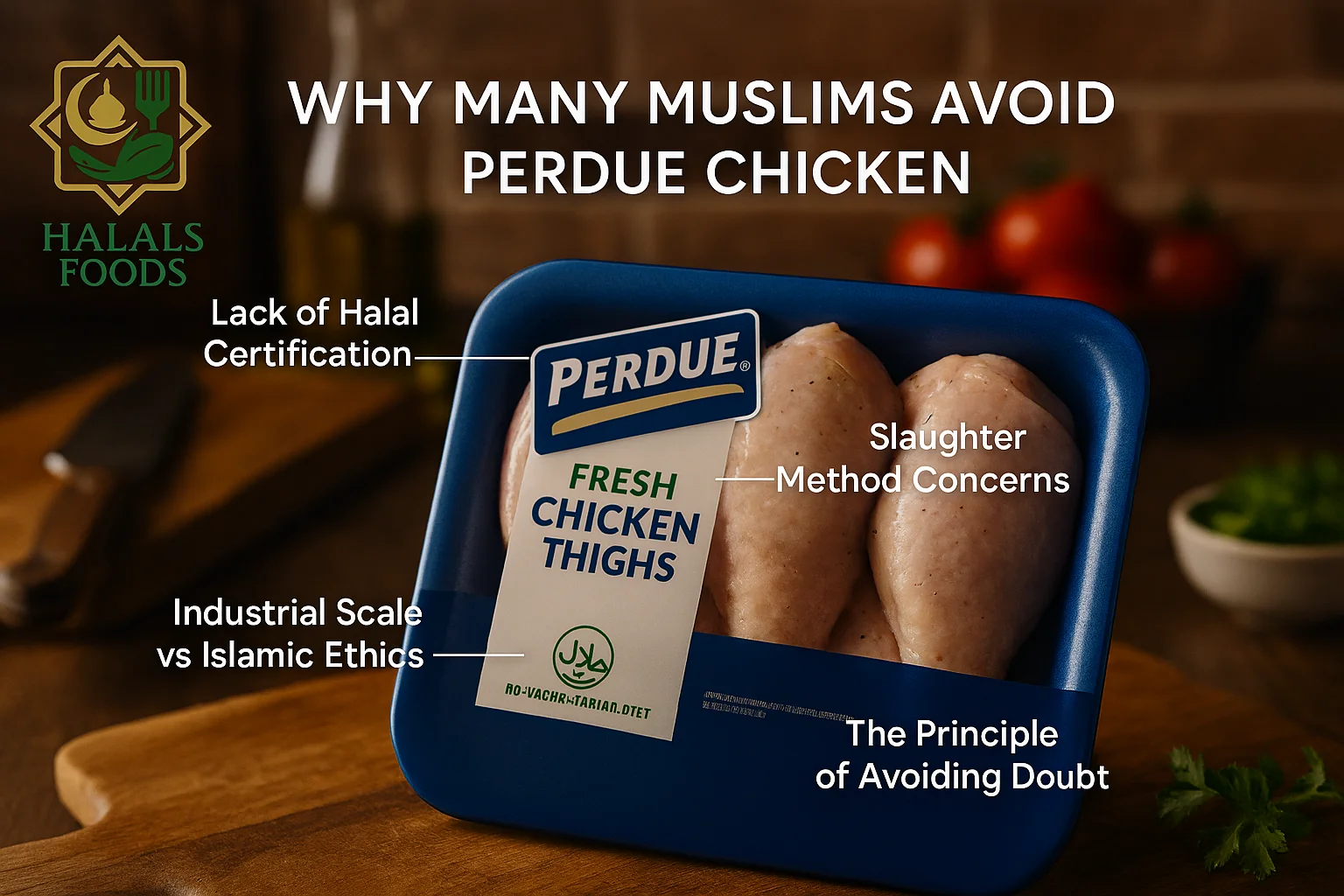
On the other side, a large number of Muslim scholars, halal authorities, and consumers avoid Perdue chicken entirely. Their concerns are rooted in well-established Islamic principles.
Lack of Halal Certification
The strongest reason Muslims avoid Perdue chicken is simple:
There is no halal certification.
Islamic law emphasizes certainty (yaqeen) in halal matters. When halal status is unclear, Muslims are encouraged to avoid the product altogether.
Slaughter Method Concerns
As discussed earlier:
-
Perdue uses high-speed mechanical slaughter
-
Stunning is widely practiced
-
There is no confirmation of tasmiyah (mentioning Allah’s name)
According to the majority of scholars:
-
Mechanical slaughter without individual tasmiyah is invalid
-
If stunning kills the animal before slaughter, the meat becomes haram
Industrial Scale vs Islamic Ethics
Modern poultry plants process thousands of birds per hour. This scale makes it practically impossible to ensure:
-
Individual religious compliance
-
Muslim supervision
-
Proper Islamic intention
For this reason, many halal certifying bodies refuse to approve such systems unless strict controls are in place—which Perdue does not publicly claim.
The Principle of Avoiding Doubt
The Prophet Muhammad ﷺ said:
“Leave that which makes you doubt for that which does not make you doubt.”
For many Muslims, Perdue chicken falls squarely into the doubtful (shubha) category.
USA Halal Market Context: Why This Confusion Exists
Understanding why people ask “Is Perdue chicken halal?” requires understanding how halal food works in the United States.
Halal Is Not Federally Regulated
In the U.S.:
-
“Halal” is not regulated like “organic”
-
Any company can make claims without strict oversight
-
Certification is handled by private organizations
This leads to confusion, misinformation, and assumptions by consumers.
Common Issues in the U.S. Halal Meat Market
Muslim consumers often face:
-
Mislabeling
-
Ambiguous ingredient lists
-
No clear slaughter details
-
Lack of transparency from brands
Large corporations like Perdue cater to the general market, not religious minorities, unless there is strong demand.
What Muslims Should Check on Labels
When buying chicken in the U.S., Muslims should look for:
-
Recognized halal certification logos
-
Clear mention of “Zabiha halal”
-
Certifying authority name (IFANCA, HFSAA, etc.)
-
Separate halal processing lines
If these are missing, the product should be treated with caution.
Muslim Consumer Habits in the USA
Most informed Muslim consumers:
-
Buy from halal butchers
-
Order meat from halal online stores
-
Support Muslim-owned brands
-
Avoid major non-certified poultry brands
This shift is growing as halal awareness increases.
Final Verdict: Is Perdue Chicken Halal?
After reviewing ingredients, slaughter methods, manufacturing processes, halal certification status, and official brand statements, the conclusion is clear:
Perdue chicken is NOT halal-certified and does not meet standard halal requirements in the United States.
While the ingredients themselves may appear halal-friendly, Islamic dietary law places greater importance on slaughter methodology and religious compliance. Perdue does not provide verification of Zabiha slaughter, Muslim supervision, or tasmiyah.
For Muslims seeking certainty in their food, it is safer and religiously wiser to avoid Perdue chicken and choose certified halal alternatives instead. When halal meat is easily available, consuming doubtful meat is unnecessary and discouraged in Islam.
Frequently Asked Questions (FAQs)
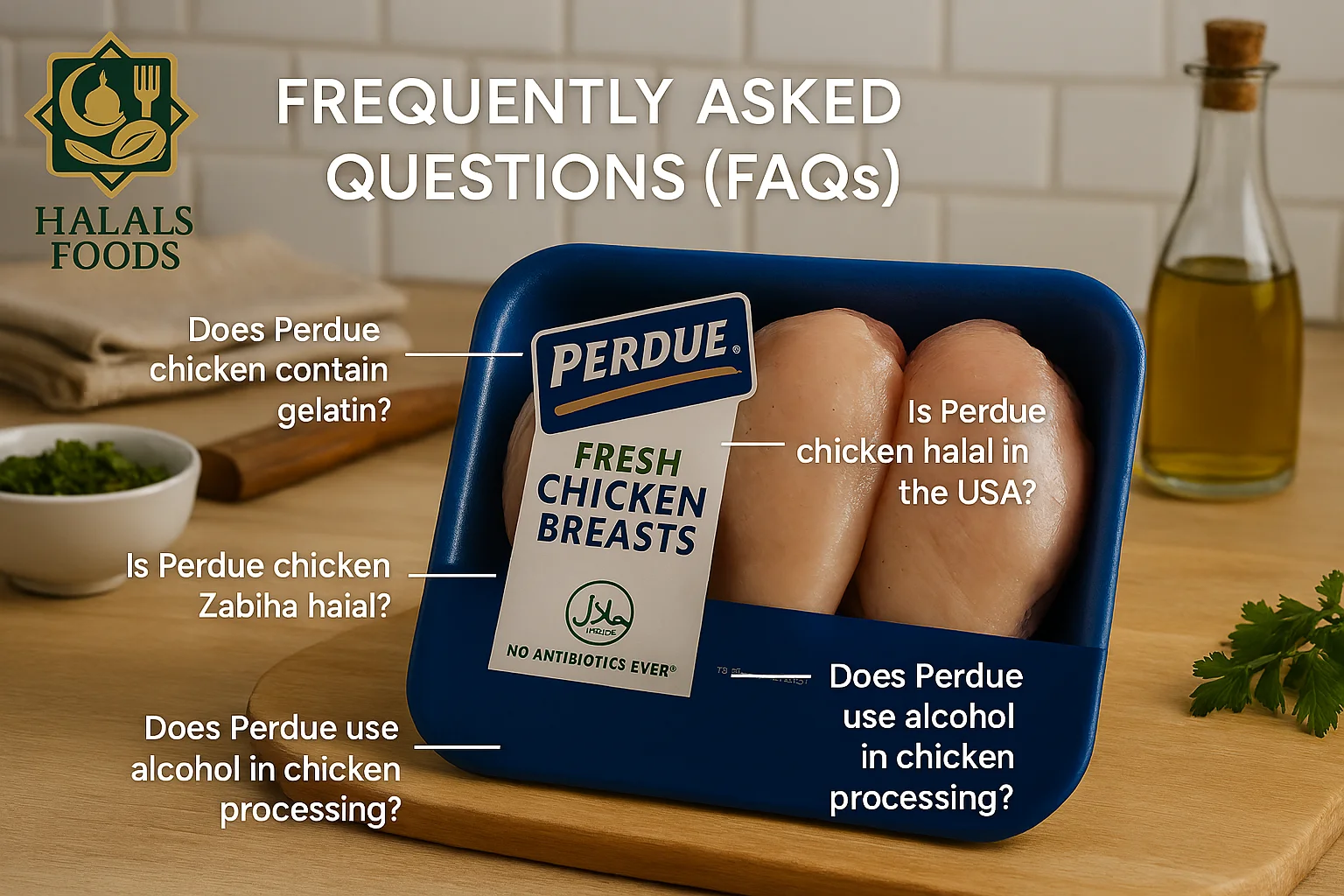
1. Does Perdue chicken contain gelatin?
Plain Perdue chicken does not contain gelatin. However, some processed Perdue products may include additives where the source is unclear. Without halal certification, gelatin sourcing cannot be confirmed.
2. Is Perdue chicken halal in the USA?
No. Perdue chicken sold in the USA is not halal-certified and does not guarantee Islamic slaughter practices.
3. Is Perdue chicken halal in the UK or Canada?
There is no verified halal-certified Perdue product line in the UK or Canada. Halal status may vary by region, but no official certification exists.
4. Is Perdue chicken Zabiha halal?
No. Perdue does not claim Zabiha slaughter, nor does it provide evidence of individual Islamic slaughter with tasmiyah.
5. Does Perdue use alcohol in chicken processing?
Alcohol is not listed in plain chicken, but “natural flavors” in processed products may involve alcohol-based solvents. This cannot be verified without certification.
6. Do Perdue factories process pork?
Perdue primarily focuses on poultry, but facilities may process non-halal products using shared equipment, increasing cross-contamination risk.
7. Is Perdue chicken acceptable for Hanafi or Shafi’i scholars?
Most Hanafi and Shafi’i scholars require confirmed halal slaughter, which Perdue does not provide. Therefore, it is generally not considered halal under these schools.
8. Can Muslims eat Perdue chicken in necessity?
Some scholars allow leniency in extreme necessity. However, in most U.S. cities, halal meat is accessible, making necessity claims weak.
9. Why doesn’t Perdue get halal certification?
Large brands often avoid halal certification due to cost, operational changes, and limited perceived demand. This does not imply halal compliance.
12. References
-
Perdue Farms Official Website
-
Islamic Food and Nutrition Council of America (IFANCA)
-
Halal Food Standards Alliance of America (HFSAA)
-
U.S. FDA Food Labeling Guidelines
-
Contemporary Islamic Fiqh Opinions on Meat Slaughter
Related Halal Food Guides You May Find Helpful
People searching for “Is [ Is Tyson Chicken Halal in the USA? ]” are also curious about other foods and ingredients. Below, you’ll find related halal food articles that clearly explain ingredient sources, how products are made, and whether they meet halal requirements.
More.[ Is Sanderson Farms Halal? ]
More [ Is Beef Gelatin Halal? ]