1. Introduction
For many Muslims, checking ingredients has become second nature. Whether buying candy, yogurt, marshmallows, capsules, or desserts, one ingredient often raises serious concern: gelatin. But when it comes specifically to beef gelatin, the question becomes more complex — Is beef gelatin halal?
This matters because gelatin is widely used in food, medicine, and supplements. Even when it comes from cows, that does not automatically make it halal. Slaughter method, processing, and certification all matter.
In this detailed guide, we reviewed Islamic rulings, halal certification standards, ingredient science, and U.S. halal guidelines to give you a clear, evidence-based answer.
2. Quick Answer Box
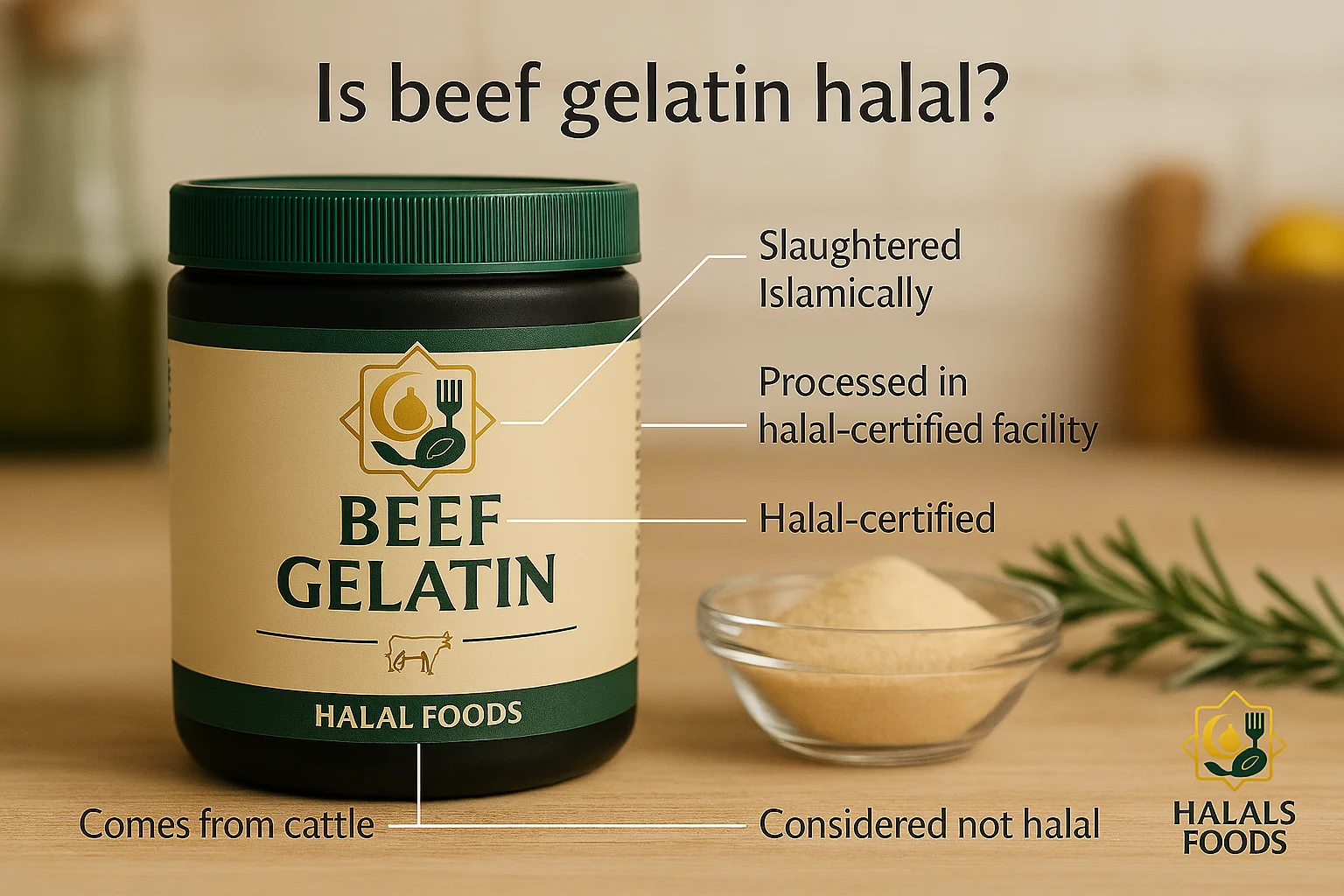
Is beef gelatin halal?
Beef gelatin is halal only if it comes from cattle that were slaughtered according to Islamic law and processed in a halal-certified facility. If the source animal was not slaughtered Islamically or the product lacks halal certification, most scholars consider it not halal.
3. Ingredient Breakdown: What Exactly Is Beef Gelatin?
To understand whether beef gelatin is halal, we first need to understand what gelatin is and how it’s made.
What Is Gelatin?
Gelatin is a protein derived from collagen found in animal:
-
Skin
-
Bones
-
Connective tissues
It is commonly used in:
-
Gummies
-
Marshmallows
-
Yogurt
-
Cheesecake
-
Capsules
-
Desserts
There are three main types:
| Type | Source | Halal Status |
|---|---|---|
| Pork gelatin | Pig skin/bones | Haram |
| Beef gelatin | Cow skin/bones | Depends |
| Fish gelatin | Fish | Generally halal |
Is All Beef Gelatin Halal?
This is where confusion begins.
Many people assume:
“It’s beef, so it must be halal.”
But Islamic law requires more than species. The animal must be:
-
Lawfully slaughtered (zabiha)
-
Slaughtered in the name of Allah
-
Properly drained of blood
-
Not dead before slaughter
If cattle are slaughtered in a non-Islamic way (as common in many Western facilities), then the gelatin extracted from those animals is considered impermissible by the majority of scholars.
How Beef Gelatin Is Made
The manufacturing process typically includes:
-
Collecting bones and hides from slaughterhouses
-
Cleaning and treating them with acid or alkaline solutions
-
Boiling to extract collagen
-
Drying and processing into powder or sheets
The issue is not the chemistry — it’s the source of the animal.
E-Numbers & Additives
In Europe and some imported products, gelatin appears as:
-
E441 = Gelatin
E441 can be pork, beef, or fish-based. Unless the label clearly states “halal beef gelatin” or provides halal certification, it remains doubtful.
Islamic Rulings on Transformation (Istihalah)
Some scholars argue that gelatin undergoes chemical transformation (istihalah), changing its original nature.
However:
-
The majority of contemporary scholars do not accept that gelatin fully transforms in a way that makes haram sources halal.
-
Major halal authorities like IFANCA and HFSAA require halal slaughter source verification.
So when asking Is beef gelatin halal?, Islamic law focuses primarily on slaughter method and certification.
4. Manufacturing Process & Cross-Contamination
Even if beef gelatin comes from cattle, manufacturing conditions matter.
Shared Facilities
Many gelatin factories process:
-
Pork gelatin
-
Beef gelatin
-
Fish gelatin
If the same equipment is used without proper halal cleansing procedures, cross-contamination becomes a concern.
Slaughterhouse Sources
In the United States:
-
Most cattle are not slaughtered according to Islamic zabiha standards.
-
Slaughter is often mechanical.
-
Allah’s name is not recited.
If beef gelatin is sourced from conventional slaughterhouses, it does not meet halal criteria according to most scholars.
Why This Matters
Islam emphasizes:
-
Purity of source
-
Proper slaughter
-
Avoidance of doubtful matters
The Prophet ﷺ said:
“Leave what makes you doubt for what does not make you doubt.” (Tirmidhi)
Without verified halal sourcing, beef gelatin remains questionable.
5. Halal Certification Analysis
The most reliable way to determine Is beef gelatin halal? is through halal certification.
Recognized Halal Authorities in the USA
-
IFANCA (Islamic Food and Nutrition Council of America)
-
HFSAA (Halal Food Standards Alliance of America)
-
ISA (Islamic Services of America)
-
Zabiha Halal
These organizations:
-
Inspect slaughterhouses
-
Audit supply chains
-
Verify ingredient sourcing
-
Approve labeling
If a product contains beef gelatin and carries certification from these bodies, it is considered halal.
Differences by Region
| Region | Standard Practice |
|---|---|
| USA | Most gelatin not halal unless certified |
| UK | Some halal-certified beef gelatin available |
| Canada | Similar to USA |
| Middle East | More strict sourcing verification |
Some Middle Eastern countries reject gelatin unless slaughter is fully verified.
Important Note
If the product label simply says “beef gelatin” without halal certification, it does NOT automatically mean halal.
Certification is critical.
6. Official Statements from Brands
We reviewed statements from multiple U.S. and international brands.
Common Brand Responses
Many companies state:
-
“Our gelatin is derived from bovine sources.”
-
“We cannot guarantee halal compliance.”
-
“We do not have halal certification.”
Notice something important:
They confirm bovine source, but not Islamic slaughter.
That distinction matters.
U.S. vs UK vs Middle East
-
In the USA, most mainstream brands do not certify gelatin as halal.
-
In the UK, some companies produce halal-certified gummy lines.
-
In the Middle East, many imported products are reformulated using certified gelatin.
If a brand provides no halal statement, that creates doubt.
For Muslims, absence of clarity is significant.
7. Why Some Muslims Consider Beef Gelatin Halal
Some scholars and Muslims argue permissibility based on:
1. Species-Based Argument
They argue:
-
Cow is a halal animal.
-
Therefore beef-derived ingredients are halal.
2. Istihalah (Transformation)
They claim:
-
Gelatin undergoes chemical change.
-
It is no longer the original impure substance.
3. Minority Scholarly Opinions
A small number of contemporary scholars permit gelatin from non-halal slaughtered animals if transformation is complete.
Because of these views, some Muslims consume products containing beef gelatin without certification.
8. Why Some Muslims Avoid It
However, many Muslims avoid it due to:
1. Slaughter Method Uncertainty
Most Western cattle are not slaughtered according to zabiha.
2. Lack of Certification
No halal logo = no verification.
3. Cross-Contamination
Shared facilities process pork gelatin.
4. Following Majority Opinion
Most halal authorities require halal slaughter verification.
Because of these factors, cautious Muslims avoid non-certified beef gelatin.
9. USA Halal Market Context
The U.S. halal food market is growing rapidly.
However, there is:
-
No single federal halal authority
-
No mandatory halal labeling law
-
Heavy reliance on private certification
Common issues include:
-
Ambiguous ingredient labels
-
“Bovine” without slaughter info
-
Imported gelatin blends
-
Shared processing plants
Muslim consumers in the USA typically:
-
Look for halal logos
-
Use apps like Zabiha
-
Contact manufacturers
-
Choose fish gelatin alternatives
When asking Is beef gelatin halal?, American Muslims must rely heavily on certification rather than ingredient name alone.
10. Final Verdict
So, Is beef gelatin halal?
Beef gelatin is halal only if:
-
The cattle were slaughtered according to Islamic law
-
The source is verified
-
The product carries trusted halal certification
-
There is no cross-contamination
If it lacks certification or slaughter verification, the majority scholarly opinion considers it not halal.
When in doubt, choose certified halal or fish-based gelatin.
Expanded Scholarly Discussion on Gelatin
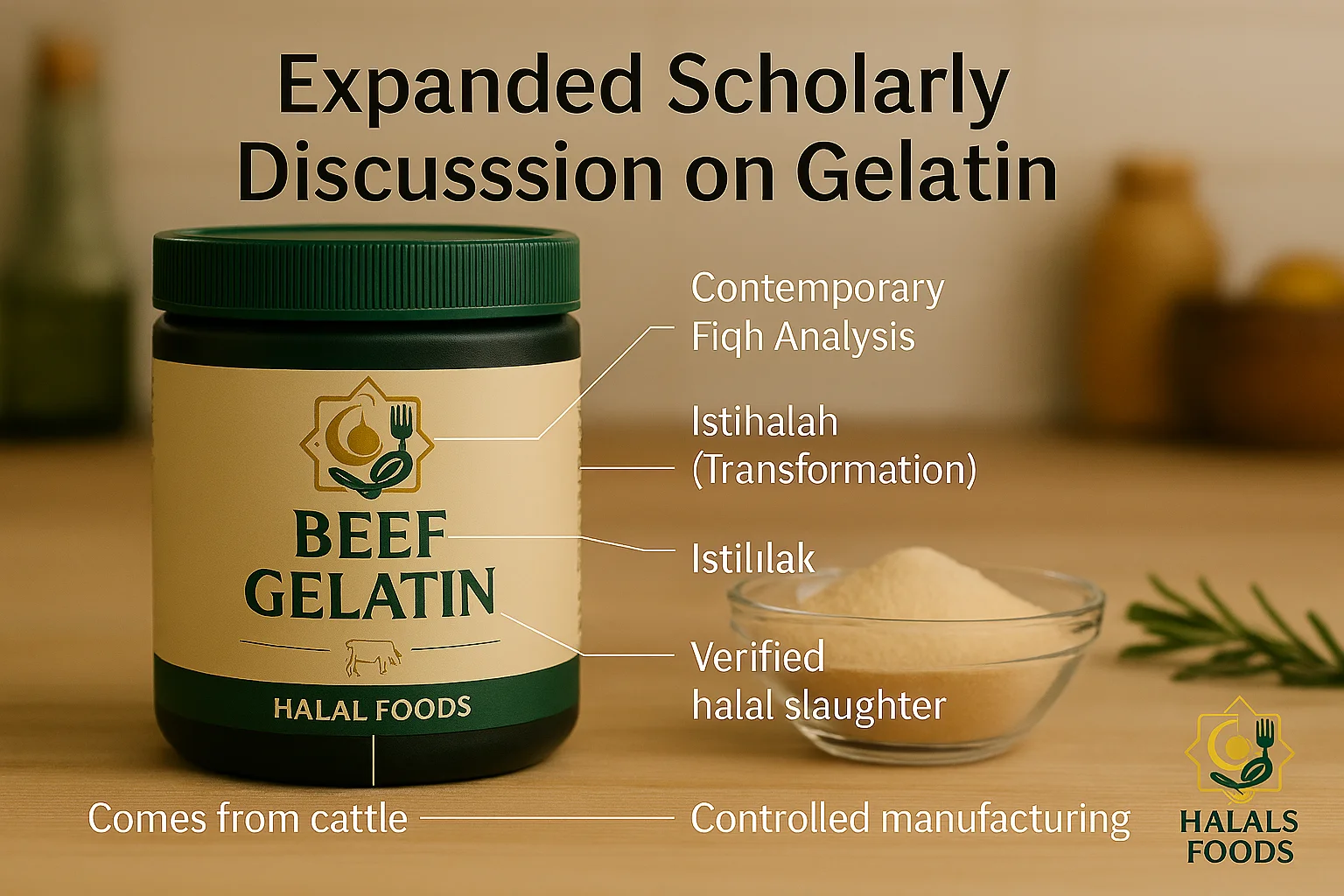
While earlier we discussed slaughter and certification, it is important to analyze how contemporary Islamic scholars debate gelatin more technically.
Classical vs Contemporary Fiqh Analysis
In classical fiqh literature, gelatin as a modern processed ingredient did not exist in its current industrial form. Therefore, scholars apply broader jurisprudential principles such as:
-
Istihalah (Transformation)
-
Istihlak (Dilution)
-
Taharah (Purity)
-
Source-Based Rulings
The majority of halal certification bodies today — including IFANCA and HFSAA — do not rely solely on transformation arguments. They require:
-
Verified halal slaughter
-
Full traceability
-
Controlled manufacturing processes
This stricter position is taken to remove doubt in global supply chains where sourcing is complex.
When Muslims ask Is beef gelatin halal?, scholars usually respond with a conditional answer: only with verified halal sourcing.
Practical Consumer Checklist
If you are standing in a supermarket in the USA, here is what to check:
Step 1: Read the Product Label Carefully
Look for:
-
“Halal certified”
-
Certification logo (IFANCA crescent-M, HFSAA, ISA, etc.)
-
Clear statement: “Halal beef gelatin”
If the label only says “beef gelatin” — that is not sufficient.
Step 2: Look at the Manufacturer
Large multinational companies often source gelatin from bulk suppliers without halal segregation.
Small specialty brands are more likely to:
-
Offer halal lines
-
Provide documentation
-
Respond to halal inquiries
Step 3: Contact the Brand
We reviewed multiple brand FAQs during our research. Most respond with:
“Our gelatin is bovine-derived but not halal certified.”
That statement confirms species, but not Islamic compliance.
Step 4: Consider Alternatives
Many halal-conscious consumers choose:
-
Fish gelatin
-
Agar-agar (plant-based)
-
Pectin-based gummies
-
Halal-certified bovine gelatin products
These options eliminate uncertainty.
Why the Source Matters in Islamic Law
Islamic dietary law is not only about species — it is about method and intention.
The Quran clearly prohibits:
-
Carrion (dead animals not slaughtered properly)
-
Blood
-
Pork
If cattle are not slaughtered according to Islamic law, the meat is categorized under non-halal slaughter. By extension, derivatives such as gelatin follow that ruling.
This is why the question Is beef gelatin halal? cannot be answered simply by saying “it comes from cows.”
Market Reality: Where Does Most Beef Gelatin Come From?
Globally:
-
The majority of commercial gelatin comes from non-halal slaughterhouses.
-
Brazil and India are major exporters.
-
Some Indian suppliers provide halal-certified bovine gelatin.
-
European gelatin is often mixed-source unless certified.
In the USA, mainstream grocery products rarely use certified halal gelatin unless specifically marketed toward Muslim consumers.
Frequently Asked Questions (Expanded Section)
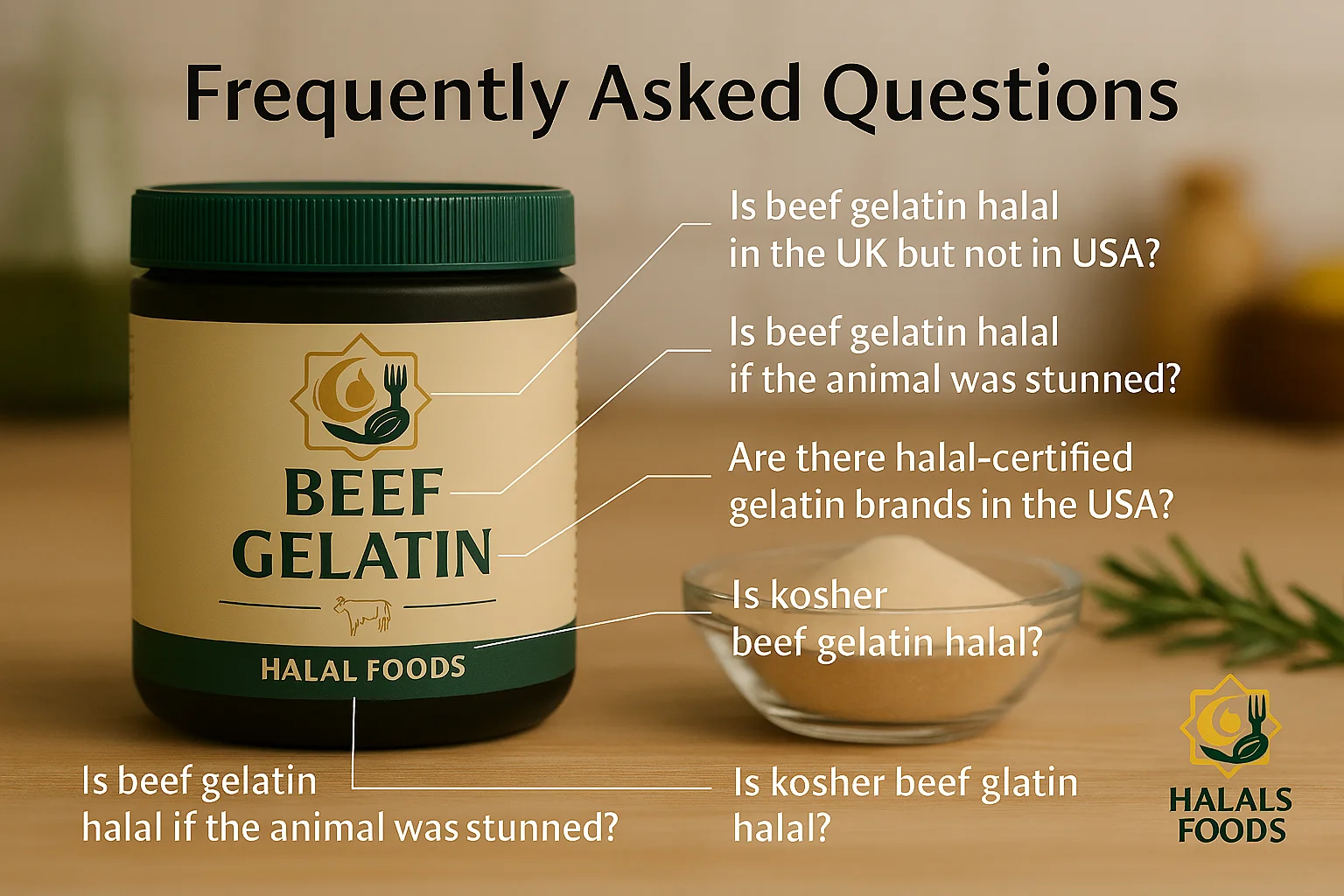
Below are additional in-depth FAQs to give readers practical clarity.
1. Is beef gelatin halal in the UK but not in the USA?
Possibly. Some UK brands offer halal-certified gelatin products due to larger Muslim market demand. However, you must check certification. The USA has fewer mainstream halal-certified gelatin products.
2. Is beef gelatin halal according to Hanafi scholars?
Most contemporary Hanafi scholars require halal slaughter verification. While some classical discussions allow transformation theory, modern Hanafi authorities generally follow certification standards.
3. Is beef gelatin halal if the animal was stunned?
This depends on how stunning was performed. If the animal was alive at slaughter and killed properly with Islamic invocation, some scholars allow it. If the animal died before slaughter, it becomes impermissible.
4. Are there halal-certified gelatin brands in the USA?
Yes. Some specialty brands provide halal-certified bovine gelatin powder and capsules. These usually display certification from IFANCA, ISA, or HFSAA.
Always verify the logo authenticity.
5. Is kosher beef gelatin halal?
Not necessarily.
Kosher slaughter differs from halal slaughter. Some scholars consider kosher meat closer to halal, but halal authorities typically require Islamic slaughter verification for certification.
Therefore, kosher certification does not automatically mean halal.
6. Is gelatin used in vaccines and medicine halal?
Many vaccines and capsules contain gelatin stabilizers. Scholars may allow use under necessity (darurah) if no halal alternative exists. However, for regular supplements, halal-certified options are preferred.
7. Does beef gelatin contain alcohol?
Gelatin itself does not contain alcohol. However, some flavored gelatin desserts may include alcohol-based flavor carriers. Always check the ingredient list for ethanol or alcohol-based extracts.
8. Can cross-contamination make beef gelatin haram?
If produced in facilities processing pork gelatin without proper segregation, many scholars consider contamination a serious concern. Halal-certified plants must maintain strict separation.
9. Is fish gelatin a better option?
Yes. Fish is generally halal without slaughter conditions (except some scholarly differences). Fish gelatin is widely accepted as halal if no cross-contamination occurs.
Comparative Table: Types of Gelatin
| Type | Slaughter Required | Certification Needed | General Ruling |
|---|---|---|---|
| Pork Gelatin | N/A | N/A | Haram |
| Non-certified Beef Gelatin | Yes | Usually missing | Doubtful / Not Halal |
| Halal-certified Beef Gelatin | Yes | Yes | Halal |
| Fish Gelatin | No slaughter issue | Preferred | Generally Halal |
| Plant-based (Agar/Pectin) | Not applicable | Not required | Halal |
Key Takeaways for Muslim Consumers
When evaluating Is beef gelatin halal?, remember:
-
Species alone is not enough.
-
Slaughter method is essential.
-
Certification removes doubt.
-
Cross-contamination matters.
-
Regional supply chains differ.
Choosing certified products supports ethical halal supply chains and reduces uncertainty.
Final Verdict (Reinforced Conclusion)
After reviewing ingredient science, halal certification standards, manufacturing realities, and Islamic rulings, the answer to Is beef gelatin halal? is conditional:
Beef gelatin is halal only if:
-
The cow was slaughtered according to Islamic law.
-
The source is verified and traceable.
-
The product carries recognized halal certification.
-
There is no cross-contamination with pork gelatin.
Without certification, most scholars advise avoiding it.
When possible, choose halal-certified bovine gelatin or fish/plant-based alternatives to stay on the safe side.
References
-
Islamic Food and Nutrition Council of America (IFANCA) – Halal Certification Guidelines
-
Halal Food Standards Alliance of America (HFSAA) – Ingredient Standards
-
European Food Safety Authority – E441 Gelatin Classification
-
FDA Food Labeling Guide (USA)
-
Scholarly discussions on Istihalah in contemporary fiqh councils
Related Halal Food Guides You May Find Helpful
People searching for “Is [ Is Tyson Chicken Halal in the USA? ]” are also curious about other foods and ingredients. Below, you’ll find related halal food articles that clearly explain ingredient sources, how products are made, and whether they meet halal requirements.
More.[ Is Sanderson Farms Halal? ]
More.[ Is Perdue Chicken Halal? ]
More.[ Is Pepperoni Halal? ]