A bag of chips looks harmless. Potatoes, oil, salt… simple, right?
That’s exactly why many Muslims get confused when asking Are Lays halal in USA. On the surface, Lay’s seems like one of the safest snacks in America. But once you start reading the ingredients closely, things become less straightforward.
One flavor contains cheese enzymes. Another has “natural flavors.” Some include additives like disodium inosinate and guanylate. Then there’s the bigger issue nobody talks about enough — shared factories, flavor processing, and the fact that Lay’s in the USA is not officially halal-certified.
This is where the confusion begins.
Some Muslims eat Lay’s without hesitation. Others avoid the brand completely. And honestly, both sides usually have reasons behind their decision.
The problem is that most articles online either say “everything is halal” without evidence or make everything sound haram without proper explanation. Real people want balanced answers.
So in this guide, we’re going deeper.
Not just ingredient lists.
Not just copy-paste fatwas.
But actual analysis of:
- Lay’s ingredients in America
- Flavor additives
- E-numbers and enzymes
- Cross-contamination concerns
- Scholar opinions
- PepsiCo statements
- Which flavors are lower risk
- Why Muslims disagree on this issue
Because when someone searches Are Lays halal in USA, what they really want is clarity.
And that’s exactly what this article is going to give.
Why Muslims Question Are Lays halal in USA
Twenty years ago, many Muslims only worried about obvious haram foods like pork or alcohol.
Today, processed foods are a completely different story.
Modern snacks contain:
- Flavor enhancers
- Fermentation agents
- Cheese cultures
- Preservatives
- Enzymes
- Artificial and natural flavor systems
A simple potato chip can go through dozens of industrial processes before reaching a supermarket shelf.
That’s why Muslims now question even basic snack brands.
And Lay’s is one of the biggest examples.
The company sells dozens of flavors across America:
- Classic
- Barbecue
- Sour Cream & Onion
- Salt & Vinegar
- Cheddar & Sour Cream
- Flamin’ Hot
- Honey BBQ
- Limón
- Dill Pickle
- Wavy varieties
Each flavor uses different seasoning formulas.
Some are simple.
Others contain highly processed flavor compounds that are difficult for ordinary consumers to trace.
This is why the question Are Lays halal in USA does not have one simple yes-or-no answer for every flavor.
The Quick Answer Most People Want
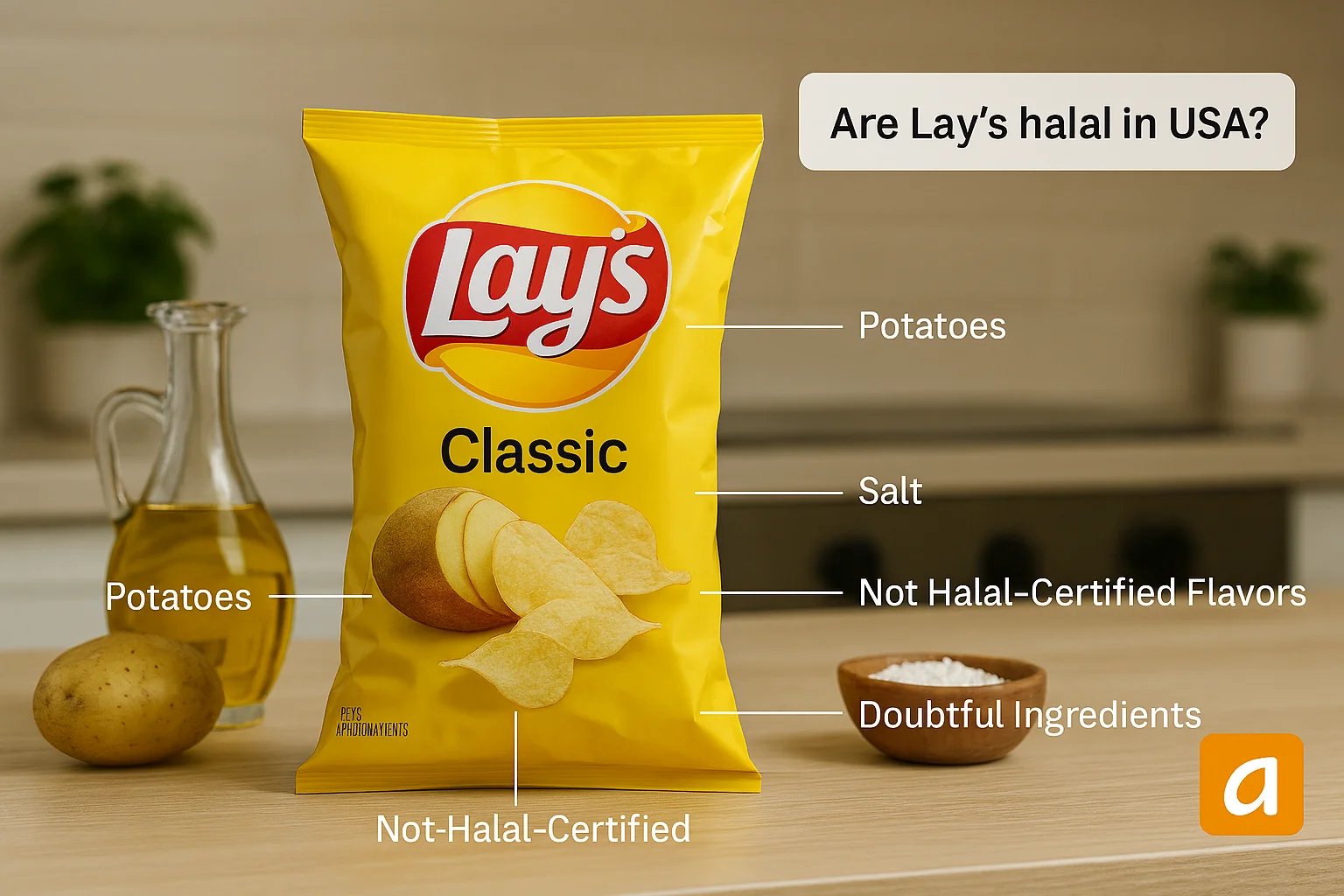
Here’s the short version before we go deeper.
Plain Lay’s Classic chips are generally considered low-risk and likely halal by many Muslims because they mainly contain:
- Potatoes
- Vegetable oil
- Salt
However, flavored Lay’s varieties become more questionable because they may contain:
- Natural flavors
- Dairy enzymes
- Whey powders
- Cheese cultures
- Flavor enhancers
- Possible alcohol-based carriers
And importantly:
Lay’s USA products are NOT broadly halal-certified.
That changes everything for cautious consumers.
Understanding the Real Halal Issue With Processed Snacks
Many people think halal only means “no pork.”
But Islamic dietary law is broader than that.
A food can become questionable due to:
- Animal-derived ingredients
- Alcohol processing
- Improper slaughter sources
- Cross-contamination
- Hidden flavor compounds
- Enzymes from non-halal animals
Here’s the part most people ignore…
Modern flavor manufacturing is incredibly complex.
When a package says “natural flavors,” that could mean dozens of tiny compounds blended together in laboratories and manufacturing plants.
Some may come from plants.
Some may come from dairy.
Others could involve animal processing aids.
Under U.S. labeling laws, companies often do not need to fully disclose every source publicly.
So when Muslims ask Are Lays halal in USA, they’re really asking:
“Can we trust the sourcing and processing behind these ingredients?”
That’s the real issue.
Breaking Down Lay’s Core Ingredients
Let’s start with the good news first.
Most Lay’s chips begin with a very basic foundation.
Potatoes
Potatoes are naturally halal.
No debate there.
They are plant-based and universally permissible in Islam.
Vegetable Oils
Lay’s commonly uses oils such as:
- Corn oil
- Sunflower oil
- Canola oil
- Soybean oil
These are generally halal unless contaminated during production.
Most scholars consider vegetable oils permissible.
Salt
Salt is mineral-based and halal.
Again, no issue.
So Why Do Muslims Still Debate Are Lays halal in USA?
Because the concern starts AFTER the basic ingredients.
The seasoning powders are where things become complicated.
Especially flavored chips.
The “Natural Flavors” Problem Explained Simply
You’ve probably seen “natural flavors” written on food packages hundreds of times.
But most consumers don’t know what it actually means.
Under FDA rules, natural flavors can include substances extracted from:
- Plants
- Fruits
- Vegetables
- Dairy
- Meat
- Fermented ingredients
And manufacturers are not always required to explain every source publicly.
This creates a halal gray area.
For example:
A barbecue seasoning might contain smoke flavor compounds processed with alcohol carriers.
A cheese flavor may contain enzymes from animal sources.
A savory flavor enhancer could use meat-derived compounds.
Without halal certification, consumers simply cannot verify every detail.
That uncertainty is exactly why cautious Muslims hesitate.
Are E631 and E627 Halal in Lay’s?
This is one of the biggest questions online.
People constantly ask about:
- Disodium inosinate (E631)
- Disodium guanylate (E627)
These ingredients are flavor enhancers often used to boost savory taste.
The confusing part?
They can come from different sources.
Possible Sources Include:
- Tapioca starch
- Sugar fermentation
- Plant starches
- Fish
- Meat extracts
If plant-derived, scholars generally consider them halal.
If animal-derived from non-halal meat, then they become haram.
This is why Muslims become cautious when these additives appear in snack foods.
Now here’s something important:
Lay’s USA does not clearly publish the exact source for every flavor enhancer publicly.
That lack of transparency keeps the debate alive.
Some Muslims assume plant origin unless proven otherwise.
Others avoid doubtful additives completely.
The Cheese Enzyme Question Nobody Explains Properly
Cheese-flavored chips sound harmless.
But enzymes create one of the biggest halal concerns in processed foods.
Flavors like:
- Cheddar & Sour Cream
- Sour Cream & Onion
- Cheese-based varieties
may contain enzyme-produced dairy ingredients.
The issue is that enzymes can come from:
1. Microbial Sources
Produced through fermentation.
Usually halal.
2. Plant Sources
Generally halal.
3. Animal Rennet
Can become haram if sourced from non-halal slaughtered animals.
And unfortunately, companies rarely explain which type they use in public ingredient lists.
So when Muslims ask Are Lays halal in USA, cheese flavors usually become the most debated category.
What About Alcohol in Flavorings?
This topic creates huge arguments online.
Some food flavor systems use tiny amounts of alcohol as solvents or carriers.
Consumers usually never see this listed directly because it becomes part of the flavor compound itself.
Islamic scholars differ on this issue.
Some scholars say:
Tiny evaporated trace amounts used in industrial processing may be excused.
Others say:
Any alcohol involvement should be avoided entirely.
Because Lay’s does not provide detailed halal processing disclosure in the USA, consumers are left making personal judgment calls.
This is why some Muslims comfortably eat Lay’s while others avoid it completely.
Why Halal Certification Changes Everything
A halal logo does more than just “look Islamic.”
It means a third-party organization inspected:
- Ingredients
- Suppliers
- Manufacturing processes
- Cleaning procedures
- Cross-contamination risks
- Documentation systems
Without certification, consumers must investigate ingredients themselves.
And honestly, average shoppers cannot trace industrial supply chains fully.
That’s why halal certification matters so much in America.
Is Lay’s Officially Halal-Certified in the USA?
No.
This is one of the clearest facts in the entire discussion.
Lay’s USA products generally do not carry certification from major halal organizations such as:
- IFANCA
- HFSAA
- ISA
- Halal Transactions of Omaha
That does NOT automatically make the chips haram.
But it does mean:
PepsiCo is not officially guaranteeing halal compliance for U.S. Lay’s products.
That distinction is extremely important.
Why Lay’s in Other Countries Can Be Different
Here’s where many Muslims get confused.
Someone from Saudi Arabia says Lay’s is halal.
Someone in America says it’s doubtful.
Both may actually be correct.
Why?
Because recipes and factories change by country.
In Muslim-majority regions, companies often use:
- Halal-certified suppliers
- Dedicated halal facilities
- Local halal auditing systems
But in the United States, halal certification is voluntary.
Most mainstream snack companies do not prioritize it unless targeting Muslim markets directly.
So the answer to Are Lays halal in USA may differ completely from:
- UAE
- Saudi Arabia
- Malaysia
- Pakistan
- Indonesia
Location matters.
A lot.
Why Some Muslims Still Eat Lay’s Comfortably
You might be surprised how many Muslims regularly eat Lay’s in America.
Their reasoning usually includes:
- No pork listed
- No gelatin listed
- Basic ingredients appear halal
- Many additives are likely plant-based
- Scholars allow foods unless clearly proven haram
Some also follow this Islamic legal principle:
“The default ruling of things is permissibility.”
Meaning:
If there is no clear evidence a food is haram, it remains halal.
This opinion is especially common among Muslims living in non-Muslim countries where certification is limited.
Why Other Muslims Avoid Lay’s Completely
Now on the other side…
Many Muslims refuse to touch non-certified snacks.
Not because they want to make life difficult.
But because they prefer certainty.
Their concerns include:
- Ambiguous flavor sources
- Hidden alcohol carriers
- Unknown enzyme origins
- Shared manufacturing equipment
- Lack of halal audits
And honestly, their caution is understandable too.
Especially today when halal-certified alternatives are becoming easier to find.
The Shared Factory Concern Most People Forget
This issue rarely gets enough attention.
Large snack factories often process multiple products on shared lines.
That can include:
- Cheese snacks
- Meat-flavored chips
- Non-halal seasoning powders
- Dairy blends
Even if Lay’s Classic itself looks simple, the equipment may also handle other products.
Now scholars differ here too.
Some say industrial cleaning is enough.
Others prefer dedicated halal production systems.
Since Lay’s USA does not publicly operate under halal supervision, cautious Muslims remain uncertain.
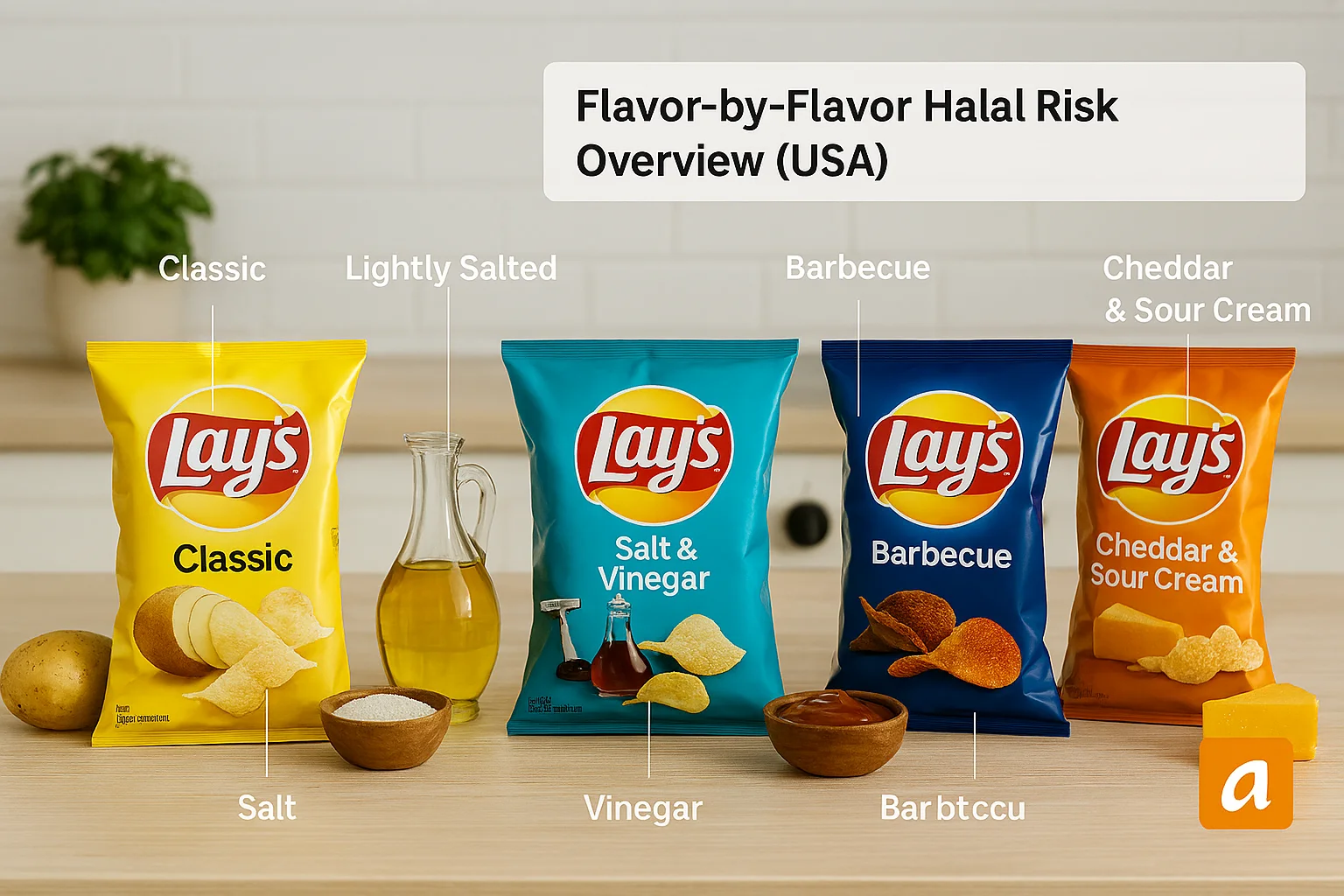
Which Lay’s Flavors Are Lowest Risk?
Based on ingredient analysis, these are generally considered lower-risk options:
Lower Risk
- Classic
- Lightly Salted
- Original potato chips
These contain minimal ingredients.
Medium Risk
- Salt & Vinegar
- Barbecue
- Flamin’ Hot
These include more complex flavor systems.
Higher Risk
- Cheddar & Sour Cream
- Sour Cream & Onion
- Cheese-heavy flavors
These contain dairy compounds and enzyme concerns.
A Question Many Muslims Secretly Ask
“Am I overthinking chips?”
Honestly, you’re not alone.
Modern processed food creates genuine confusion.
One scholar says permissible.
Another says doubtful.
One Muslim family eats Lay’s weekly.
Another avoids them completely.
This is why personal conviction matters too.
Islam allows room for caution.
But it also avoids unnecessary hardship.
The important thing is making informed decisions instead of blindly assuming everything is halal or haram.
The Bigger Reality About Halal Snacks in America
The American halal market has grown massively.
Muslim consumers today are more ingredient-aware than ever.
People now research:
- E-numbers
- Emulsifiers
- Cheese enzymes
- Food dyes
- Flavor carriers
- Manufacturing practices
And snack brands know this.
That’s why some companies actively pursue halal certification now.
But major mainstream brands like Lay’s still operate mostly outside official halal positioning in the USA.
Which keeps the debate ongoing.
The deeper you go into the question Are Lays halal in USA, the more you realize this issue is not only about chips.
It’s really about how Muslims navigate modern food systems.
Years ago, families bought simple foods from local markets. Today, one seasoning packet may contain ingredients sourced from five different countries, processed through multiple factories, and blended using industrial flavor technology most consumers never even hear about.
That’s why this discussion matters.
Not because Muslims are trying to make snacks complicated.
But because halal is important, and people genuinely want clarity.
And honestly, this is where Lay’s becomes one of the biggest examples of modern halal confusion in America.
Why “Halal by Ingredients” and “Halal by Certification” Are Different
A major reason Muslims disagree on Are Lays halal in USA is because people use two completely different standards when judging food.
Understanding this changes everything.
1. Ingredient-Based Halal Approach
Some Muslims examine the ingredient list only.
Their logic is simple:
- No pork listed
- No alcohol listed
- No gelatin listed
- Mostly plant ingredients
Therefore, they consider many Lay’s flavors acceptable unless proven otherwise.
This group usually believes:
“You cannot declare something haram without clear evidence.”
And to be fair, this principle has strong roots in Islamic law.
2. Certification-Based Halal Approach
Other Muslims believe ingredient lists alone are not enough.
Why?
Because labels don’t always reveal:
- Enzyme sources
- Flavor carriers
- Processing aids
- Supplier origins
- Shared equipment contamination
This group prefers foods with trusted halal certification because scholars and inspectors already investigated the supply chain.
For them, uncertainty itself is the issue.
And this is exactly why some Muslims comfortably eat Lay’s while others avoid it completely.
The “Natural Flavor” Debate Is Bigger Than Lay’s
Let’s be real…
If Muslims avoided every product containing “natural flavors,” grocery shopping would become extremely difficult in America.
That ingredient appears in:
- Chips
- Soft drinks
- Sauces
- Frozen meals
- Candy
- Protein bars
- Fast food seasonings
The problem is that “natural flavor” is legally broad.
Companies can include flavor compounds from many different sources while still using that single label.
This doesn’t automatically mean haram.
But it does create uncertainty.
Some halal researchers contact manufacturers directly to ask questions like:
- Is the flavor plant-based?
- Are alcohol carriers used?
- Are enzymes microbial?
- Is animal material involved?
Sometimes companies answer clearly.
Sometimes they don’t.
PepsiCo generally provides standard ingredient information but does not publicly guarantee halal compliance for U.S. Lay’s products.
And that distinction matters.
What PepsiCo Actually Confirms
Many people expect companies to directly say:
“Yes, this product is halal.”
But PepsiCo USA usually avoids making that claim for Lay’s.
Instead, the company focuses on:
- Ingredient transparency
- Allergen disclosures
- General dietary information
That means Muslim consumers are still responsible for deciding whether the product meets their halal standards.
And honestly, corporations often avoid halal claims unless they officially certify products through recognized organizations.
Why?
Because halal certification involves:
- Audits
- Ongoing inspections
- Supplier verification
- Documentation systems
- Facility monitoring
It’s a serious process.
Are Lay’s Factories Shared With Non-Halal Products?
This question comes up constantly.
And it’s understandable why.
PepsiCo owns many snack brands besides Lay’s, including:
- Doritos
- Cheetos
- Ruffles
- Fritos
- Tostitos
Some products contain:
- Cheese powders
- Animal-derived seasonings
- Meat flavorings
Large factories often use shared industrial equipment.
Now here’s where Islamic opinions differ again.
Some Scholars Say:
If industrial cleaning removes impurities effectively, the next product remains permissible.
Other Scholars Say:
Dedicated halal lines are safer and preferable.
Especially for certified products.
Since Lay’s USA facilities are not broadly halal-certified, Muslim consumers cannot independently verify the exact level of separation between products.
That uncertainty becomes important for stricter consumers.
Why Plain Lay’s Gets the Most Acceptance
Among all Lay’s products, Classic usually receives the least criticism.
Why?
Because the ingredient list is extremely short.
Typically:
- Potatoes
- Vegetable oil
- Salt
No cheese powders.
No meat flavoring.
No complex seasoning blends.
That simplicity matters a lot in halal analysis.
Many Muslims who avoid flavored chips still eat plain Lay’s because the ingredients appear straightforward.
In fact, some Islamic scholars specifically mention that minimally processed foods carry fewer halal concerns than heavily flavored processed snacks.
And honestly, this makes practical sense.
The fewer additives involved, the fewer questionable sourcing issues exist.
Which Lay’s Flavors Create the Biggest Halal Concerns?
Not all flavors are equal.
Some raise far more questions than others.
Cheese-Based Flavors
Examples:
- Cheddar & Sour Cream
- Sour Cream & Onion
Main concerns:
- Dairy enzymes
- Cheese cultures
- Whey processing
The biggest issue is enzyme sourcing.
Without halal verification, consumers cannot confirm whether animal-derived enzymes were used.
BBQ Flavors
This surprises many people.
Barbecue chips often contain:
- Smoke flavor compounds
- Flavor enhancers
- Yeast extracts
- Savory additives
Sometimes “BBQ flavor” does not mean actual meat.
But consumers still question the sourcing of flavor compounds.
Flamin’ Hot Varieties
These products often contain more complex seasoning systems.
Potential concerns include:
- Natural flavors
- Color additives
- Flavor enhancers
- Dairy traces
Again, uncertainty becomes the main issue.
The E631 Fear Online — Is It Always Haram?
If you search halal snack discussions online, you’ll constantly see warnings about E631.
But here’s the important thing many posts leave out:
E631 is NOT automatically haram.
Its halal status depends on its source.
It may come from:
- Tapioca starch
- Plant fermentation
- Fish
- Meat extraction
Plant-derived versions are generally considered halal.
The issue is transparency.
Most consumers cannot trace the origin themselves.
This is why many Muslims prefer certified products where these details are already verified by halal auditors.
Why Some Scholars Allow Doubtful Processed Foods in Non-Muslim Countries
Living in America creates unique halal challenges.
Not every city has:
- Halal-certified supermarkets
- Muslim-owned brands
- Fully verified snack products
Because of this reality, some scholars adopt more practical rulings for Muslims living as minorities.
They argue:
If no clearly haram ingredient is identified, excessive suspicion should be avoided.
This approach helps Muslims function realistically in modern societies.
However, scholars still encourage avoiding clearly doubtful ingredients when alternatives exist.
That balance is important.
The Difference Between “Haram” and “Mashbooh”
This distinction is often misunderstood online.
Haram
Clearly forbidden.
Examples:
- Pork
- Intoxicating alcohol
- Improperly slaughtered meat
Mashbooh
Doubtful or unclear.
This is where many Lay’s flavors fall for cautious Muslims.
The product may not contain obvious haram ingredients.
But sourcing uncertainty creates hesitation.
And Islam absolutely allows Muslims to avoid doubtful matters for peace of mind.
That’s a personal choice many people respect.
What Muslim Consumers in America Usually Do
In reality, most Muslims fall into one of three categories regarding Are Lays halal in USA.
Group 1: Eats Most Lay’s Freely
Their reasoning:
- No obvious haram ingredients
- Widely consumed
- Basic ingredients appear permissible
Group 2: Eats Only Plain Lay’s
Their reasoning:
- Minimal ingredient risk
- Avoids cheese and flavor complications
This is probably one of the most common approaches.
Group 3: Avoids All Non-Certified Lay’s
Their reasoning:
- Prefers certainty
- Wants halal audits
- Avoids doubtful ingredients completely
All three positions exist within the Muslim community today.
A Hidden Reality About American Food Labels
Many people assume labels tell the full story.
They don’t always.
Food manufacturers are not required to publicly explain every processing detail behind ingredients.
For example:
“Cheese flavor” may involve multiple supplier systems.
“Natural flavor” may contain dozens of microscopic compounds.
Even seemingly simple additives can involve complicated manufacturing chains.
That’s why halal certification became so important globally.
It simplifies complexity for consumers.
Without it, average shoppers must investigate products themselves — which is difficult.
Why Halal Certification Is Growing Fast in America
The Muslim consumer market in the United States is growing rapidly.
Families increasingly look for:
- Certified snacks
- Verified ingredients
- Transparent sourcing
- Cleaner labeling
This demand is pushing more companies toward halal certification.
But huge mainstream brands move slowly.
Lay’s has massive distribution already, so halal certification may not currently be a business priority in the U.S.
Still, consumer pressure can influence future changes.
Are There Better Halal-Certified Alternatives to Lay’s?
Yes.
Many Muslim consumers now prefer halal-certified snack brands for peace of mind.
These products often provide:
- Clear ingredient sourcing
- Halal logos
- Dedicated production systems
- Scholar-reviewed audits
For cautious consumers, that removes much of the uncertainty surrounding mainstream snack brands.
Still, availability depends heavily on location.
Some areas have many halal options.
Others have very few.
Important Reminder: Halal Decisions Can Differ
One thing Muslims should avoid is attacking each other over gray-area foods.
This issue genuinely contains scholarly differences.
Someone eating plain Lay’s does not automatically mean they ignore halal rules.
And someone avoiding Lay’s entirely is not “extreme.”
Different scholars, schools of thought, and personal comfort levels all influence these decisions.
Respect matters.
Especially in doubtful matters.
Quick Flavor-by-Flavor Risk Summary
| Flavor | Halal Risk Level | Main Concern |
|---|---|---|
| Classic | Low | Minimal ingredients |
| Lightly Salted | Low | Simple formulation |
| Salt & Vinegar | Low-Medium | Natural flavors |
| BBQ | Medium | Flavor compounds |
| Flamin’ Hot | Medium | Additives & seasonings |
| Sour Cream & Onion | Medium-High | Dairy enzymes |
| Cheddar & Sour Cream | High | Cheese cultures & enzymes |
This is not an official fatwa.
It’s simply ingredient-based analysis using common halal concerns.
FAQs About Are Lays halal in USA
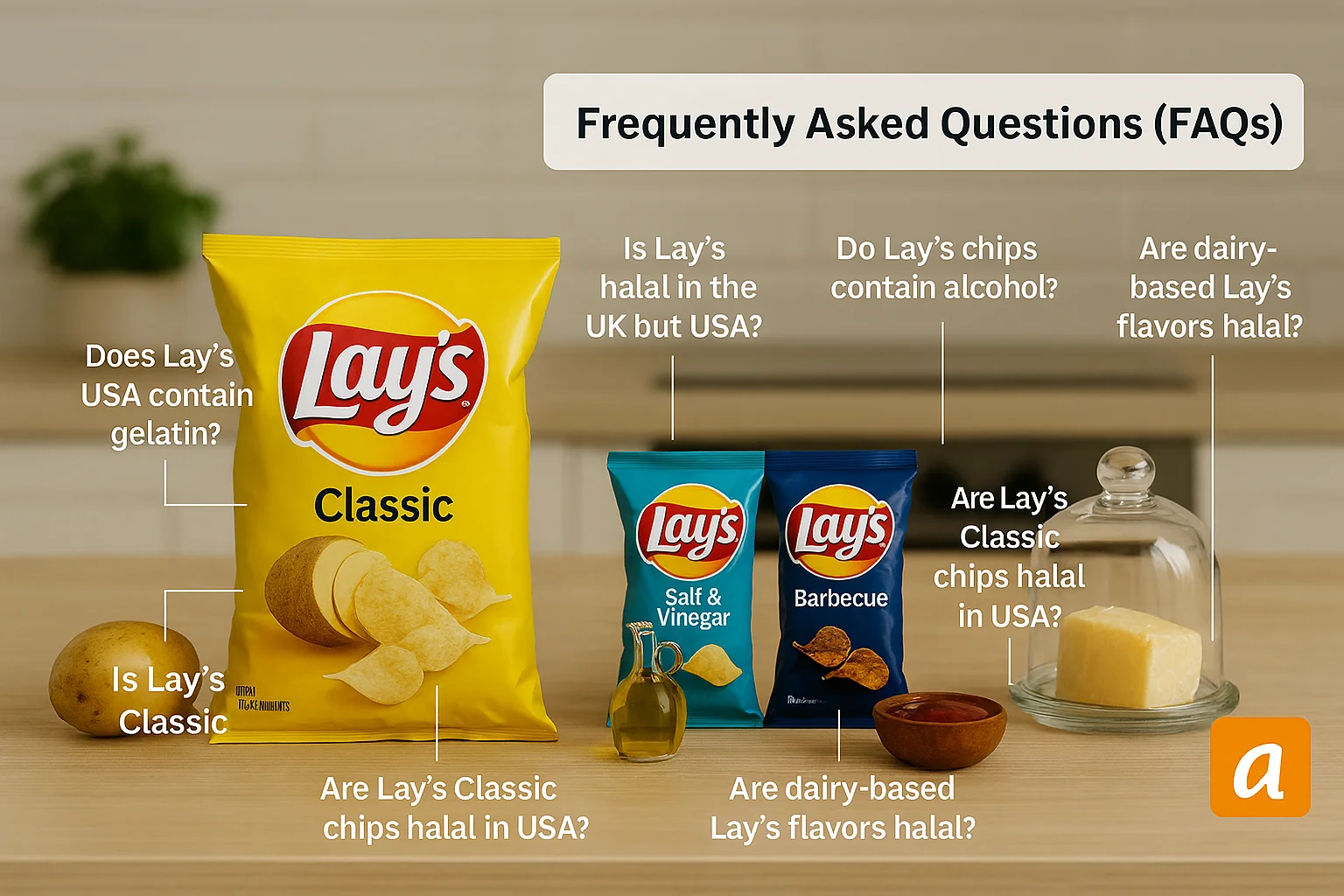
Does Lay’s USA have halal certification?
No. Most Lay’s products sold in the United States are not broadly halal-certified.
Are Lay’s Classic chips halal?
Many Muslims consider them likely halal because they contain only potatoes, oil, and salt. However, there is no official halal certification.
Do Lay’s chips contain pork?
Standard Lay’s potato chips do not list pork ingredients directly.
Are cheese-flavored Lay’s halal?
They are more questionable due to dairy enzymes and cheese cultures whose sources are not publicly clarified.
Is E631 in Lay’s always haram?
No. E631 can be plant-derived or animal-derived. The source determines its halal status.
Does Lay’s use alcohol?
Alcohol is not directly listed on labels, but some processed flavor systems in the food industry may use alcohol-based carriers. PepsiCo does not publicly provide detailed halal processing disclosure for U.S. Lay’s products.
Final Verdict — Are Lays halal in USA
After analyzing ingredients, manufacturing concerns, scholarly opinions, and certification status, here’s the balanced conclusion:
Plain Lay’s varieties like Classic are generally considered lower-risk and likely halal by many Muslims based on ingredient analysis.
However…
Flavored Lay’s chips remain doubtful for cautious consumers because of:
- Natural flavors
- Enzyme sourcing uncertainty
- Dairy processing concerns
- Lack of halal certification
- Shared manufacturing systems
So the answer to Are Lays halal in USA ultimately depends on your personal halal standard.
If you follow ingredient-based permissibility:
You may feel comfortable eating plain Lay’s or certain flavors.
If you require official halal certification:
Lay’s USA does not currently provide broad halal-certified assurance.
For Muslims seeking maximum certainty, certified halal snack brands remain the safest option.
Related Halal Food Guides You May Find Helpful
People searching for “ [Is Skittles Halal?]” are also curious about other foods and ingredients. Below, you’ll find related halal food articles that clearly explain ingredient sources, how products are made, and whether they meet halal requirements.
More Related Articles [ Halal Candies in USA ]
More Related Articles [ Are Sour Patch Kids Halal? ]