Introduction
For many Muslims living in Western countries, eating at fast-food chains can raise important dietary questions. One of the most common questions is “Is Taco Bell halal?” Taco Bell is one of the most popular Mexican-style fast-food chains in the United States, with thousands of locations worldwide. Its menu includes tacos, burritos, nachos, and various meat and cheese products.
However, Muslim consumers must consider several factors before deciding whether Taco Bell fits within Islamic dietary rules. These include ingredients, halal certification, food preparation methods, and cross-contamination risks.
In this guide, we carefully researched the product label information, official Taco Bell statements, and halal certification data to determine whether Taco Bell food can be considered halal. We also analyze why some Muslims eat it while others avoid it.
Quick Answer: Is Taco Bell Halal?
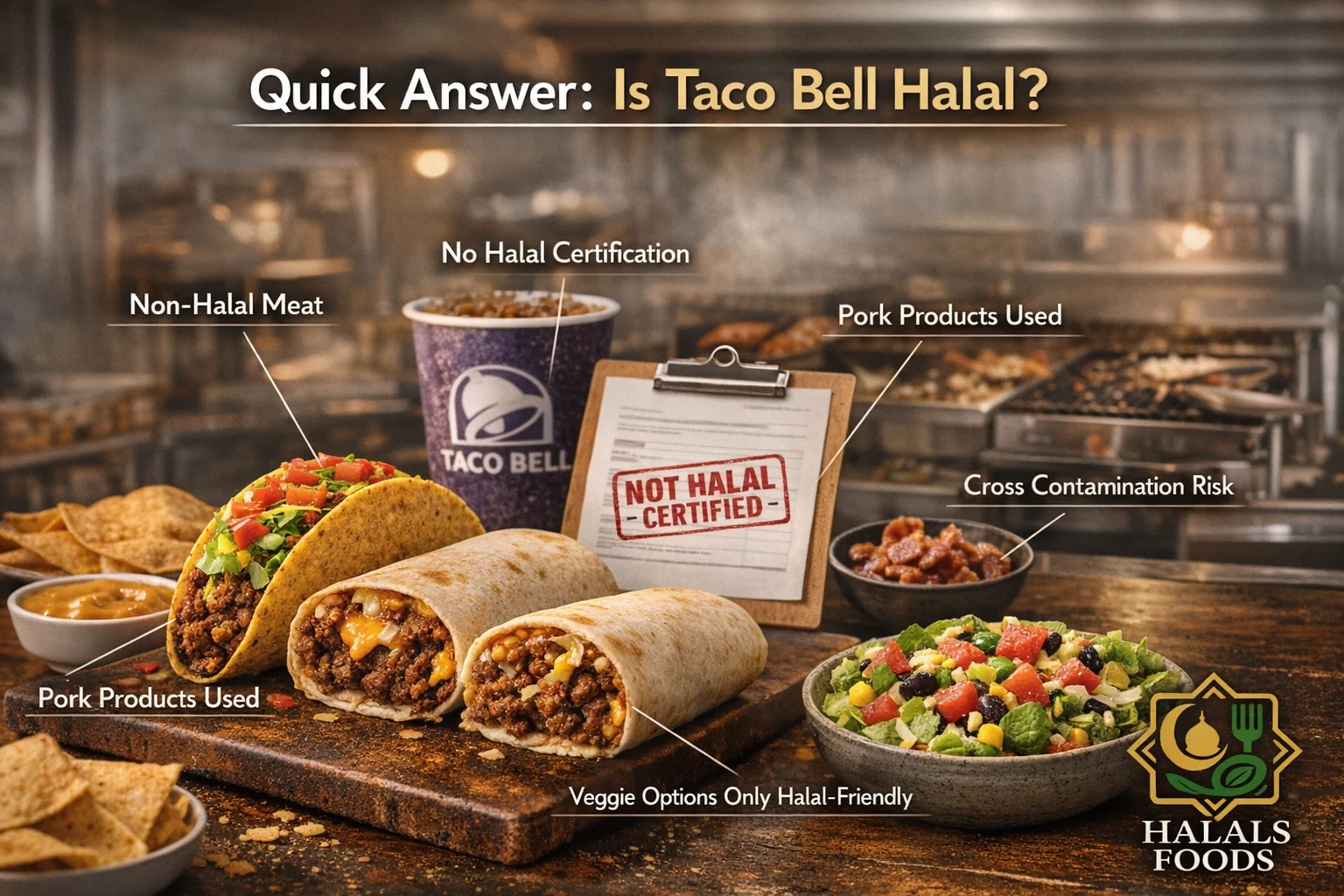
No, Taco Bell in the United States is generally not considered halal.
Our research shows that most Taco Bell locations do not use halal-certified meat and are not certified by recognized halal authorities. Additionally, the food is prepared in kitchens where pork products are handled, creating cross-contamination concerns. Some vegetarian menu items may be halal-friendly, but the overall restaurant is not officially halal.
Ingredient Breakdown
To understand “Is Taco Bell halal?”, we first examined the ingredients used in popular Taco Bell menu items such as tacos, burritos, and quesadillas.
While Taco Bell offers a wide variety of products, many menu items share common ingredients such as seasoned beef, chicken, cheese, sauces, tortillas, and flavoring agents.
Below is a breakdown of ingredient categories from a halal perspective.
Core Ingredients in Taco Bell Menu Items
Common ingredients found in Taco Bell foods include:
| Ingredient | Halal Status | Notes |
|---|---|---|
| Beef | Doubtful | Not halal-certified in most regions |
| Chicken | Doubtful | Slaughter method unclear |
| Cheese | Usually halal | But enzymes may vary |
| Flour tortillas | Halal | Usually wheat-based |
| Beans | Halal | Plant-based |
| Spices | Halal | Generally safe |
| Flavor enhancers | Sometimes doubtful | May contain alcohol carriers |
The biggest concern comes from the source of meat and processing methods.
Seasoned Beef Ingredients
Taco Bell’s seasoned beef is not simply plain ground beef. According to Taco Bell’s ingredient lists, the beef contains a mixture of spices and additives.
Typical ingredients include:
-
Beef
-
Water
-
Seasoning blend
-
Salt
-
Chili pepper
-
Tomato powder
-
Soy lecithin
-
Oats
-
Modified corn starch
From an Islamic perspective, most of these ingredients are halal individually. However, the primary issue is the beef itself.
For meat to be halal, it must meet several conditions:
-
The animal must be slaughtered according to Islamic zabiha rules
-
The slaughter must be performed by a Muslim, Christian, or Jew
-
The name of Allah must be invoked during slaughter
-
Blood must be fully drained
Since Taco Bell does not confirm halal slaughter practices in the U.S., the meat is considered non-halal by most scholars.
Cheese and Dairy Ingredients
Many Taco Bell menu items contain cheese, including:
-
Cheddar cheese
-
Monterey Jack cheese
-
Nacho cheese sauce
Most cheese itself is halal, but there is one potential issue: enzymes used during cheese production.
Cheese production often involves rennet or enzymes, which may come from animal or microbial sources.
Possible enzyme sources include:
-
Animal rennet from calves
-
Microbial enzymes
-
Plant-based enzymes
If the enzymes come from non-halal slaughtered animals, the cheese could become questionable.
However, in the United States, most fast-food cheese uses microbial enzymes, which are generally considered halal.
Flavorings and Additives
Another point of analysis when asking “Is Taco Bell halal?” involves flavor additives.
Fast-food restaurants often use:
-
natural flavors
-
artificial flavors
-
flavor carriers
Some natural flavors can include alcohol-based solvents during extraction. These alcohol traces are usually minimal and evaporate during processing.
Many Islamic scholars consider trace processing alcohol permissible, while others prefer to avoid it.
This difference of opinion contributes to why some Muslims still consume certain Taco Bell items.
E-Numbers and Food Additives
Although Taco Bell menus in the U.S. usually list ingredients instead of E-numbers, additives may still correspond to common food codes used internationally.
Examples include:
| Additive | Purpose | Halal Status |
|---|---|---|
| E322 (Lecithin) | Emulsifier | Usually halal |
| E415 (Xanthan gum) | Thickener | Halal |
| E330 (Citric acid) | Preservative | Halal |
Most food additives used in fast food are plant-based or synthetic, making them generally halal.
The major concern remains the meat source rather than the additives.
Manufacturing Process & Cross-Contamination
Another important factor when evaluating “Is Taco Bell halal?” is how the food is prepared in the restaurant.
Even if some ingredients are halal individually, the preparation environment can affect the final ruling.
Shared Kitchen Equipment
Most Taco Bell restaurants prepare food using shared equipment such as:
-
grills
-
frying stations
-
food preparation counters
-
utensils
These surfaces are used for multiple menu items, including pork products.
Common pork items in Taco Bell kitchens include:
-
bacon
-
pork fillings
-
pork-based ingredients in certain regional menus
Because of this, there is a high possibility of cross-contact.
For Muslims who strictly follow halal guidelines, cross-contamination with pork is a serious concern.
Cross-Contamination Risks
Cross-contamination can happen through several ways:
-
Shared cooking equipment
-
Shared utensils
-
Shared food storage areas
-
Oil used for multiple products
For example, if bacon is cooked on the same grill used for tortillas or meat fillings, traces may transfer.
While restaurants clean surfaces regularly, they do not maintain halal separation standards.
Why This Matters in Islamic Law
Islamic dietary law emphasizes purity (taharah) in food preparation.
Many scholars state that:
-
Food cooked on equipment used for pork may become questionable
-
Cross-contamination with haram ingredients should be avoided
Because Taco Bell does not follow halal kitchen standards, most scholars advise caution.
Halal Certification Analysis
Halal certification is one of the strongest indicators of whether a restaurant can be trusted by Muslim consumers.
Certification ensures that:
-
ingredients are halal
-
slaughter methods follow Islamic law
-
production facilities meet halal standards
So when asking “Is Taco Bell halal?”, we must look at whether the brand holds certification.
Taco Bell in the United States
In the United States, Taco Bell does not hold halal certification for its restaurants or meat supply chain.
Major halal certifying bodies such as:
-
IFANCA (Islamic Food and Nutrition Council of America)
-
HFSAA (Halal Food Standards Alliance of America)
-
ISA (Islamic Services of America)
do not list Taco Bell as a certified halal restaurant chain.
Without certification, Muslim consumers cannot verify whether the meat follows halal slaughter practices.
Taco Bell in Other Countries
The halal status of Taco Bell can vary by country.
Some international markets adapt their menu to local dietary requirements.
Examples include:
United Kingdom
Most Taco Bell locations in the UK are not halal certified, though some ingredients may be halal-friendly.
Middle Eastern Countries
In Muslim-majority countries, Taco Bell restaurants are much more likely to use halal meat because of government regulations.
Malaysia and Indonesia
Some locations have received local halal certifications from national authorities.
This means the answer to “Is Taco Bell halal?” can vary depending on the region.
Why Certification Matters
Halal certification bodies conduct detailed audits of:
-
slaughterhouses
-
ingredient suppliers
-
food processing
-
kitchen practices
Without these audits, halal claims cannot be verified.
For many Muslim consumers, lack of certification is enough reason to avoid the restaurant.
Official Statements From Taco Bell
When researching the question “Is Taco Bell halal?”, we reviewed information from Taco Bell’s official website, ingredient database, and public brand statements.
Taco Bell is known for being relatively transparent about its ingredients. The company provides a detailed ingredient guide and allergen information for consumers. However, when it comes to halal status, the company does not make a universal claim.
What Taco Bell Says About Its Meat
According to Taco Bell’s official ingredient resources, their beef and chicken are sourced from U.S. suppliers that meet federal food safety standards.
However, the company does not claim that its meat is halal-certified.
The brand mainly focuses on:
-
food safety
-
ingredient transparency
-
allergen information
But there is no official halal statement confirming Islamic slaughter practices.
This means that the answer to “Is Taco Bell halal?” cannot be confirmed based on brand claims alone.
Taco Bell Halal Policy by Region
Because Taco Bell operates in many countries, the halal status may change depending on local regulations and consumer demand.
United States
In the United States:
-
Taco Bell restaurants are not halal certified
-
Meat is sourced from standard commercial suppliers
-
Pork products are present in the kitchen
Therefore, most Islamic scholars consider Taco Bell in the U.S. not halal.
United Kingdom
In the UK, Taco Bell has also stated that most of its restaurants are not halal-certified.
Some ingredients may technically be halal-friendly, but the company does not maintain a halal-certified supply chain.
Muslim-Majority Countries
In countries such as:
-
Malaysia
-
Indonesia
-
Saudi Arabia
-
United Arab Emirates
fast-food chains often comply with local halal regulations.
Some Taco Bell locations in these regions may offer halal-certified meat, but this varies by franchise and local authority.
This is why Muslim consumers must always check the specific location rather than assuming the entire chain is halal.
Why Some Muslims Consider Taco Bell Halal
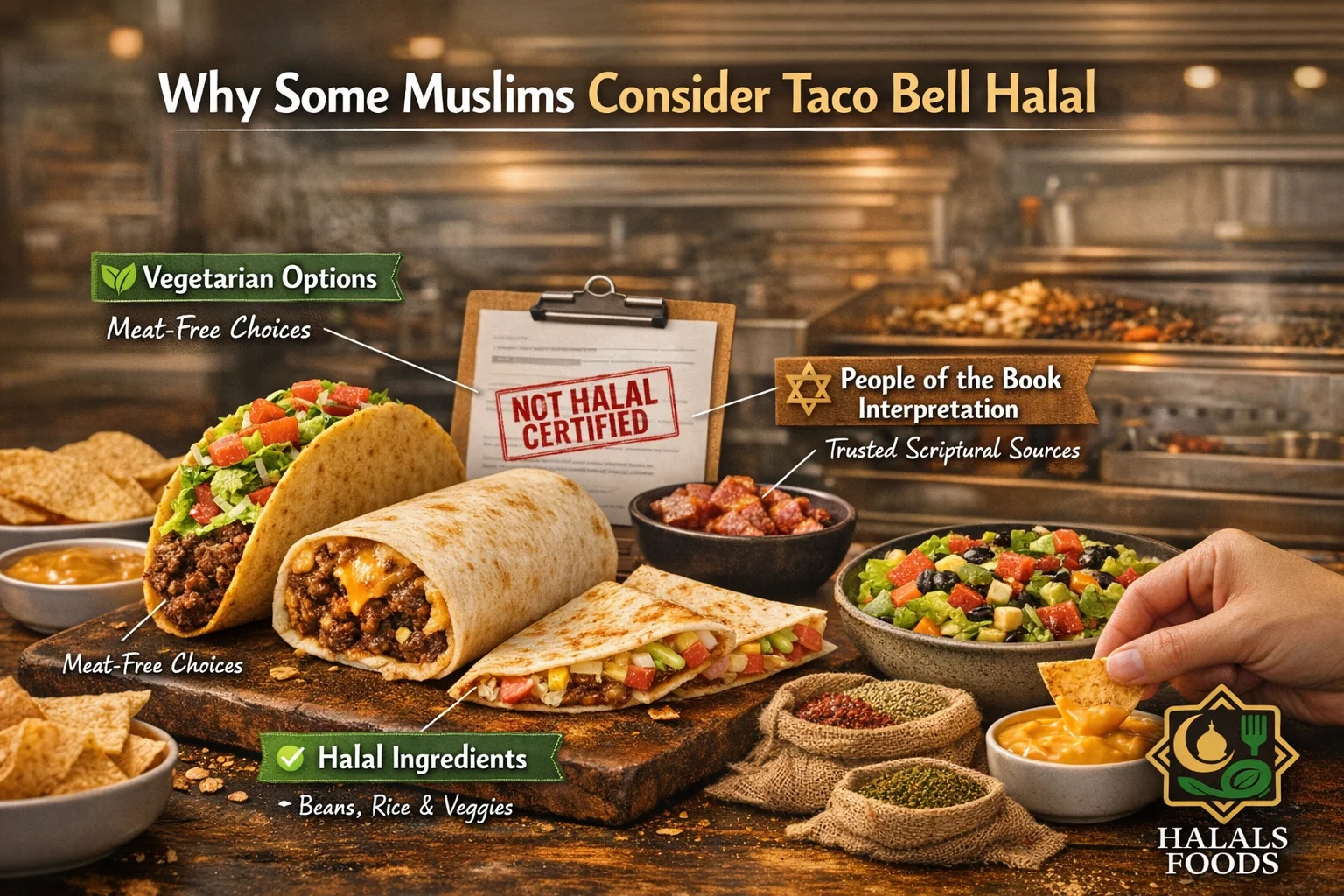
Despite the lack of certification, some Muslims still choose to eat certain Taco Bell items.
Their reasoning usually falls into a few categories.
1. Vegetarian Menu Items
Taco Bell offers a variety of vegetarian foods, such as:
-
Bean burritos
-
Cheese quesadillas
-
Nachos with beans
-
Rice bowls
Since these items contain no meat, some Muslims consider them permissible.
However, cross-contamination concerns still remain.
2. “People of the Book” Interpretation
Some Islamic scholars interpret Quranic verses to mean that meat from People of the Book (Christians and Jews) may be permissible.
Based on this interpretation, some Muslims assume that meat from Western countries may be acceptable if it is not pork.
However, this view is debated among scholars, especially when modern industrial slaughter methods are involved.
3. Ingredient-Based Reasoning
Another reason some Muslims consider Taco Bell halal is that most individual ingredients are halal by default.
For example:
-
wheat tortillas
-
beans
-
rice
-
vegetables
-
spices
Because of this, some people eat vegetarian or seafood options only.
Why Some Muslims Avoid Taco Bell
While some Muslims may occasionally eat at Taco Bell, many others avoid it completely.
Their concerns are based on both Islamic rulings and food safety practices.
1. Lack of Halal Certification
The most common concern is the absence of halal certification.
Without certification from organizations such as:
-
IFANCA
-
HFSAA
-
ISA
-
Halal Monitoring Committee (UK)
there is no guarantee that the meat follows Islamic slaughter requirements.
For practicing Muslims, this uncertainty is enough reason to avoid the food.
2. Unknown Slaughter Method
Islamic dietary rules require animals to be slaughtered in a specific way.
These requirements include:
-
invoking the name of Allah
-
cutting the throat swiftly
-
draining the blood
Commercial meat used by many fast-food chains may involve mechanical slaughter or stunning practices that scholars debate.
Because Taco Bell does not clarify these practices, many Muslims consider the meat doubtful.
3. Cross-Contamination With Pork
Another major concern when asking “Is Taco Bell halal?” is the presence of pork products in the kitchen.
Examples include:
-
bacon toppings
-
pork ingredients in certain menu items
Since the same grills, counters, and utensils are used, cross-contact may occur.
For Muslims who strictly follow halal guidelines, this makes the restaurant unsuitable.
USA Halal Market Context
Understanding the halal status of fast-food chains like Taco Bell also requires looking at the broader halal food industry in the United States.
The U.S. halal market has grown rapidly over the past two decades.
Growing Muslim Consumer Market
The United States has an estimated 3–4 million Muslim consumers, and demand for halal food continues to grow.
Because of this demand:
-
many grocery stores now sell halal-certified meat
-
halal restaurant chains are expanding
-
certification bodies have become more active
However, major fast-food chains have been slow to adopt halal certification nationwide.
Halal Labeling in the U.S.
Unlike some Muslim-majority countries, halal labeling in the U.S. is not federally standardized.
This means companies may:
-
voluntarily seek halal certification
-
choose not to certify products
Muslim consumers must rely on third-party halal organizations to verify compliance.
What Muslim Consumers Should Check
When evaluating whether a product or restaurant is halal, experts recommend checking:
-
halal certification logos
-
ingredient labels
-
company statements
-
supplier information
Without these indicators, food may fall into the doubtful (mashbooh) category.
This explains why the question “Is Taco Bell halal?” continues to appear frequently among Muslim consumers.
Final Verdict: Is Taco Bell Halal?
After reviewing Taco Bell’s ingredients, preparation methods, and certification status, the conclusion is clear.
Taco Bell in the United States is generally not considered halal.
The main reasons include:
-
lack of halal certification
-
unknown slaughter method for meat
-
presence of pork products in kitchens
-
cross-contamination risks
Some vegetarian menu items may contain halal ingredients individually, but the overall restaurant environment does not meet halal standards.
For Muslims who strictly follow Islamic dietary guidelines, it is usually safer to choose restaurants with verified halal certification.
Frequently Asked Questions (FAQs)
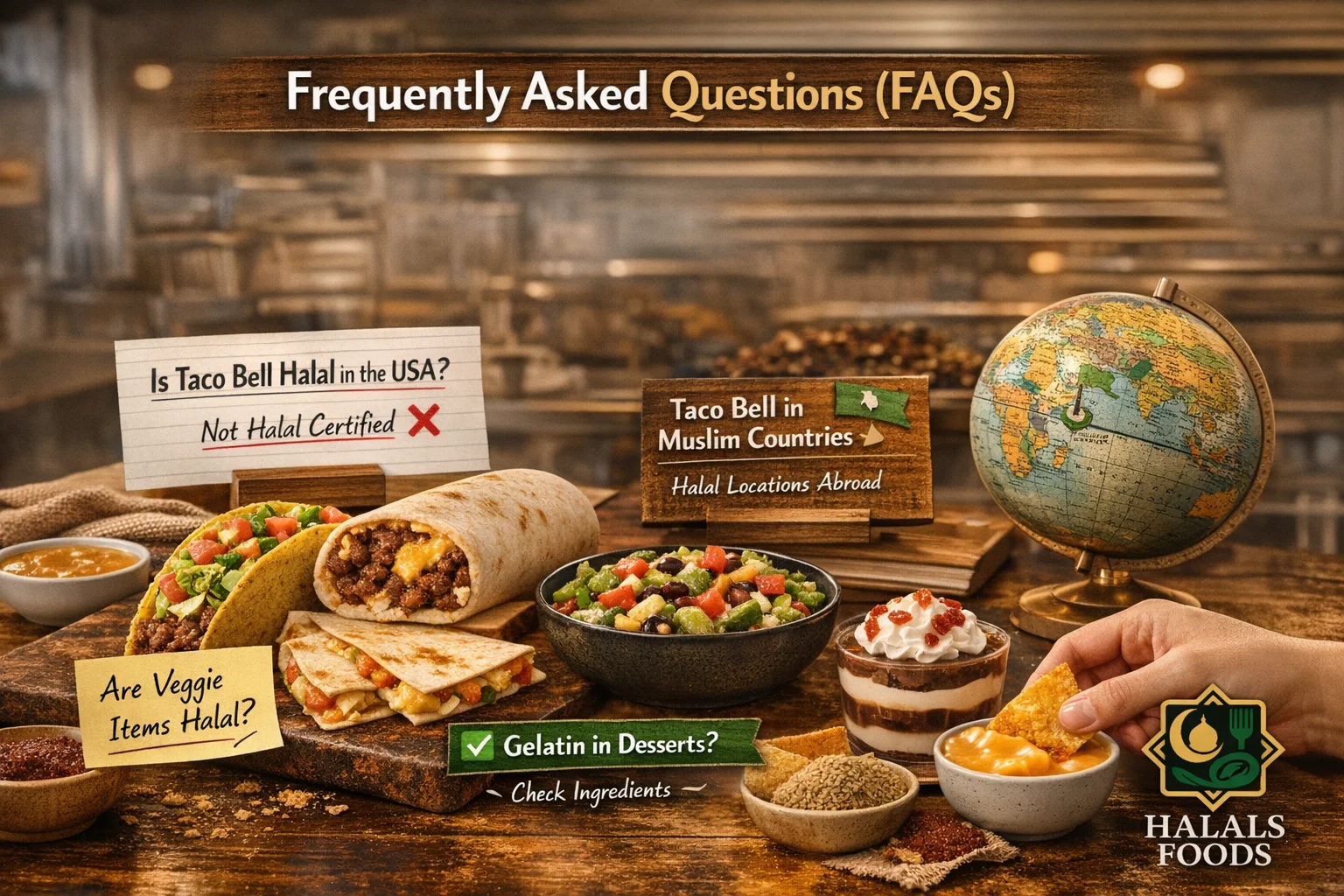
1. Does Taco Bell use halal meat?
In most countries, including the United States, Taco Bell does not use halal-certified meat. The meat comes from standard commercial suppliers that follow national food safety regulations rather than Islamic slaughter guidelines.
2. Is Taco Bell halal in the USA?
No, Taco Bell is generally not halal in the United States. The restaurants do not have halal certification, and the kitchens prepare pork products alongside other foods.
3. Are Taco Bell vegetarian items halal?
Some vegetarian items may contain halal-friendly ingredients, such as beans, rice, and tortillas. However, cross-contamination with meat or pork products may occur in the kitchen.
4. Is Taco Bell halal in Muslim countries?
In some Muslim-majority countries, Taco Bell restaurants may offer halal-certified meat due to local regulations. However, this depends on the specific country and franchise.
5. Does Taco Bell food contain gelatin?
Most Taco Bell menu items do not contain gelatin, but certain desserts or specialty products in some regions could include gelatin-based ingredients.
Always check the ingredient list for confirmation.
6. Does Taco Bell use alcohol in flavoring?
Some natural flavors used in food production may involve trace alcohol during extraction, but these amounts are extremely small and usually evaporate during processing.
Scholars differ on whether such traces are acceptable.
7. Is Taco Bell halal for Hanafi scholars?
Many Hanafi scholars advise avoiding Taco Bell because:
-
the meat is not halal-certified
-
slaughter methods are unknown
-
cross-contamination with pork may occur
8. Can Muslims eat Taco Bell cheese or sauces?
Cheese and sauces may contain halal ingredients individually. However, without certification, it is difficult to verify the source of enzymes or flavoring agents used.
9. Are Taco Bell beans halal?
Yes, Taco Bell beans are generally plant-based and halal-friendly, as they are made from beans, spices, and vegetable ingredients.
Still, preparation methods should be considered.
References
-
Taco Bell Official Ingredient Guide
-
IFANCA (Islamic Food and Nutrition Council of America)
-
HFSAA Halal Certification Standards
-
USDA Food Ingredient Labeling Resources
-
Halal Monitoring Committee UK
Related Halal Food Guides You May Find Helpful
People searching for “Is [Is Burger King Halal ]” are also curious about other foods and ingredients. Below, you’ll find related halal food articles that clearly explain ingredient sources, how products are made, and whether they meet halal requirements.
More Related Articles [ Is McDonald’s Halal in USA? ]
[ Is Subway Halal or Haram? ]
[ Halal Fast-Food Options in USA ]
[ Are McDonald’s Fries Halal? ]
[ Is KFC Halal? ]