Walk into almost any supermarket in America, Canada, or the UK and you’ll see Doritos everywhere. Bright packaging. Bold flavors. Huge shelves full of Nacho Cheese, Cool Ranch, Flamin’ Hot, and Spicy Sweet Chili.
For many people, they’re just chips.
But for Muslim consumers, the question gets deeper very fast:
Are Doritos halal?
And honestly, this is where things become confusing.
Because the answer is not simply “yes” or “no.”
Some Muslims eat Doritos without hesitation. Others avoid them completely. Some only buy certain flavors. And then there are people who check every ingredient but still feel unsure after reading the label.
The real issue is that modern processed foods are complicated. A bag of chips today contains much more than corn and salt. There are cheese cultures, enzymes, flavor enhancers, artificial colors, dairy powders, processing agents, and “natural flavors” that companies rarely explain clearly.
That’s why so many Muslims keep searching:
- Are Doritos halal in the USA?
- Do Doritos contain pork enzymes?
- Which Doritos flavors are safe?
- Are cheese chips haram?
- Why are some Doritos halal in one country but not another?
This guide breaks everything down in simple language without confusing technical jargon.
Because here’s the part many articles skip:
The halal status of Doritos is not only about ingredients. It’s also about manufacturing, certification, hidden processing methods, and how different scholars interpret doubtful ingredients.
And once you understand that, the entire debate suddenly makes more sense.
Why Processed Snacks Create So Much Halal Confusion
Years ago, snacks were simple.
Potatoes. Oil. Salt.
Done.
But modern chips are engineered foods. Big companies spend millions creating flavors that feel addictive and intense. That famous Doritos taste comes from layered seasoning systems made with dairy powders, acids, sweeteners, flavor boosters, and processing compounds.
This is where Muslims become cautious.
Not because chips themselves are haram.
But because some ingredients inside flavored snacks can come from sources that are not clearly halal.
That’s the key issue behind Are Doritos halal.
And most consumers never look past the front of the package.
The First Thing Muslims Usually Check
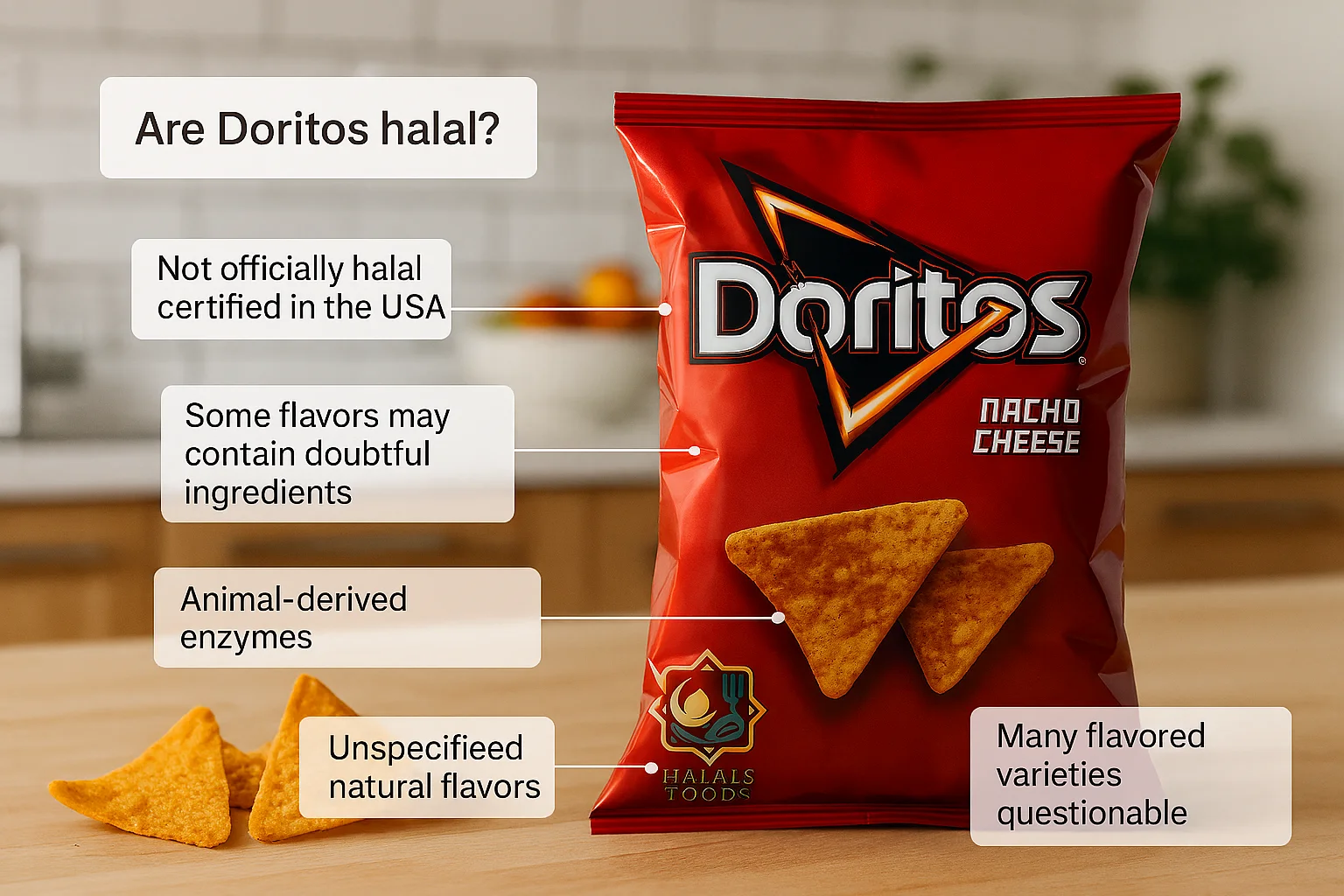
When people pick up a bag of Doritos, they often look for obvious haram ingredients like:
- Pork
- Gelatin
- Lard
- Alcohol
Interestingly, most Doritos flavors do NOT openly list pork or gelatin.
That’s why many people immediately assume the chips are halal.
But processed foods are rarely that simple.
The real concerns are usually hidden under broad ingredient names such as:
- Enzymes
- Natural flavors
- Cheese cultures
- Whey ingredients
- Flavoring systems
These terms can come from halal or non-halal sources depending on how they were made.
And companies are not always required to explain the source publicly.
That uncertainty is what creates the debate.
Breaking Down the Main Ingredients Inside Doritos
To properly understand Are Doritos halal, we need to separate the ingredients into two groups:
Ingredients That Are Usually Halal
Most Doritos contain:
- Corn
- Vegetable oil
- Salt
- Sugar
- Onion powder
- Garlic powder
- Spices
- Corn starch
- Maltodextrin
These ingredients are generally considered halal.
Corn itself is halal.
Vegetable oils used by Frito-Lay are usually corn oil, sunflower oil, or canola oil. There is no strong evidence showing Doritos are fried in animal fat in the United States.
That part is actually reassuring for Muslim consumers.
So the problem is not the chips themselves.
The concern starts with flavoring ingredients.
The Cheese Ingredient Problem Most People Ignore
Now we reach the biggest issue.
Cheese powders.
Many Doritos flavors contain ingredients like:
- Cheddar cheese
- Romano cheese
- Whey protein
- Buttermilk
- Cultures
- Enzymes
At first glance, cheese sounds harmless.
But the halal concern is not the milk.
It’s the enzymes used during cheese production.
What Are Cheese Enzymes?
Cheese production usually requires enzymes to help milk coagulate and form solid cheese.
These enzymes can come from several sources:
1. Microbial Enzymes
Produced through fermentation.
Generally halal.
2. Plant-Based Enzymes
Taken from plants.
Also halal.
3. Animal-Derived Enzymes
Taken from animal stomach linings.
This becomes problematic if the animal was not slaughtered according to Islamic rules.
And this is exactly why Muslims ask:
Are Doritos halal if the cheese enzymes are unclear?
Because many American food labels simply say “enzymes” without specifying where they came from.
That single missing detail changes everything for cautious consumers.
Why U.S. Food Labels Create Confusion
Here’s something many people don’t realize.
In the United States, companies are often NOT legally required to specify whether enzymes are microbial or animal-based.
So two products can both say “enzymes” while having completely different halal rulings.
One could use microbial fermentation.
Another could use animal rennet.
The label may look identical.
That’s why ingredient reading alone sometimes fails.
And this is where halal certification becomes extremely important.
The “Natural Flavors” Debate
Another major concern in Are Doritos halal discussions is natural flavoring.
This ingredient appears in many Doritos flavors.
The problem?
“Natural flavors” is one of the broadest ingredient terms allowed under FDA regulations.
It can include:
- Plant extracts
- Dairy compounds
- Meat derivatives
- Fermented ingredients
- Alcohol-based carriers
Now, not all natural flavors are haram.
In fact, many are completely halal.
But because the source is often hidden, some Muslims prefer to avoid products that rely heavily on unspecified flavor systems.
And honestly, this is why different Muslims reach different conclusions about Doritos.
Some say:
“If there’s no proof it’s haram, it’s halal.”
Others say:
“If the source is unclear, better to avoid it.”
Both approaches exist within Islamic discussions about doubtful foods.
Why Some Flavors Raise More Concerns Than Others
Not every Doritos flavor carries the same level of risk.
This is important.
Many Muslims specifically avoid cheese-based flavors because enzymes become part of the discussion.
Flavors that usually create the MOST concern include:
- Nacho Cheese
- Cool Ranch
- Loaded Cheese varieties
Because these rely heavily on dairy seasoning systems.
Meanwhile, flavors like Spicy Sweet Chili are often viewed differently because they do not prominently contain cheese ingredients.
That’s why some Muslims say:
“I only eat the non-cheese Doritos.”
But even then, certification is still missing in most Western markets.
So the debate continues.
Why Country Matters More Than People Think
One of the biggest surprises for consumers is this:
Doritos are not identical worldwide.
The formula can change depending on the country.
This means the answer to Are Doritos halal may change depending on where you buy them.
For example:
United States
Most flavors are NOT halal certified.
United Kingdom
Some ingredient formulas differ slightly, but halal certification is still generally absent.
Canada
Very similar to U.S. production systems.
Saudi Arabia / UAE / Muslim Markets
Some Doritos products may carry recognized halal certification.
This confuses many Muslims online because someone in Dubai may say:
“Doritos are halal.”
While someone in America says:
“No they’re not.”
Both may technically be talking about different manufacturing systems.
The Hidden Manufacturing Concern
Here’s something many ingredient-checking articles forget completely.
Even if ingredients look halal, production methods still matter.
Large snack companies like Frito-Lay produce huge numbers of products inside shared factories.
These factories may handle:
- Cheese snacks
- Meat-flavored chips
- BBQ seasoning blends
- Dairy powders
- Other processed foods
Without halal-supervised production lines, some Muslims worry about cross-contamination.
Now, companies do clean equipment for safety and allergen reasons.
But halal standards are stricter than normal cleaning standards in some scholarly opinions.
And because Frito-Lay does not publicly market halal-segregated facilities in the USA, cautious consumers remain uncertain.
This is another major reason why Are Doritos halal keeps becoming such a debated topic online.
Why Many Muslims Still Eat Doritos Anyway
Despite all these concerns, millions of Muslims still consume Doritos.
Why?
Because many scholars and consumers follow the principle:
“Food is considered permissible unless proven otherwise.”
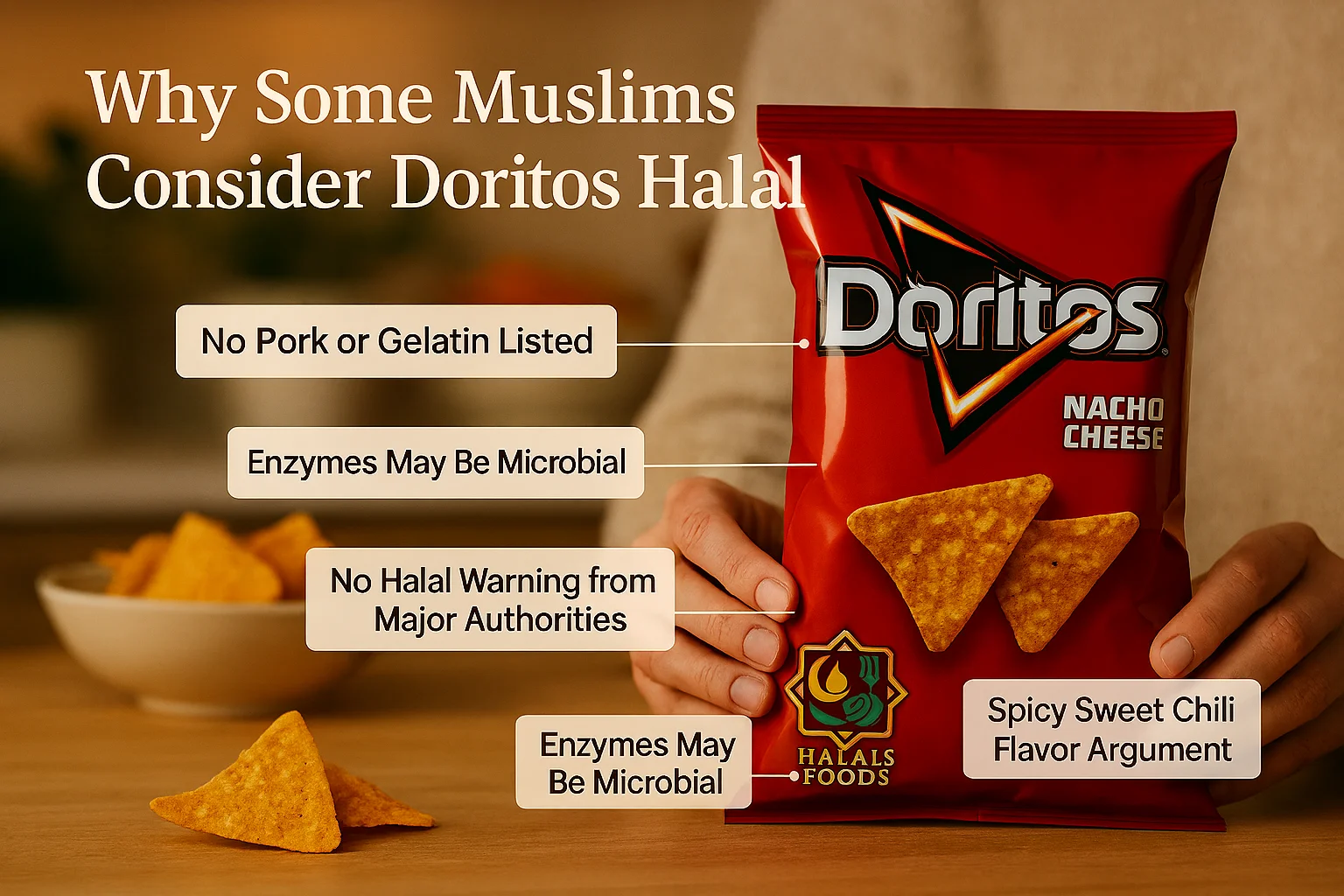
Their reasoning usually includes:
- No pork listed directly
- No gelatin listed
- Vegetable oils are used
- Enzymes may be microbial
- No official fatwa declaring Doritos haram
For these consumers, the uncertainty is not strong enough to prohibit the product completely.
Especially in countries where halal-certified snacks are limited.
The Difference Between “Not Halal Certified” and “Haram”
This distinction is extremely important.
Many people confuse these two ideas.
A product that is NOT halal certified does not automatically become haram.
It simply means:
No recognized halal organization officially audited or approved it.
That’s all.
Some uncertified foods are still halal.
Some certified foods are questionable.
Certification simply adds confidence and verification.
So when people ask Are Doritos halal, they are often really asking:
“Is there enough certainty for me personally to feel comfortable eating it?”
And that answer can vary depending on someone’s level of caution.
The Flavor That Muslims Debate the Most
If you spend time in Muslim food forums, one flavor appears constantly:
Spicy Sweet Chili Doritos
Why?
Because many consumers noticed it lacks obvious cheese ingredients.
That immediately lowers one of the biggest halal concerns.
As a result, some Muslims specifically choose this flavor while avoiding Nacho Cheese or Cool Ranch.
But here’s the thing many people forget:
Even plant-based flavors can still contain complex flavor systems under “natural flavors.”
So while Spicy Sweet Chili may appear safer, it still lacks official halal certification in the USA.
For some consumers, that’s acceptable.
For others, it still remains doubtful.
Why Scholars Sometimes Disagree About Processed Foods
This surprises many Muslims.
People assume there is always one universal halal answer.
But processed food issues often involve scholarly interpretation.
Some scholars focus heavily on certainty.
Others focus on probability.
Others examine chemical transformation during food processing.
That’s why you may hear different opinions about products like Doritos.
And honestly, this is one reason the topic becomes emotionally frustrating for many Muslim consumers.
They just want a simple answer.
But modern food manufacturing rarely gives simple answers anymore.
The Real Question Behind Are Doritos halal
At its core, this discussion is actually about something bigger.
Trust.
Consumers want to trust:
- ingredient labels
- companies
- certifications
- manufacturing systems
But when information becomes vague, Muslims naturally become more cautious.
Especially when eating something every week.
Because nobody wants to accidentally consume something doubtful for years without realizing it.
And this is exactly why the debate around Doritos continues growing across Muslim communities worldwide.
The interesting thing about the Are Doritos halal debate is that most Muslims are not actually arguing about corn chips.
They’re arguing about uncertainty.
And in today’s food industry, uncertainty is everywhere.
One ingredient supplier changes, and suddenly the same product may have a completely different halal ruling. A flavoring company updates its formula, and consumers may never even notice. That’s why many Muslims no longer rely only on ingredient lists. They look for halal certification, company transparency, and even regional manufacturing differences.
Because honestly, modern processed food is built on hidden layers most people never see.
And Doritos became one of the biggest examples of that problem.
Why Cheese Snacks Create More Halal Questions Than Plain Chips
Plain salted chips usually create very little controversy.
But once companies add cheese flavoring, everything changes.
That’s because industrial cheese production can involve several hidden processing stages that ordinary consumers never think about.
For example:
- Enzymes
- Cultures
- Fermentation agents
- Anti-caking powders
- Dairy flavor boosters
Even a tiny amount of one doubtful ingredient can change the halal discussion completely.
This is why cheese-flavored snacks almost always receive more scrutiny from Muslim consumers than plain tortilla chips.
And Doritos is heavily dependent on cheese seasoning systems.
That’s why the question Are Doritos halal keeps appearing again and again online.
The Internet Made Muslims More Careful About Ingredients
Ten or fifteen years ago, most people never researched snack ingredients deeply.
Today it’s different.
Muslims now:
- scan ingredient labels
- search halal databases
- watch food investigation videos
- contact manufacturers directly
- compare international product formulas
This increased awareness changed consumer behavior completely.
A single TikTok video discussing animal enzymes can suddenly make thousands of Muslims question products they’ve eaten for years.
And Doritos often appears in these conversations because it’s globally popular.
What Happens When Companies Don’t Give Clear Answers
One major frustration among Muslim consumers is vague corporate responses.
People contact brands asking:
“Are your enzymes animal-derived?”
And the reply sometimes sounds like:
“Our ingredients may vary by supplier.”
Or:
“We cannot guarantee products meet halal standards unless specifically certified.”
Technically, those responses are honest.
But they also leave consumers with uncertainty.
And uncertainty matters in halal eating.
Especially for Muslims trying seriously to avoid doubtful ingredients.
This is why many consumers eventually stop asking:
“Is it probably halal?”
And start asking:
“Why isn’t it clearly halal certified if the ingredients are fine?”
That question becomes difficult for companies to answer.
The Growing Demand for Halal Snacks in America
Here’s something interesting many people overlook.
The halal food market in the United States is exploding.
Millions of Muslims now actively search for:
- halal candy
- halal fast food
- halal chips
- halal instant noodles
- halal snacks for children
And companies know this.
In fact, many brands now proudly place halal logos on packaging because it increases trust and attracts loyal consumers.
So when people notice Doritos lacks halal certification in America, they naturally become more cautious.
Because if a product truly meets halal standards comfortably, certification would usually be a smart business advantage.
That absence raises questions for many consumers.
Why Some Muslims Avoid “Doubtful” Foods Completely
There’s a famous Islamic principle many Muslims follow:
Avoid doubtful matters when clear halal alternatives exist.
This approach is based on caution and spiritual comfort.
For these Muslims, even a small uncertainty about enzymes or flavorings is enough to walk away from the product entirely.
And honestly, this mindset has become more common recently.
Especially among younger Muslims who are more ingredient-aware.
Many now prefer:
- certified halal snacks
- cleaner ingredient labels
- transparent sourcing
- simpler foods
So even though Doritos may not contain obvious haram ingredients, uncertainty itself becomes the reason some Muslims avoid them.
The “Everything Is Halal Until Proven Haram” Argument
On the other side, many Muslims strongly disagree with extreme caution.
Their argument is simple:
Islam does not require people to investigate every microscopic ingredient unless there is strong evidence of haram.
This opinion relies on the principle:
“Things are permissible by default.”
According to this view:
- no pork is listed
- no gelatin is listed
- no alcohol is openly declared
- enzymes may very well be microbial
Therefore, some Muslims continue eating Doritos comfortably.
Especially because major Islamic organizations have not universally declared all Doritos haram.
This is why the discussion around Are Doritos halal stays divided instead of reaching one universal conclusion.
Why the Same Flavor May Change Over Time
Here’s the part many consumers completely miss.
Even if a flavor seems acceptable today, food companies can quietly reformulate products later.
Suppliers change.
Flavor systems change.
Cheese ingredients change.
Manufacturing partners change.
That’s why halal-conscious consumers regularly recheck ingredient lists instead of assuming products remain permanently safe.
And honestly, this is smart.
Because processed foods evolve constantly.
A chip flavor from three years ago may not be identical today.
Which Doritos Flavors Are Usually Seen as More Questionable?
Although opinions vary, Muslims often place Doritos flavors into “higher concern” and “lower concern” categories.
Higher Concern Flavors
Usually dairy-heavy flavors such as:
- Nacho Cheese
- Cool Ranch
- Ultimate Cheddar
- Cheese Explosion varieties
These contain cheese powders and enzyme discussions become unavoidable.
Lower Concern Flavors
Usually flavors with less dairy emphasis, such as:
- Spicy Sweet Chili
- Salsa-style flavors
- Some chili or spicy variants
But remember:
Lower concern does NOT automatically mean halal certified.
It only means fewer obvious dairy-enzyme concerns exist.
That distinction matters.
The UK vs USA Debate
One of the biggest misconceptions online is this idea:
“Doritos are halal in the UK but haram in America.”
Reality is more complicated.
Sometimes UK formulas differ slightly from U.S. formulas because food regulations are different.
Europe also uses E-number labeling systems more commonly.
However, many UK Doritos products still lack official halal certification.
So Muslims there often face the same uncertainty Americans face:
unclear enzymes and unspecified flavoring systems.
The difference is mostly about formulation transparency rather than guaranteed halal status.
What About Cross-Contamination?
Some Muslims worry less about ingredients and more about factory handling.
This issue becomes especially sensitive when factories produce:
- meat-flavored snacks
- pork-seasoned products
- cheese snacks
- shared powder seasonings
Now realistically, major companies clean equipment thoroughly for food safety.
But halal standards are not identical to standard industrial cleaning standards.
And because Frito-Lay does not publicly advertise halal-dedicated production systems in the USA, stricter consumers remain cautious.
For them, halal is not just about ingredients.
It’s also about the environment where food is produced.
Why Muslim Parents Often Become Extra Careful
An interesting pattern appears in many Muslim families.
Adults may personally accept doubtful snacks occasionally.
But when buying for children, they become far stricter.
Parents increasingly prefer:
- halal-certified chips
- school-safe halal snacks
- transparent ingredient products
Because feeding children doubtful ingredients repeatedly feels uncomfortable for many families.
This emotional factor matters more than companies realize.
And it’s one reason halal-certified snack brands continue growing rapidly in Western countries.
Are There Better Halal Alternatives to Doritos?
Yes — and the market keeps expanding.
Today many Muslim consumers choose:
- halal-certified tortilla chips
- organic chips with simple ingredients
- vegan-certified snacks
- certified halal ethnic snack brands
Some halal shoppers even use vegan products as a “safer shortcut” when avoiding animal enzymes.
Although vegan certification is NOT identical to halal certification, it sometimes removes one major concern: animal-derived ingredients.
Still, proper halal certification remains the strongest option for Muslims seeking certainty.
The Psychological Side of Halal Eating
Here’s something many people don’t talk about enough.
Halal food is not only about legality.
It’s also about peace of mind.
If someone constantly feels anxious while eating a product, that discomfort itself affects their experience.
Some Muslims can eat uncertified snacks comfortably.
Others feel spiritually uneasy without clear halal assurance.
Neither reaction is unusual.
And honestly, this emotional side explains why debates around Are Doritos halal become so personal online.
Because people are not only discussing chips.
They’re discussing religious comfort, trust, and responsibility.
What Most Experts Usually Recommend
When halal researchers analyze processed snacks, their recommendations often fall into three categories:
1. Clearly Halal
Products with trusted halal certification.
2. Clearly Haram
Products containing obvious haram ingredients like pork gelatin or alcohol.
3. Doubtful / Grey Area
Products with unclear enzymes, natural flavors, or manufacturing uncertainty.
Doritos in the USA usually falls into this third category for many scholars and halal researchers.
Not clearly haram.
But not clearly verified halal either.
That distinction is extremely important.
So, Are Doritos halal? Final Balanced Verdict
After examining:
- ingredient systems
- cheese enzymes
- natural flavor concerns
- manufacturing questions
- certification status
- scholarly approaches
- regional differences
Here’s the most balanced answer:
Doritos sold in the USA are generally NOT officially halal certified, and some flavors contain doubtful ingredients such as unspecified enzymes and natural flavorings.
Cheese-based flavors raise the biggest concerns because enzyme sourcing remains unclear.
Non-cheese flavors like Spicy Sweet Chili are often viewed as less problematic, but they still lack formal halal certification in most Western markets.
So the final ruling depends largely on your personal level of caution:
If you follow strict halal verification:
You will probably avoid Doritos unless locally certified.
If you follow default permissibility:
You may consider some flavors acceptable unless proven haram.
If you want complete peace of mind:
Halal-certified alternatives remain the safest option.
And honestly, that’s why the debate continues worldwide.
Because Doritos sits directly in the grey area between convenience food and halal certainty.
Quick FAQ Section
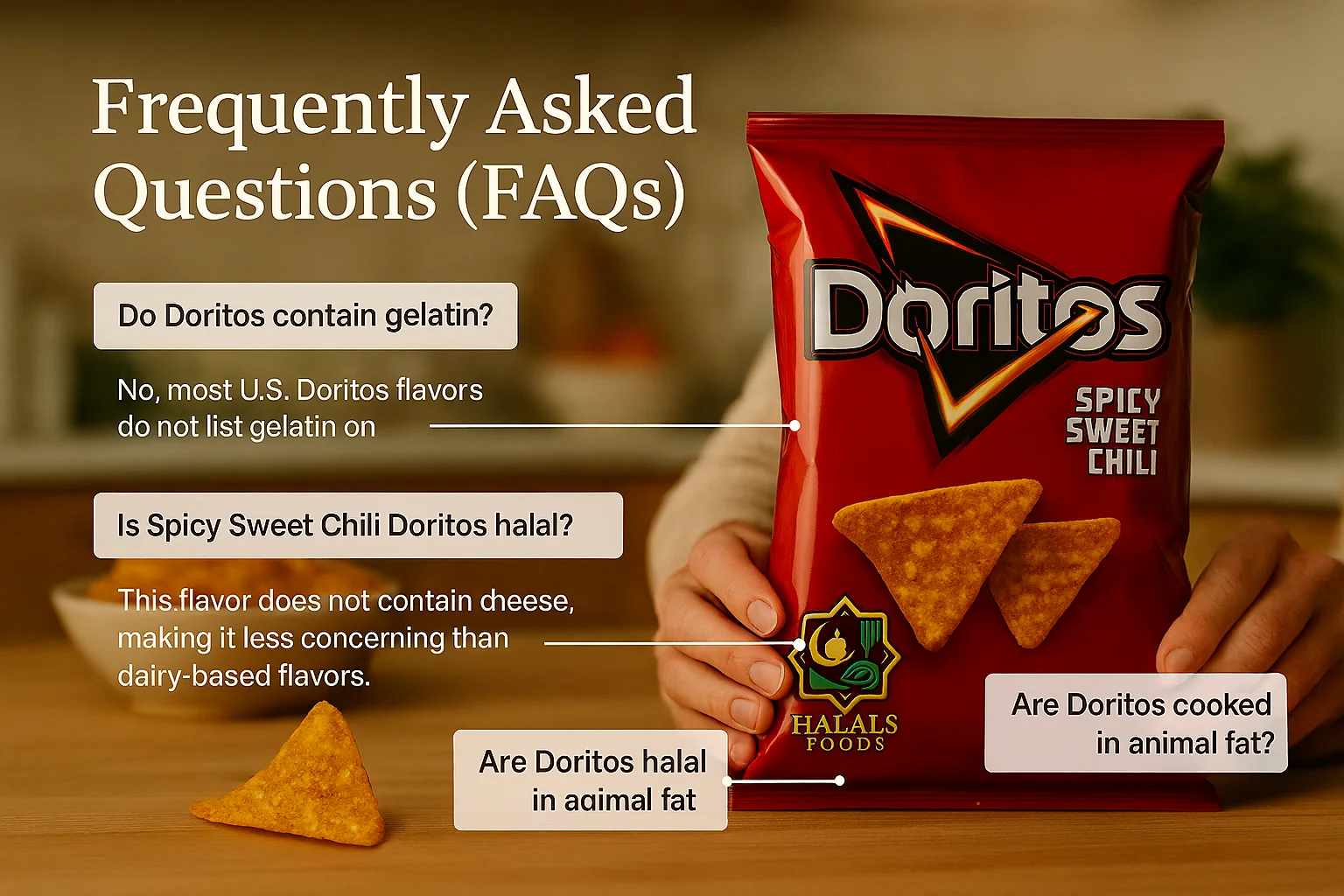
Do Doritos contain pork?
Most Doritos labels in the USA do not openly list pork ingredients. However, enzyme and flavor sources are not always clearly specified.
Are Doritos vegetarian?
Some flavors may be vegetarian-friendly, while cheese flavors still involve enzyme questions depending on sourcing.
Is Spicy Sweet Chili Doritos halal?
Many Muslims consider it less concerning because it lacks cheese ingredients, but it is still not officially halal certified in the USA.
Are Doritos cooked in animal fat?
No strong evidence suggests U.S. Doritos are fried in animal fat. They are generally cooked in vegetable oils.
Why don’t Doritos just get halal certified?
Halal certification is voluntary. Companies usually certify products only when they see strong business demand.
Related Halal Food Guides You May Find Helpful
People searching for “Is [ Is Starburst Halal or Doubtful? ]” are also curious about other foods and ingredients. Below, you’ll find related halal food articles that clearly explain ingredient sources, how products are made, and whether they meet halal requirements.
People searching for “Is [ Are Sour Patch Kids Halal? ]” are also curious about other foods and ingredients. Below, you’ll find related halal food articles that clearly explain ingredient sources, how products are made, and whether they meet halal requirements.
More : [ Are Jolly Ranchers Halal ]
More : [ Is Skittles Halal? ]
More : [ Are Pringles Halal? ]