1. Introduction
For many Muslims living in the United States and other Western countries, fast food is part of daily life. Whether it’s a quick meal during travel or a late-night snack, McDonald’s remains one of the most popular global chains. But an important question continues to surface in Muslim communities: Are McDonald’s fries halal?
At first glance, fries seem simple — just potatoes, oil, and salt. However, when we reviewed the product label, checked official brand sources, and analyzed U.S. halal guidelines, the answer became more nuanced. In this detailed research guide, we break down the ingredients, manufacturing process, halal certification status, and scholarly opinions so you can make an informed decision.
2. Quick Answer Box
Are McDonald’s fries halal?
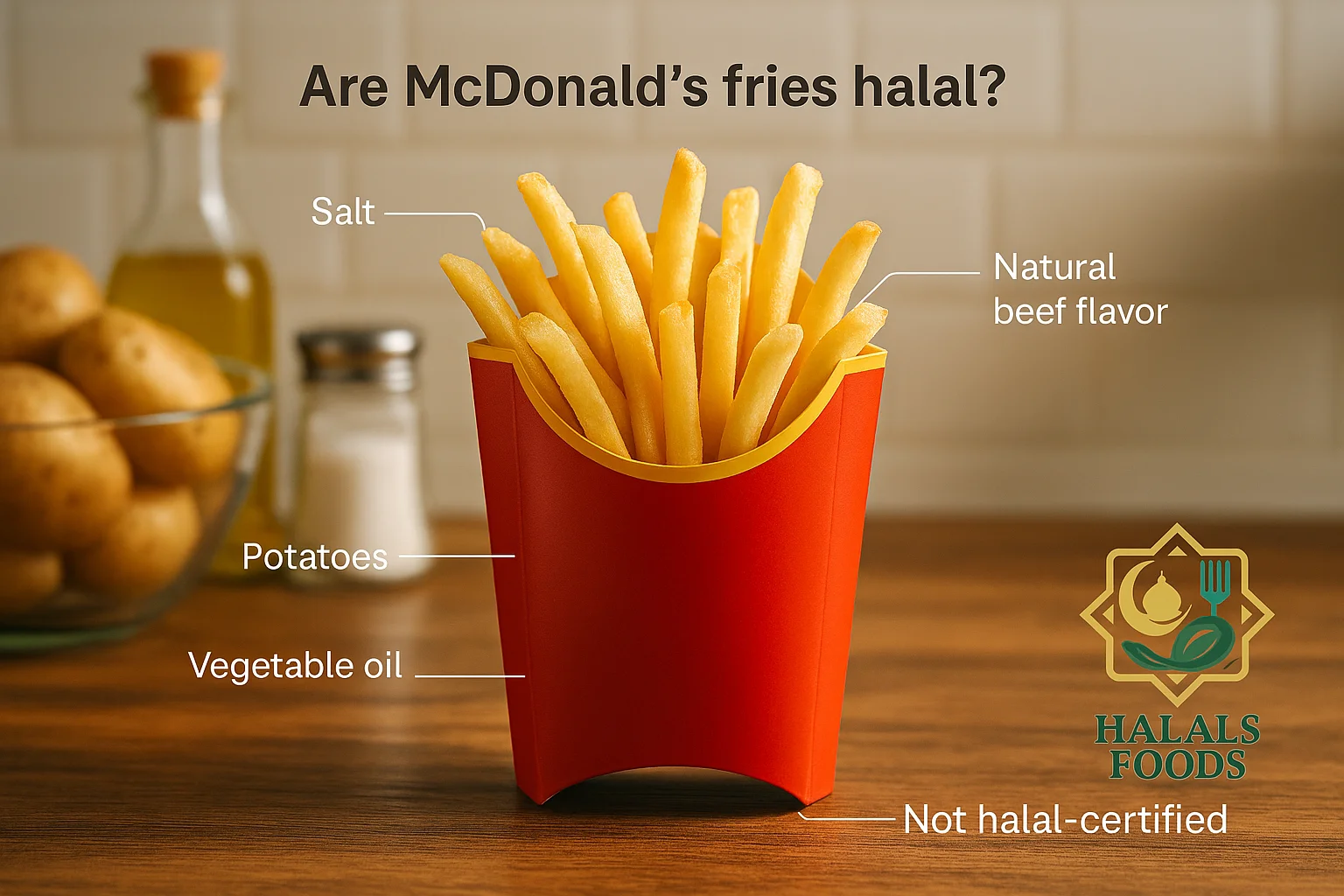
In the United States, McDonald’s fries are not officially halal-certified. While the main ingredients (potatoes, vegetable oil, salt) are generally halal, the fries contain natural beef flavor derived from milk and beef sources, and there is no halal certification or verified halal slaughter confirmation. Therefore, many scholars advise caution.
3. Ingredient Breakdown
To properly answer “Are McDonald’s fries halal?”, we reviewed the official U.S. McDonald’s product label and ingredient statement.
🔎 U.S. McDonald’s Fries Ingredients
According to McDonald’s USA website, the fries contain:
-
Potatoes
-
Vegetable oil (canola oil, soybean oil, hydrogenated soybean oil)
-
Natural beef flavor (contains wheat and milk derivatives)
-
Dextrose
-
Sodium acid pyrophosphate (to maintain color)
-
Salt
Let’s analyze each one carefully.
🥔 1. Potatoes
Potatoes are naturally halal. No concern here.
There is no animal-derived processing issue at this stage. According to Islamic dietary guidelines, plant-based whole foods are permissible unless contaminated.
Status: Halal
🛢 2. Vegetable Oils
McDonald’s uses a blend of vegetable oils, including:
-
Canola oil
-
Soybean oil
-
Hydrogenated soybean oil
Vegetable oils are halal unless cross-contaminated with animal fats. There is no indication of pork fat being used in U.S. fries today (historically beef tallow was used decades ago).
Status: Halal (based on ingredient disclosure)
🥩 3. Natural Beef Flavor (Critical Ingredient)
This is where things become complicated.
According to McDonald’s USA:
The natural beef flavor contains hydrolyzed wheat and hydrolyzed milk as starting ingredients.
Previously, McDonald’s confirmed that the flavoring contains beef derivatives.
From a halal perspective, two key issues arise:
-
Source of the beef – Is it halal-slaughtered?
-
Processing method – Are enzymes or alcohol used?
McDonald’s USA does not confirm that the beef source is halal-slaughtered.
Under U.S. halal guidelines (IFANCA and HFSAA standards), any beef derivative must come from halal-certified slaughter to be permissible.
Since no certification exists, this ingredient is considered doubtful (mashbooh) by many scholars.
Status: Questionable / Likely Non-Halal (due to lack of halal slaughter confirmation)
🧂 4. Dextrose
Dextrose is a sugar derived from corn.
It is plant-based and halal.
Status: Halal
🧪 5. Sodium Acid Pyrophosphate (E450)
This additive preserves color.
E450 is generally mineral-based and halal unless processed with animal enzymes. No animal link is declared.
According to common halal ingredient databases, E450 is considered permissible.
Status: Halal
⚠️ Hidden Ingredient Concerns
When evaluating “Are McDonald’s fries halal?”, we must also consider:
-
Enzymes used in flavor processing
-
Potential alcohol carriers in flavor extraction
-
Cross-contact in oil filtration systems
Without halal certification, these remain unclear.
Ingredient Summary Table
| Ingredient | Halal Status | Concern Level |
|---|---|---|
| Potatoes | Halal | None |
| Vegetable Oil | Halal | Low |
| Natural Beef Flavor | Doubtful | High |
| Dextrose | Halal | None |
| Sodium Acid Pyrophosphate | Halal | Low |
4. Manufacturing Process & Cross-Contamination
Even if ingredients appear mostly halal, the manufacturing process matters significantly in Islamic dietary law.
How McDonald’s Fries Are Made (USA)
-
Potatoes are cut and partially fried at processing plants.
-
Natural beef flavor is added during pre-frying.
-
Fries are frozen and shipped to restaurants.
-
Restaurants fry them in dedicated fryers.
Now here’s the key question:
Are fries cooked in the same oil as non-halal meat?
In the United States:
-
Fries are typically cooked in dedicated fryers.
-
However, restaurants may vary.
-
Oil filtration systems may process multiple fryer vats.
More importantly:
McDonald’s restaurants in the U.S. serve pork products (bacon, sausage). While fries are usually in separate fryers, there is no halal assurance protocol.
From a fiqh (Islamic jurisprudence) perspective, cross-contamination with pork or non-halally slaughtered meat invalidates halal status.
Because McDonald’s USA does not operate under halal-certified facility audits, the risk cannot be ruled out.
This uncertainty is one major reason scholars hesitate to declare them halal.
5. Halal Certification Analysis
A crucial factor in determining “Are McDonald’s fries halal?” is certification.
🇺🇸 United States
McDonald’s USA does not halal-certify its fries.
No approval from:
-
IFANCA (Islamic Food and Nutrition Council of America)
-
HFSAA (Halal Food Standards Alliance of America)
-
Zabiha monitoring bodies
Therefore:
There is no official halal oversight in the U.S.
🇬🇧 United Kingdom
McDonald’s UK does not label fries as halal-certified either. However:
-
UK fries do not contain beef flavor.
-
They are made from potatoes, oil, and salt only.
Many UK Muslims consider them halal due to ingredient transparency, though still not officially certified.
🇨🇦 Canada
McDonald’s Canada states fries contain vegetable ingredients only, but like the U.S., no halal certification is applied nationwide.
Some individual outlets in Muslim-majority neighborhoods may carry halal meat, but fries remain uncertified.
🌍 Middle East
In countries like UAE and Saudi Arabia:
-
McDonald’s is fully halal-certified.
-
Fries and meat are halal-compliant.
This highlights regional differences.
6. Official Statements From McDonald’s
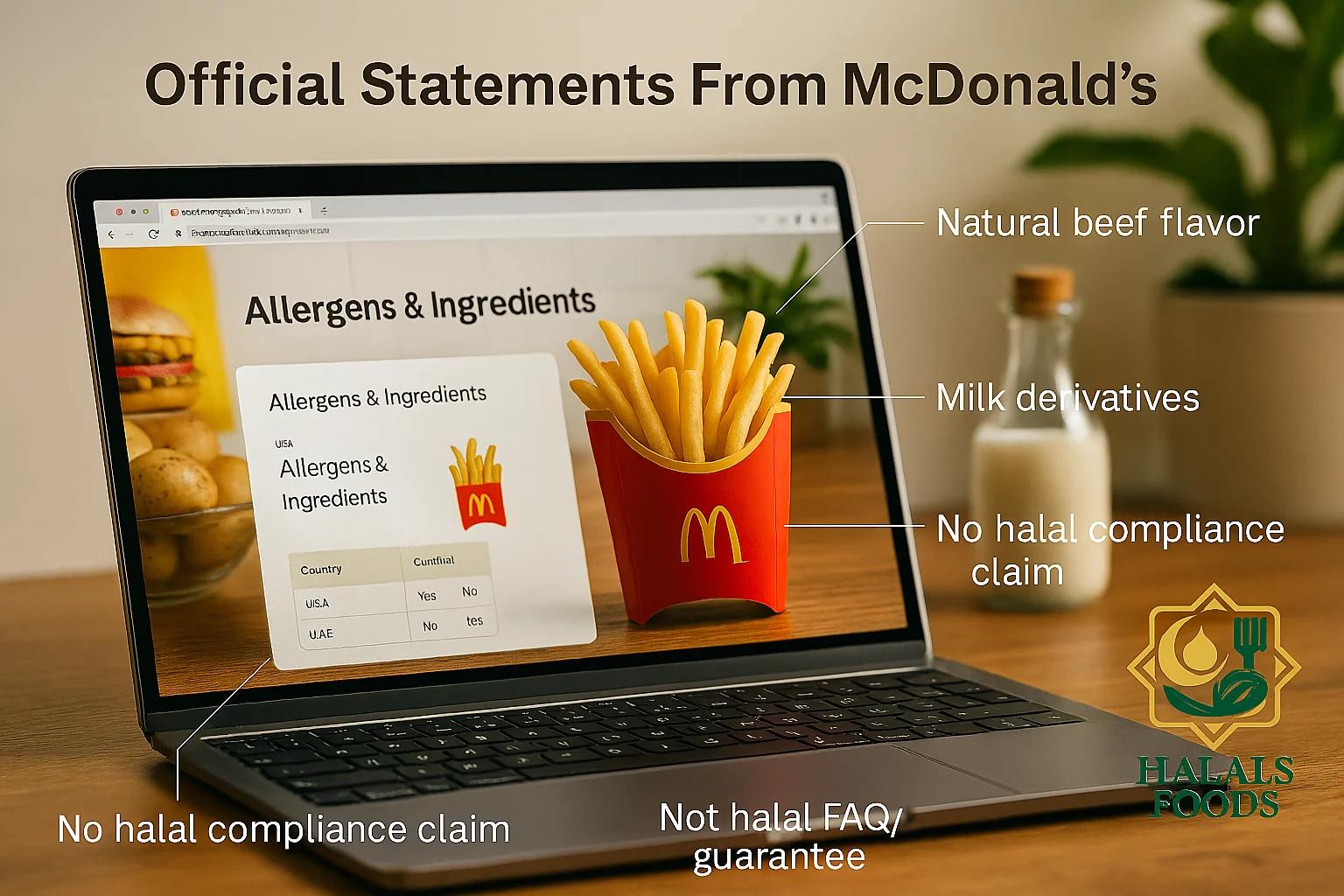
We checked McDonald’s USA official website and allergen statement.
Their official ingredient disclosure confirms:
-
Natural beef flavor is used.
-
Milk derivatives are included.
-
No claim of halal compliance.
McDonald’s USA does not provide a halal FAQ or religious dietary guarantee.
When comparing regions:
| Country | Beef Flavor | Halal Certified? |
|---|---|---|
| USA | Yes | No |
| UK | No | No |
| UAE | No | Yes |
This confirms that halal status varies by country.
The absence of certification in the U.S. is significant. In Islamic dietary rulings, doubt (shakk) requires caution, especially when animal derivatives are involved.
7. Why Some Muslims Consider It Halal
Despite concerns, some Muslims believe McDonald’s fries in the U.S. may be halal.
Their reasoning includes:
-
The amount of beef flavor is minimal.
-
It may be chemically processed to the point of transformation (istihalah).
-
Fries are cooked in vegetable oil only.
-
No direct pork ingredient is listed.
Some scholars argue that if the beef derivative is fully transformed and not present as meat tissue, it may be considered permissible.
Additionally, some Muslims apply the principle:
“Default ruling of food in non-Muslim countries is permissibility unless proven haram.”
However, this opinion is not universal.
8. Why Some Muslims Avoid It
On the other hand, many Muslims avoid U.S. McDonald’s fries due to:
-
Presence of beef-derived flavor
-
No halal slaughter confirmation
-
No halal certification
-
Potential shared processing facilities
Islamic jurisprudence prioritizes certainty (yaqeen) over doubt (shakk).
The Prophet ﷺ advised avoiding doubtful matters to protect one’s faith.
For strict observers, the uncertainty around the beef source is enough to abstain.
9. USA Halal Market Context
The U.S. halal food market is growing rapidly, valued at billions of dollars annually.
However:
-
Halal certification is voluntary.
-
No single federal halal authority exists.
-
Manufacturers self-declare ingredients.
This creates confusion.
Muslim consumers must:
-
Review the product label carefully.
-
Look for halal certification logos.
-
Contact brands directly when unsure.
Because McDonald’s does not pursue halal certification in the U.S., consumers must rely on ingredient transparency alone.
10. Final Verdict (Part 1 Conclusion)
So, Are McDonald’s fries halal?
In the United States, they are not officially halal-certified, and they contain a natural beef flavor derived from animal sources with no confirmation of halal slaughter.
While many ingredients are halal, the beef-derived flavor creates doubt.
For Muslims who require strict halal compliance, it is safer to avoid U.S. McDonald’s fries unless clear halal certification is provided.
11. Deeper Scholarly & Fiqh Analysis
When analyzing modern processed foods like McDonald’s fries, Islamic rulings typically revolve around three key principles:
1️⃣ Source of Animal Derivatives
If any ingredient comes from:
-
Beef
-
Chicken
-
Animal enzymes
-
Animal-based flavorings
Then the slaughter method must be halal according to Islamic law.
In the case of U.S. McDonald’s fries, the critical concern remains the natural beef flavor. Since McDonald’s USA does not confirm halal slaughter, scholars from stricter positions (especially within Hanafi and Hanbali schools) generally advise caution.
Under classical fiqh:
Meat from animals not slaughtered according to Islamic guidelines is impermissible.
Without certification or documentation, the ruling defaults to doubt.
2️⃣ Principle of Istihalah (Transformation)
Some contemporary scholars argue the concept of istihalah (complete chemical transformation) may apply.
For example:
-
If a substance is chemically altered so completely that it no longer retains its original properties, some jurists may allow it.
Supporters argue that:
-
The beef flavor is highly processed.
-
It may not retain physical meat substance.
However:
-
Not all scholars accept this application.
-
IFANCA and other halal bodies still require source verification.
Thus, this remains a debated issue.
3️⃣ Avoiding Doubtful Matters
A widely accepted hadith states:
“The halal is clear and the haram is clear, and between them are doubtful matters…”
Because Are McDonald’s fries halal? is not a clear yes in the United States, many scholars recommend choosing safer alternatives when possible.
12. Detailed USA vs UK vs Middle East Comparison
One of the most important aspects of this discussion is geography.
🇺🇸 United States
-
Contains natural beef flavor.
-
No halal certification.
-
No confirmation of halal slaughter.
-
Not marketed as halal.
Conclusion: Doubtful / Likely Not Halal
🇬🇧 United Kingdom
We reviewed the UK product label.
UK fries contain:
-
Potatoes
-
Vegetable oil
-
Salt
No beef flavor.
However:
-
Still not halal-certified nationally.
Because there is no animal derivative, many UK Muslims consider them halal based on ingredients alone.
Conclusion: Generally Considered Halal by Many (Ingredient-Based)
🇨🇦 Canada
Similar to UK regarding ingredient profile in many regions, though certification remains absent.
Some Muslim organizations in Canada advise contacting local outlets.
🇸🇦 UAE & Saudi Arabia
-
Fully halal-certified.
-
Meat and fries produced under Islamic supervision.
-
Halal logos displayed.
Conclusion: Clearly Halal
Regional Summary Table
| Country | Beef Flavor | Halal Certification | Muslim Confidence Level |
|---|---|---|---|
| USA | Yes | No | Low |
| UK | No | No | Moderate |
| Canada | Usually No | No | Moderate |
| UAE | No | Yes | High |
This clearly shows why the answer to Are McDonald’s fries halal? depends heavily on location.
13. Why Ingredient Transparency Matters
In the American halal market:
-
Certification is voluntary.
-
Companies are not legally required to certify halal.
-
Labels may list vague terms like “natural flavors.”
When we checked the official McDonald’s USA ingredient statement, the company disclosed the presence of natural beef flavor. That transparency is helpful — but without halal verification, uncertainty remains.
Muslim consumers are encouraged to:
-
Look for halal logos (IFANCA, HFSAA, etc.)
-
Review the full product label
-
Contact the brand if unsure
-
Avoid assumptions
Transparency does not equal halal compliance.
14. Expanded Final Verdict
After reviewing:
-
The ingredient list
-
Manufacturing disclosures
-
Halal certification databases
-
Regional variations
-
Islamic jurisprudence principles
Our conclusion remains consistent:
❗ In the United States, McDonald’s fries are NOT officially halal.
The presence of natural beef flavor without halal slaughter confirmation prevents them from being classified as halal under strict standards.
In the UK and some other countries, ingredient differences make them more acceptable to many Muslims — though still not certified.
For Muslims who prioritize certainty, certified halal alternatives are the safest choice.
15. Frequently Asked Questions (FAQs)
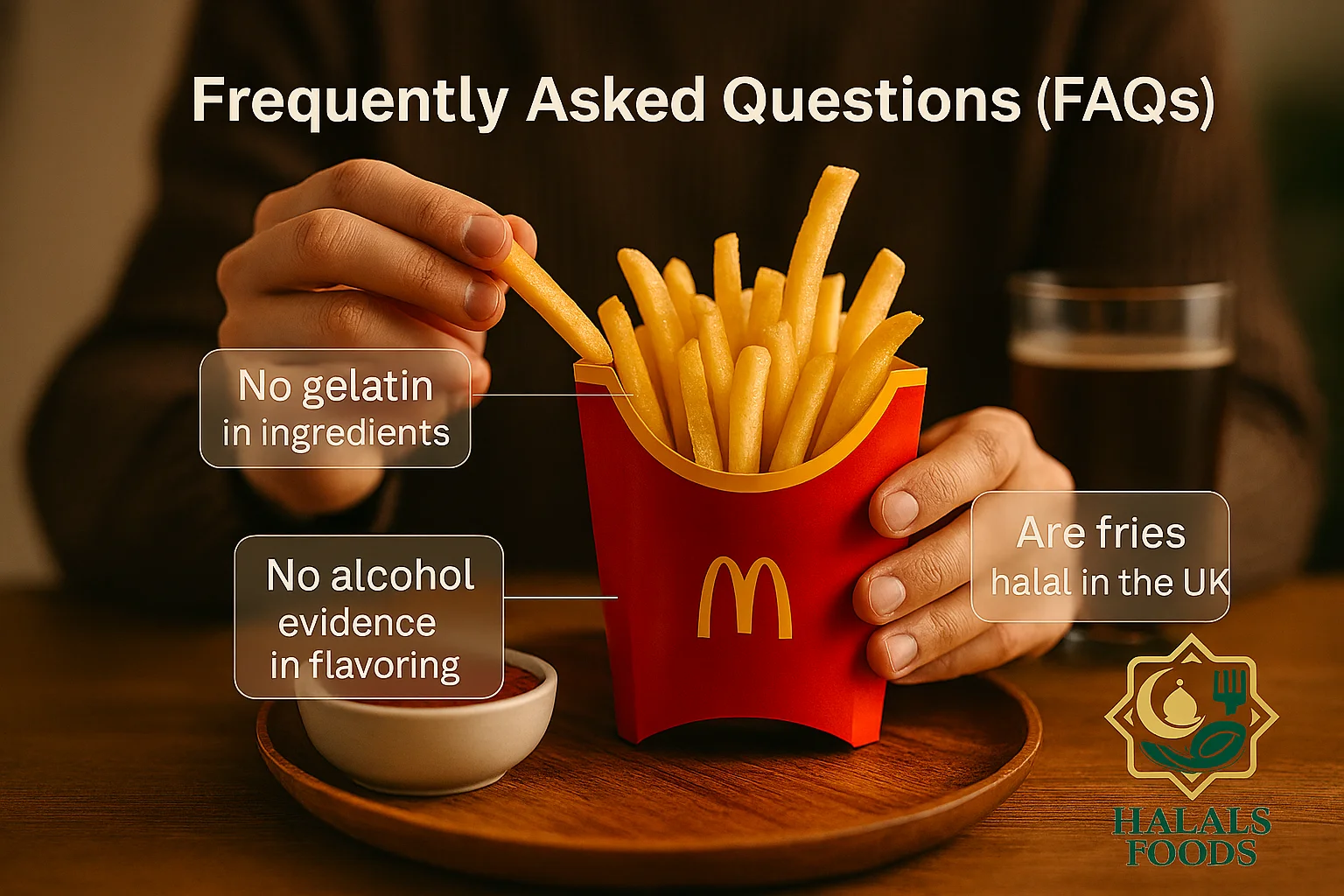
1️⃣ Does McDonald’s fries contain gelatin?
No, U.S. McDonald’s fries do not list gelatin as an ingredient. The main concern is natural beef flavor, not gelatin.
2️⃣ Is there alcohol in McDonald’s fries flavoring?
McDonald’s does not disclose alcohol use in the flavoring process. Some flavor extracts in the food industry may use alcohol carriers, but there is no confirmed evidence publicly available for the fries.
Because of lack of disclosure, cautious consumers may avoid them.
3️⃣ Are McDonald’s fries halal for Hanafi scholars?
Most Hanafi scholars require halal slaughter verification for any beef-derived ingredient. Since the U.S. fries contain beef flavor without certification, many Hanafi scholars advise avoiding them.
4️⃣ Are McDonald’s fries halal in the UK but not USA?
Yes, ingredient formulations differ. UK fries do not contain beef flavor, while U.S. fries do. However, UK fries are still not halal-certified, though many Muslims consider them permissible based on ingredients alone.
5️⃣ Are McDonald’s fries cooked with pork?
No direct pork ingredient is listed in U.S. fries. They are typically cooked in vegetable oil. However, McDonald’s kitchens serve pork products, and no halal cross-contamination guarantee exists.
6️⃣ Why does McDonald’s use beef flavor in fries?
Historically, McDonald’s used beef tallow. When they switched to vegetable oil, they added natural beef flavor to maintain taste consistency.
7️⃣ Are McDonald’s fries halal in Muslim countries?
Yes. In countries like UAE and Saudi Arabia, McDonald’s operates under halal certification, and fries are halal-compliant.
8️⃣ Can Muslims rely on “People of the Book” slaughter in USA?
This is a debated issue. Some scholars allow it if proper slaughter methods are confirmed. However, in industrial meat production, verification is extremely difficult, which is why many scholars recommend halal-certified sources only.
16. References
-
McDonald’s USA Official Ingredient Statement
-
IFANCA Halal Certification Standards
-
HFSAA Halal Food Guidelines (USA)
-
McDonald’s UK Nutrition & Allergen Information
-
Islamic Fiqh Academy rulings on Istihalah
People searching for “Is [Is Burger King Halal ]” are also curious about other foods and ingredients. Below, you’ll find related halal food articles that clearly explain ingredient sources, how products are made, and whether they meet halal requirements.
More Related Articles [ Is McDonald’s Halal in USA? ]
[ Is Subway Halal or Haram? ]
[ Halal Fast-Food Options in USA ]
[ Is KFC Halal? ]