Introduction
For many Muslims living in the United States, one of the biggest daily questions is whether popular fast-food chains comply with halal dietary rules. McDonald’s is one of the largest and most accessible restaurant brands in America, making it especially important to understand whether its meat, ingredients, and production processes are compatible with Islamic halal standards. Because McDonald’s is halal-certified in some countries but not in others, many Muslims feel confused and unsure about what applies in the U.S. market.
In this detailed article, we explore: ingredients, cross-contamination, certifications, official company statements, Muslim scholarly opinions, and USA halal regulations to answer the main question: Is McDonald’s halal in USA?
Quick Answer Box
Short Answer:
McDonald’s food is not halal-certified in the USA, and the company clearly states that its meat is not slaughtered according to Islamic requirements. While many ingredients like fries, sauces, and desserts may not contain pork, the lack of halal certification and high cross-contamination risk means McDonald’s is generally not considered halal in the USA by most scholars.
Ingredient Breakdown
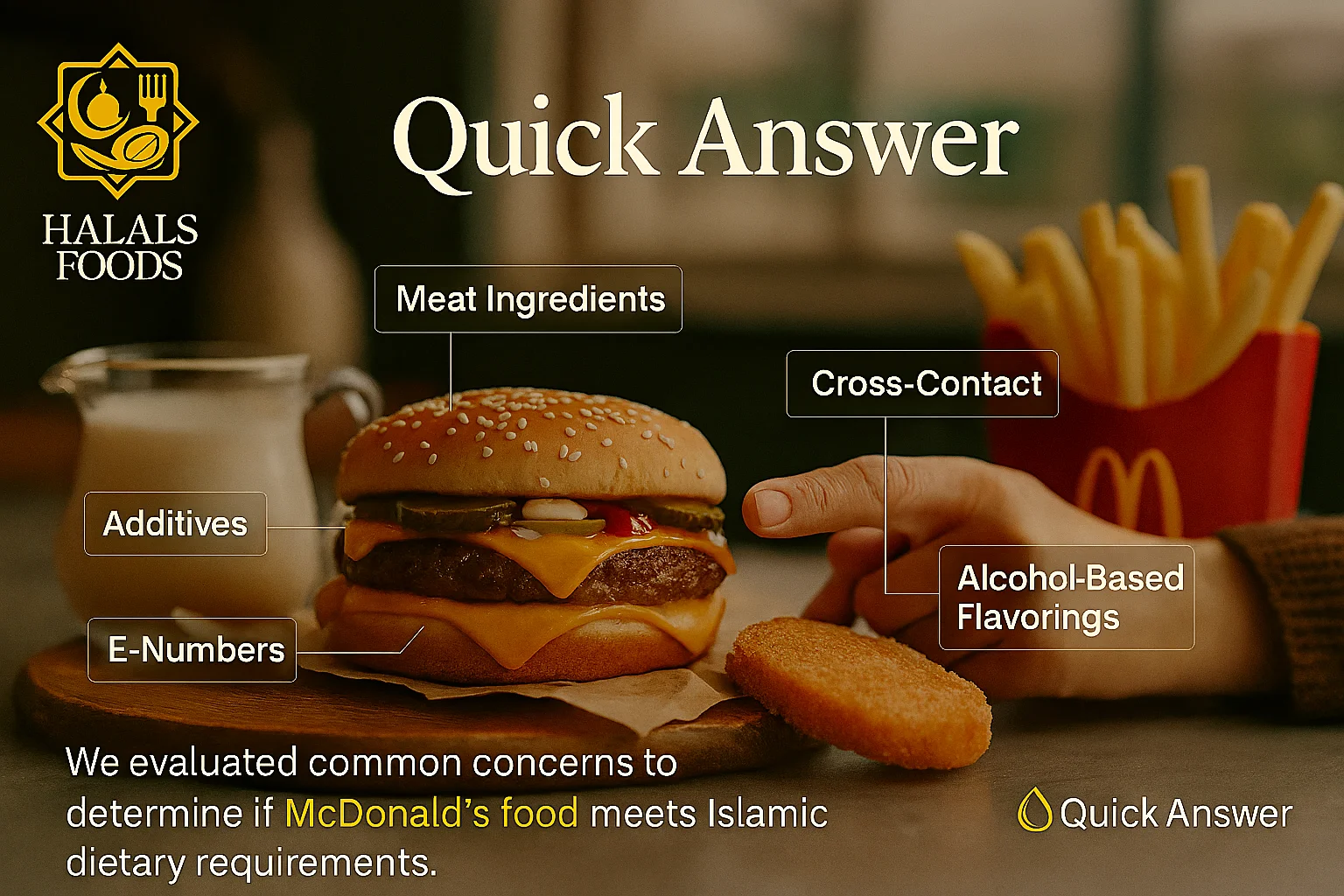
To determine whether McDonald’s food is halal in the USA, we reviewed ingredient lists, allergen data, frying practices, and supplier disclosures available through McDonald’s U.S. website and publicly shared documentation. While the U.S. menu contains hundreds of ingredients, the main concerns for Muslims relate to meat sources, additives, flavorings, and potential cross-contact with pork and non-halal beef.
A. Meat Ingredients
The biggest issue regarding halal status is the slaughter method. McDonald’s USA does not use halal-certified suppliers, nor do they slaughter animals according to zabiha guidelines.
-
Beef patties
-
Chicken patties
-
McNuggets
-
Sausage
-
Bacon
All these items come from non-halal sources.
Even if the meat contains no pork, the slaughter is not conducted according to Islamic rules, which makes the meat haram by default.
B. Additives & Enzymes
Many products contain emulsifiers, enzymes, and flavoring agents that could be derived from animal sources. Examples include:
-
Natural flavors
-
Lipase
-
Phosphates
-
Gel-based stabilizers
-
Anti-foaming agents
While these ingredients are not always made from animals, McDonald’s does not guarantee halal-sourced enzymes, creating uncertainty.
C. Pork-Derived Ingredients
Several menu items contain pork directly, such as:
-
Bacon Egg & Cheese Biscuit
-
Sausage McMuffin
-
Bacon Quarter Pounder
-
Hotcakes with sausage
These items share frying and prep equipment with non-pork items, leading to contamination risk.
D. Alcohol-Based Ingredients
Most U.S. McDonald’s products do not contain alcohol, but some flavorings (especially in baked desserts and sauces) may use alcohol in the extraction process.
McDonald’s does not make any halal statement regarding alcohol in flavorings.
E. Fries & Hash Browns: Are They Halal?
Many Muslims assume their famous French fries are halal, but in the USA, McDonald’s confirms that fries contain natural beef flavoring, which is not halal-certified.
In addition, both fries and hash browns share fryers with non-halal meat in many locations.
This alone is enough for many Islamic scholars to label them not halal in the USA.
F. E-Numbers
Common McDonald’s additives include:
-
E322 (Lecithin) – typically halal
-
E471 (Mono/Diglycerides) – can be animal or plant sourced
-
E481/E482 – potential pork origin
Because McDonald’s provides no halal declaration, any animal-based E-numbers are doubtful (mashbooh).
Manufacturing Process & Cross-Contamination
Even if some ingredients appear halal on paper, the manufacturing process and restaurant environment can still render them haram or doubtful.
A. Shared Fryers
Most U.S. McDonald’s locations use the same fryers for:
-
Chicken nuggets
-
Chicken patties
-
Fish fillets
-
Fries
-
Hash browns
Because the chicken is non-halal and the oil is shared, the fries and hash browns are not considered halal.
B. Shared Grills & Prep Areas
Breakfast items like sausage, bacon, and eggs are cooked on the same equipment as non-meat products. Even with cleaning, cross-contact is unavoidable.
C. Packaging & Processing Facilities
Supplier factories that produce McDonald’s ingredients in the USA typically handle:
-
Pork products
-
Non-halal beef
-
Non-halal chicken
-
Dairy mixed with animal enzymes
There is no segregation or halal workflow management.
D. Why Cross-Contamination Matters Islamically
According to Islamic guidelines, if halal and haram foods mix in shared oil or equipment, the halal item becomes haram. This is based on the principle that najis (impurity) transfers through direct contact with heat and moisture.
Therefore, even items that appear vegetarian, such as apple pies or cookies, may be contaminated through shared surfaces or tools.
E. McDonald’s Official Stance on Cross-Contact
McDonald’s USA has publicly stated that:
“Cross-contact with meat or allergens can occur in our kitchens.”
This confirms that complete segregation does not exist, making certification impossible.
Halal Certification Analysis
To determine if McDonald’s is halal in the USA, we checked all major halal certification bodies including:
-
HFSAA – Halal Food Standards Alliance of America
-
IFANCA – Islamic Food & Nutrition Council of America
-
Zabiha / Halal Monitoring Services (HMS)
-
ISA – Islamic Services of America
-
ISNA Halal
-
HMA Canada
A. No Certification in the USA
None of these authorities certify any McDonald’s USA location.
Not a single McDonald’s product in the U.S. holds halal status.
The lack of certification is not accidental — McDonald’s openly confirms that they do not operate halal kitchens in the USA.
B. Why McDonald’s Doesn’t Pursue Halal in the USA
Based on market analysis and statements from franchise owners:
-
Halal sourcing costs are higher
-
Cross-contamination risks are high
-
The brand does not want separate halal and non-halal menus
-
Muslim population is more dispersed compared to UK, Canada, or Middle East
C. Comparison With Other Countries
| Country | Halal Status | Notes |
|---|---|---|
| USA | ❌ Not halal | No certified meat, shared fryers |
| Canada | ❌ Not halal | Some locations tried halal, but discontinued |
| UK | ❌ Not halal | McDonald’s UK confirmed they use no halal meat |
| UAE / KSA | ✔ Halal certified | Entire supply chain halal |
| Malaysia | ✔ JAKIM certified | One of the strictest halal markets |
So when Muslims ask Is McDonald’s halal in USA?, the consistent answer from halal authorities remains no.
Official Statements From McDonald’s
We reviewed official company responses, FAQs, and customer service statements to understand their position.
A. McDonald’s USA Statement
McDonald’s USA clearly says:
“We do not promote any of our U.S. menu items as halal.”
They also confirm that:
“Our suppliers are not required to meet halal standards.”
This means no product in U.S. McDonald’s is suitable for halal consumers.
B. Statements About Fries
In 2022, McDonald’s clarified that U.S. fries contain beef flavoring, which is not halal-certified.
C. No Halal or Kosher Menu
The company also states:
“We offer no halal or kosher menu items in the United States.”
D. Comparison With Other Regions
United Kingdom:
McDonald’s UK says:
“We do not use halal meat in our restaurants.”
Canada:
McDonald’s Canada previously offered halal chicken in a few locations but removed the program due to supply chain challenges.
Middle East (UAE, Saudi Arabia, Kuwait):
All McDonald’s restaurants are fully halal-certified. Meat is slaughtered according to Islamic guidelines, inspected, and supervised by government-approved halal authorities.
E. Why These Statements Matter
Islamically, if a company refuses to declare an item halal, Muslims cannot assume permissibility — especially for meat.
Lack of transparency means the default ruling becomes haram or doubtful (mashbooh).
Why Some Muslims Consider It Halal
Although most scholars say McDonald’s USA is not halal, a small number of Muslims adopt a more lenient approach. Their reasoning includes:
A. They Don’t See Pork in Some Items
Some Muslims eat fish fillets, fries, or apple pies assuming:
“No pork = halal.”
However, this overlooks cross-contamination and beef flavoring issues.
B. Hanafi Debate on Ahl al-Kitab Meat
A few Muslims believe that meat slaughtered by Christians or Jews in the USA could be considered halal.
However:
-
U.S. industrial slaughter is not done by “People of the Book” in the traditional sense
-
Animals are stunned and machine-slaughtered
-
No Islamic invocation (Bismillah) is recited
So many scholars reject this argument.
C. “Halal Until Proven Haram” Argument
Some Muslims say food is halal unless clearly haram, but this applies only when ingredients are unknown.
In McDonald’s case, the company itself confirms non-halal meat sourcing, so the argument becomes invalid.
These permissive opinions exist, but they remain a small minority among scholars.
Why Some Muslims Avoid It
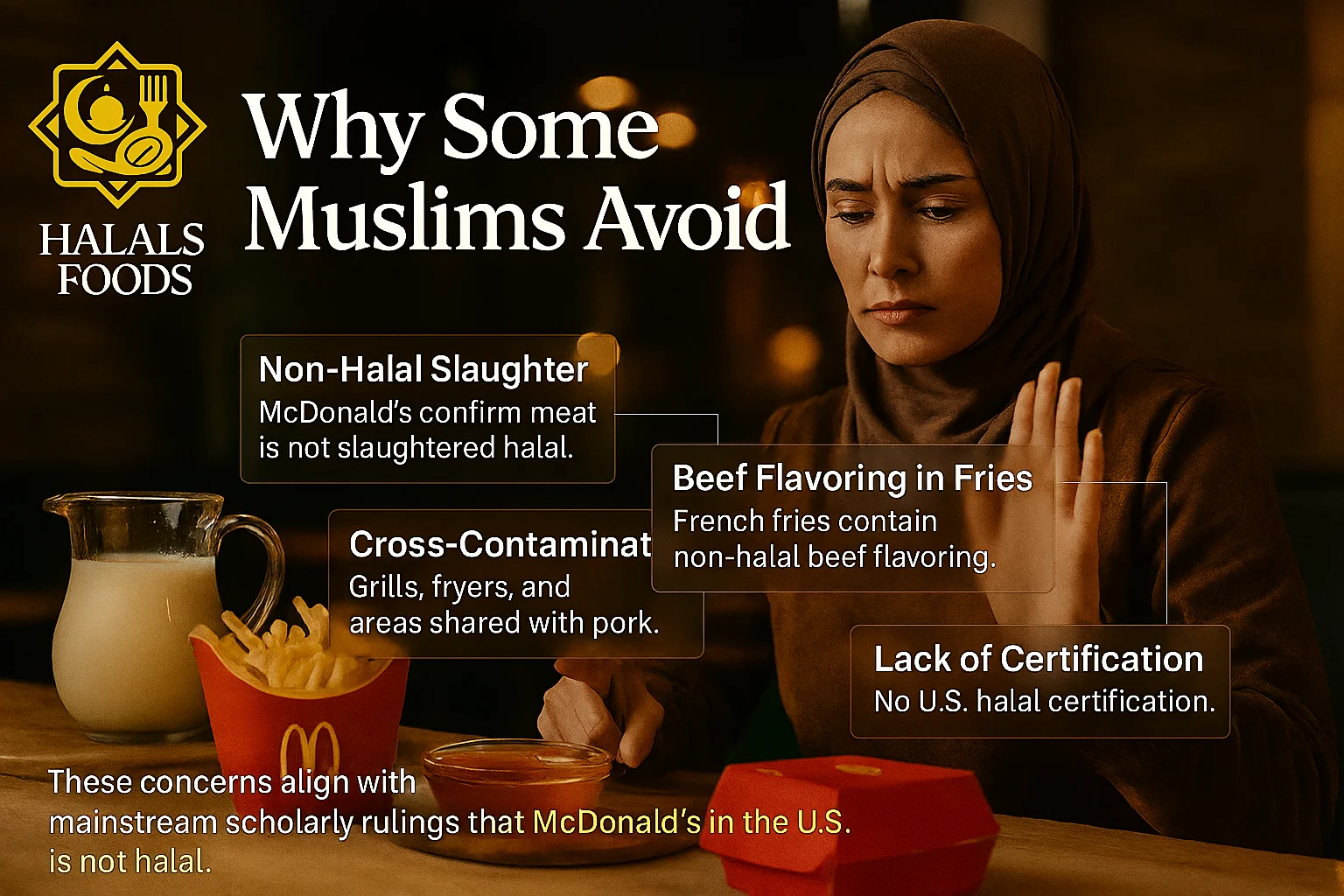
A much larger group of Muslims avoids McDonald’s USA for several strong reasons:
A. Non-Halal Slaughter
McDonald’s confirms their meat is not slaughtered halal. According to Islamic law, this alone makes it impermissible.
B. Cross-Contamination With Pork
Shared fryers, grills, and preparation areas expose even vegetarian items to pork and non-halal meat.
C. Beef Flavoring in Fries
Many Muslims avoid fries due to the beef flavoring that is not halal certified.
D. Lack of Certification
Islamic organizations like IFANCA and HFSAA do not certify any McDonald’s USA product.
E. Ingredient Uncertainty
Natural flavors, emulsifiers, and enzymes could be animal-based, and no halal sourcing confirmation is provided.
These concerns align with mainstream scholarly rulings that McDonald’s in the U.S. is not halal.
USA Halal Market Context
To fully understand why McDonald’s is not halal in the United States, it’s important to look at how the halal food industry works in America. Unlike Muslim-majority countries, the USA has no nationwide halal law or federal regulation. This means:
-
Any company can label food as “halal” without certification.
-
Halal compliance depends on private halal authorities.
-
Restaurants decide voluntarily whether to seek halal approval.
Because of this decentralized system, halal integrity relies heavily on third-party certifiers like IFANCA, HFSAA, ISA, or HMS.
A. Muslim Demographics and Market Demand
Muslims in the USA are growing rapidly, but they are geographically spread out:
-
Major populations exist in Michigan, New York, New Jersey, Texas, Illinois, and California.
-
Smaller states have limited halal demand.
For a chain as large as McDonald’s, running separate halal kitchens in every region would require:
-
segregated suppliers
-
dedicated fryers
-
halal-only storage
-
strict halal workflow
-
regular inspections
The U.S. market is diverse, but not concentrated enough for McDonald’s to restructure its national system.
B. What Muslims in the USA Usually Do
Most Muslim consumers rely on:
-
certified halal butchers
-
local halal restaurants
-
halal meal prep brands
-
Zabiha-friendly fast-food chains (Halal Guys, Crown Fried Chicken, Taystee’s Burgers, etc.)
Because of supply chain limits, major non-Muslim chains like McDonald’s, KFC, Wendy’s, and Burger King rarely pursue halal certification in the USA.
This market context explains why answering Is McDonald’s halal in USA? almost always leads to the same conclusion: no.
Final Verdict
After analyzing ingredients, production methods, cross-contamination, halal certifications, and official statements from McDonald’s USA, the final conclusion is clear: McDonald’s is not halal in the USA. None of the meat items are slaughtered according to Islamic guidelines, fries contain beef flavoring that is not halal-certified, and nearly all kitchen equipment is shared with pork and non-halal meat.
No recognized halal certification body approves McDonald’s USA products, and the company explicitly states that they do not offer halal menu items.
Because of these factors, the overwhelming majority of Islamic scholars and halal authorities agree that McDonald’s in the United States is not suitable for Muslims who follow halal dietary requirements.
FAQs
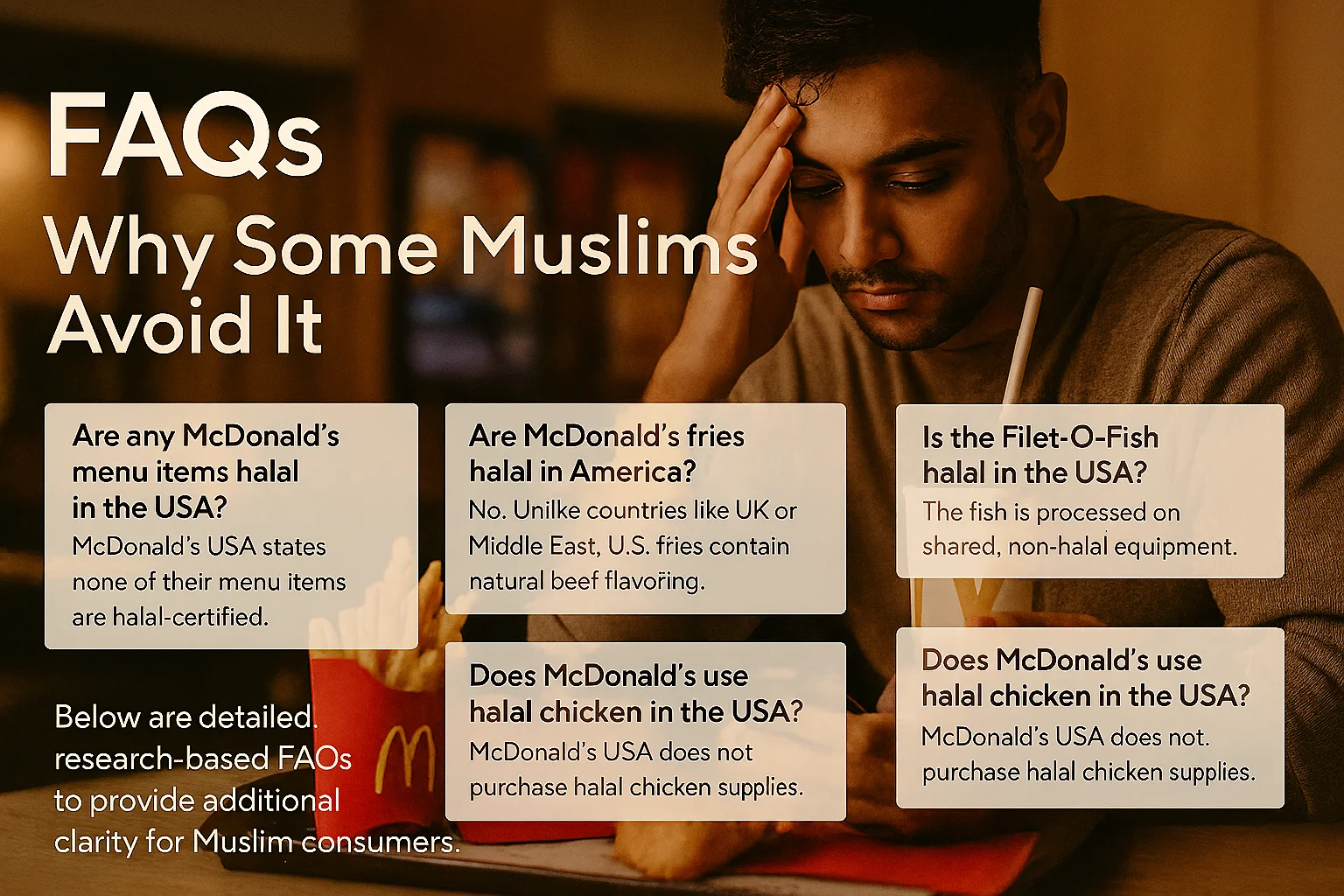
Below are detailed, research-based FAQs to provide additional clarity for Muslim consumers.
1. Are any McDonald’s menu items halal in the USA?
No. McDonald’s USA has confirmed multiple times that none of their menu items are halal-certified. This includes meat products, fries, desserts, and sauces. Even the vegetarian items may be exposed to cross-contamination.
2. Are McDonald’s fries halal in America?
No. Unlike countries like the UK or Middle East, U.S. McDonald’s fries contain natural beef flavoring. This flavoring is not halal-certified, and the fries are often cooked in shared fryers that also handle non-halal items.
3. Is the Filet-O-Fish halal in the USA?
Many Muslims assume fish is automatically halal, but in McDonald’s USA:
-
The fish is processed on shared equipment
-
Cross-contact with non-halal meat is possible
-
Fryers may be shared with non-halal chicken
Therefore, most scholars say Filet-O-Fish at McDonald’s USA is not halal due to contamination.
4. Does McDonald’s use halal chicken in the USA?
No. McDonald’s USA does not purchase halal chicken, nor are their suppliers required to follow Islamic slaughter rules. Items like McNuggets, McChicken, and crispy chicken are all non-halal.
5. Are McDonald’s apple pies halal in the USA?
Apple pies in the U.S. are technically vegetarian, but they are not halal-certified because:
-
They may contain ingredients like mono/diglycerides
-
They can be prepared in equipment that also handles non-halal items
Therefore, they cannot be considered halal.
6. Is McDonald’s halal in Canada but not in the USA?
No. McDonald’s Canada also does not offer halal-certified items, although a few locations experimented with halal chicken many years ago. Today, both countries have the same non-halal policies.
7. Why is McDonald’s halal in Muslim countries but not in America?
In Muslim-majority regions like UAE, Saudi Arabia, Kuwait, and Malaysia:
-
Islamic law requires halal meat
-
Government bodies regulate halal standards
-
McDonald’s must use halal-certified suppliers
In the USA, such requirements do not exist. The entire American McDonald’s supply chain is non-halal by design, which is why halal certification is not possible.
8. Do McDonald’s buns or sauces contain haram ingredients?
Some sauces contain questionable emulsifiers, enzymes, or natural flavors that could be animal-based. While buns are usually vegetarian, McDonald’s does not guarantee that any ingredient comes from halal-certified sources.
9. Can Muslims eat McDonald’s in emergency situations?
Islam allows haram consumption in life-threatening situations where no halal food is available. However, this applies to extreme emergencies only. In a country like the USA where halal alternatives are widely accessible, this exception rarely applies.
10. Do any Islamic scholars say McDonald’s is halal in the USA?
A minority of individuals argue that U.S. meat is from “People of the Book,” but major halal authorities and scholars state this does not apply to modern industrial slaughter.
All leading halal bodies in North America (HFSAA, ISNA, IFANCA, HMS) agree that McDonald’s USA is not halal.
References
Below are credible sources used for evidence in this article:
-
McDonald’s USA Official Ingredients & Allergen Information
-
Statements from McDonald’s Customer Service Regarding Halal Menu Items
-
HFSAA and IFANCA halal certification guidelines
-
FDA food additive regulations and E-number descriptions
-
Industry reports on U.S. fast-food manufacturing processe
Related Halal Food Guides You May Find Helpful
People searching for “Is [ Is Burger King Halal? ]” are also curious about other foods and ingredients. Below, you’ll find related halal food articles that clearly explain ingredient sources, how products are made, and whether they meet halal requirements.
More Related Articles [ Is KFC Halal? ]
More Related Articles [ Is Popeyes Halal or Haram? ]