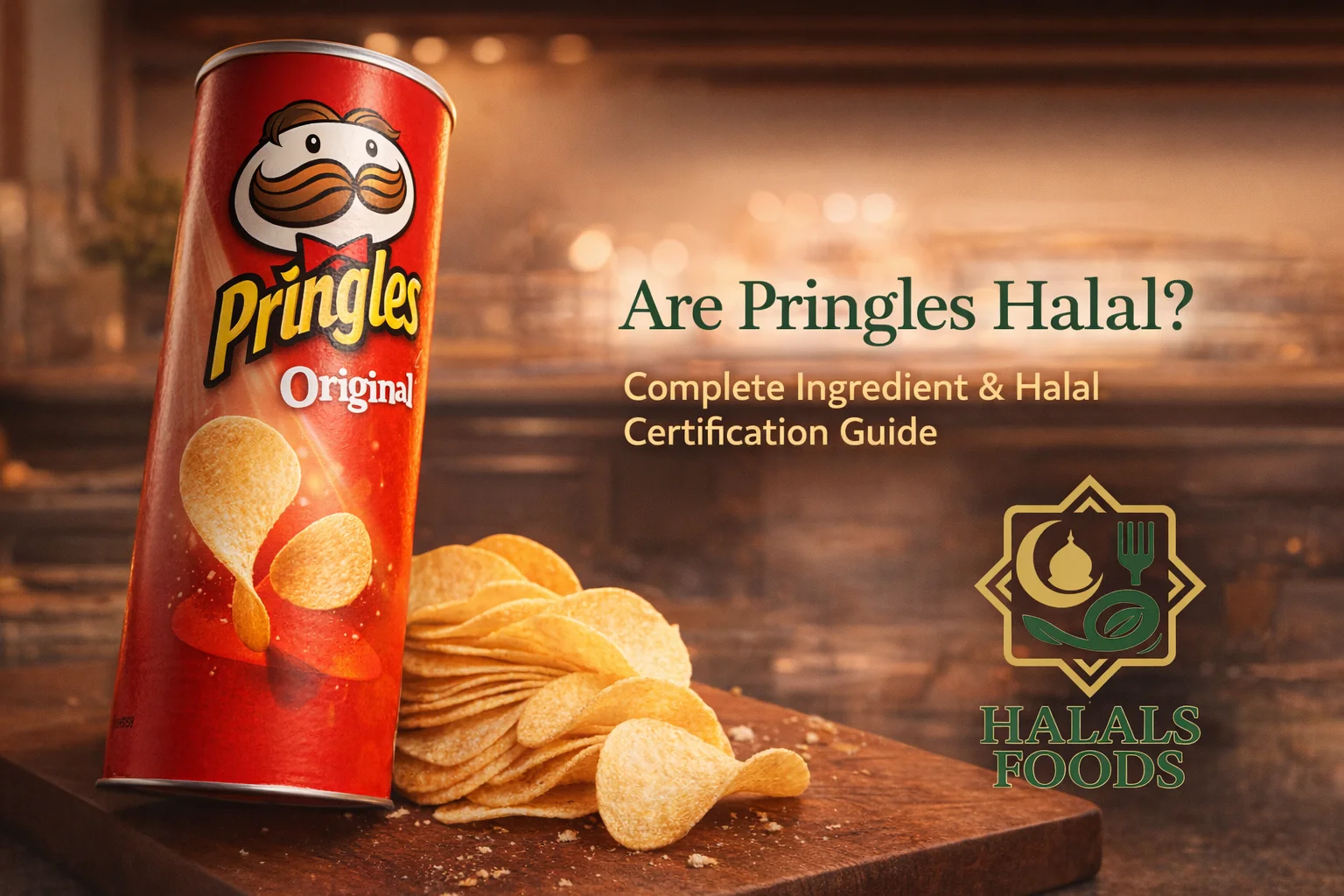
That famous popping sound when you open a Pringles can feels harmless. Potato chips, seasoning, maybe some cheese powder… nothing unusual, right?
But for many Muslims living in the USA, UK, Canada, and Europe, snacks are no longer “just snacks.” Processed foods today come with flavor chemicals, enzymes, emulsifiers, dairy cultures, and manufacturing systems most consumers never even think about.
That’s exactly why so many Muslims are searching:
Are Pringles halal?
And honestly, the confusion makes sense.
Some Muslims eat certain flavors without hesitation. Others completely avoid the brand. Then you’ll see online forums where people argue back and forth without any actual ingredient research.
Here’s where things become tricky:
Pringles are not a simple potato chip product anymore. They are highly processed stackable crisps made with potato flakes, starches, oils, flavor systems, and industrial seasoning blends.
That means the halal ruling doesn’t always depend on potatoes alone.
It depends on:
- flavor ingredients
- dairy enzymes
- flavor carriers
- halal certification
- factory processing
- regional production differences
And this is the part most people ignore…
A flavor sold in one country may be made differently in another country.
So when someone says:
“Pringles are halal.”
Or:
“Pringles are haram.”
The reality is usually much more complicated than that.
This guide breaks everything down carefully in simple English so you can actually understand what’s inside Pringles and why Muslims disagree about them.
Why Are Pringles halal Became a Huge Question Among Muslims
Twenty years ago, many Muslims mainly checked food for obvious haram ingredients like pork or alcohol.
Today, processed foods are different.
Modern snack brands use:
- flavor laboratories
- enzyme technology
- hidden carriers
- additive systems
- artificial and natural flavor compounds
Sometimes a product looks completely halal from the outside but still contains doubtful ingredients hidden under general terms.
And Pringles falls directly into that category.
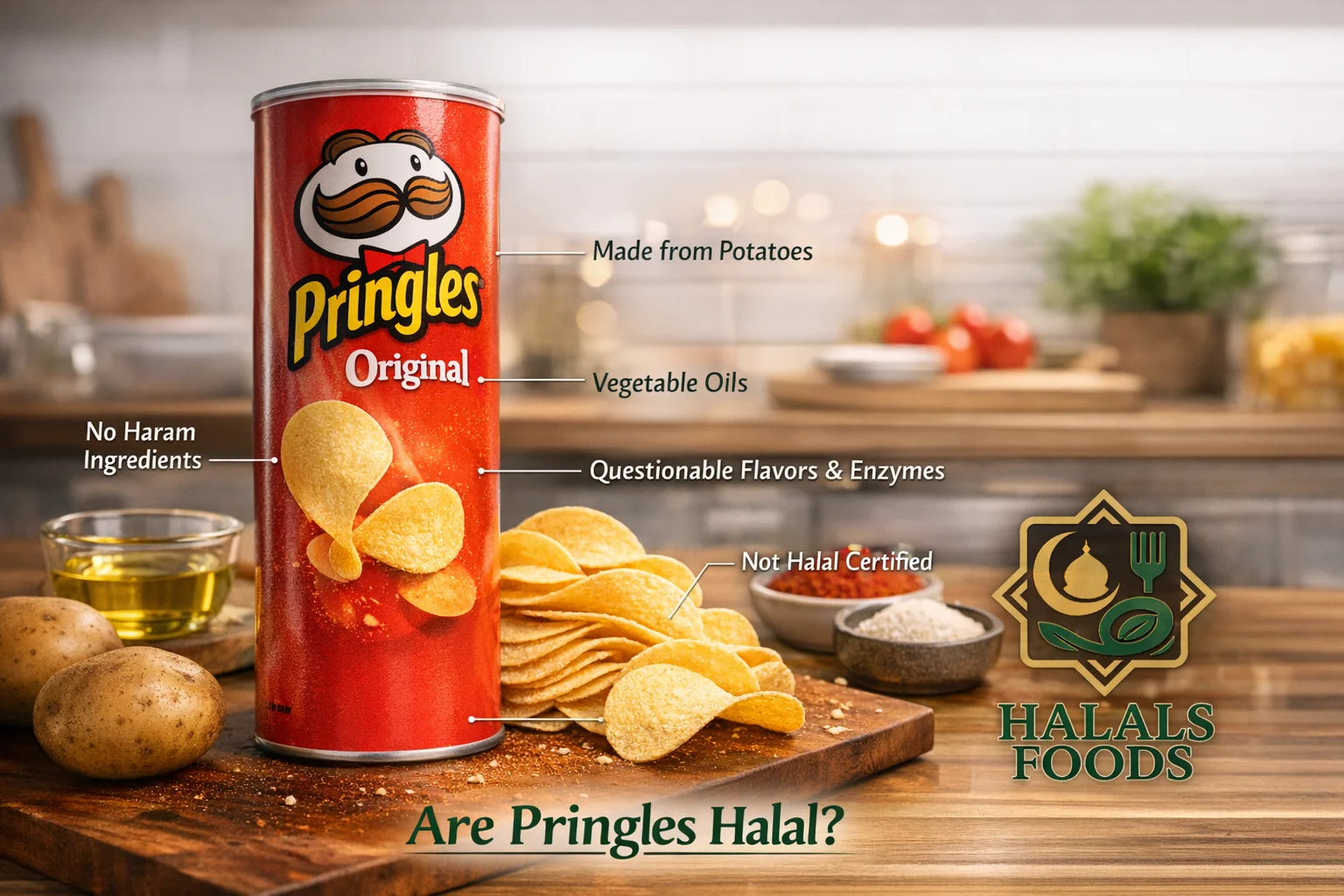
The ingredients list often looks simple at first glance:
- potatoes
- vegetable oil
- wheat starch
- rice flour
- seasoning
But once you start analyzing the seasoning systems and flavor ingredients, uncertainty appears very quickly.
That’s why the question Are Pringles halal keeps trending every year.
Especially in Western countries where halal certification is not mandatory.
First Important Thing: Pringles Are NOT Traditional Potato Chips
A lot of people assume Pringles are sliced potatoes like Lay’s or kettle chips.
They’re not.
Pringles are technically processed potato crisps.
The company uses dehydrated potato flakes mixed with starches, flours, oils, and water to create a dough-like mixture.
That mixture gets shaped into the famous curved chip design.
This manufacturing method changes everything because processed snack foods usually contain more additives than regular potato chips.
So immediately, Muslims begin asking:
- What are the flavorings made from?
- Are enzymes halal?
- Is alcohol used in flavors?
- Are the cheese ingredients permissible?
- Is there halal certification?
And those are valid questions.
The Core Ingredients Inside Pringles
Let’s start with the ingredients that are generally considered halal by most scholars and halal food experts.
Potatoes
Potatoes themselves are completely halal.
No issue here.
Pringles use dried potato flakes rather than fresh potato slices, but from an Islamic perspective, potatoes remain permissible.
Vegetable Oils
Pringles usually contain oils like:
- sunflower oil
- corn oil
- cottonseed oil
- soybean oil
These oils are generally halal unless mixed with animal fats.
Current ingredient labels in most Western countries do not mention animal fat in standard Pringles production.
So for most Muslims, the oil itself is not the main concern.
Wheat Starch & Rice Flour
These ingredients help create the crispy texture.
Since they are plant-based grain ingredients, they are considered halal.
Muslims with gluten sensitivities may still avoid them for health reasons, but halal-wise they are usually fine.
The Real Debate Starts With Flavorings
This is where the discussion about Are Pringles halal becomes serious.
You’ll often see ingredients listed like:
- natural flavors
- artificial flavors
- cheese seasoning
- whey powder
- dairy solids
And unfortunately, food companies rarely explain the exact source of these ingredients publicly.
That uncertainty changes the halal discussion completely.
What Does “Natural Flavor” Actually Mean?
Many Muslims think “natural flavor” means something simple and harmless.
But food labeling laws are surprisingly broad.
Natural flavors can include compounds derived from:
- plants
- dairy
- meat extracts
- fermentation processes
- enzyme reactions
In some cases, alcohol-based solvents are also used during flavor manufacturing.
Now, this doesn’t automatically make a product haram.
But it creates uncertainty.
And in Islamic dietary law, uncertainty matters.
That’s why some Muslims become cautious even when a product does not openly contain pork or alcohol.
Cheese Flavors Create Even Bigger Halal Concerns
This is probably the biggest issue with Pringles.
Flavors like:
- Cheddar Cheese
- Sour Cream & Onion
- Pizza
- Ranch
- Cheese Onion
often contain dairy ingredients such as:
- whey powder
- cheese cultures
- buttermilk
- lactose
- enzyme-modified cheese
Here’s the important part most people don’t realize:
Cheese itself is not always automatically halal.
The enzymes used to make cheese can come from different sources.
Some enzymes are:
✅ microbial
✅ plant-based
These are generally halal.
But others may come from animal rennet sources that are not slaughtered according to Islamic law.
And because Pringles usually does not specify the exact enzyme source publicly, many Muslims avoid cheese-based flavors entirely.
Which Pringles Flavors Are Usually Considered “Safer”?
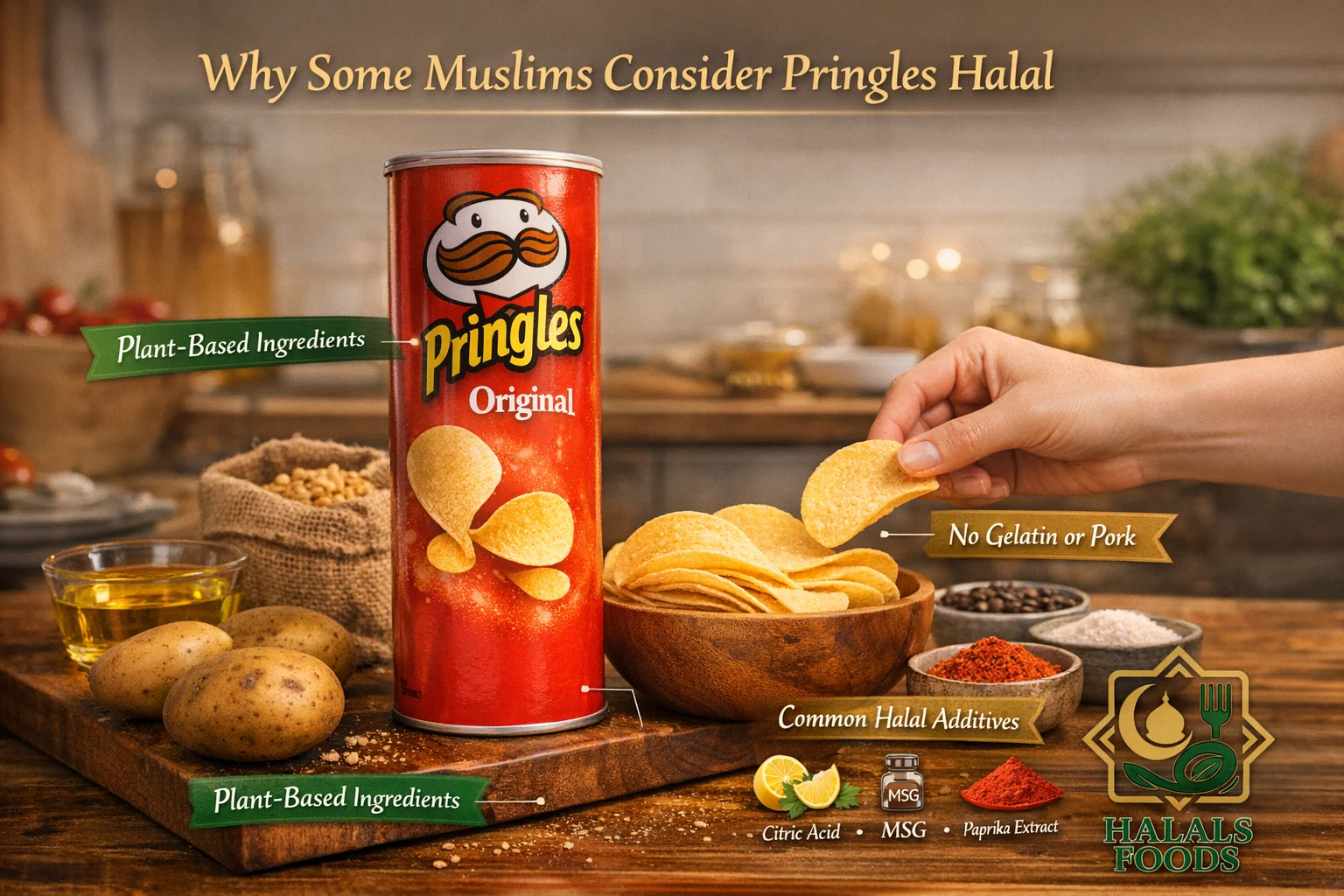
Some Muslims who eat Pringles usually stick to simpler flavors because they contain fewer questionable dairy systems.
Commonly chosen flavors include:
- Original
- Lightly Salted
- BBQ (depending on region)
But even here, opinions differ because flavoring systems still vary by country.
One country’s BBQ flavor may use different ingredients than another country’s version.
That’s why ingredient checking matters every single time.
Regional Differences Matter More Than People Think
This is honestly one of the biggest reasons online discussions become messy.
Pringles are manufactured globally.
That means:
- USA ingredients differ
- UK recipes differ
- Middle East production differs
- Asian production differs
In some Muslim-majority countries, companies produce halal-certified batches specifically for local markets.
But the exact same flavor sold in America may not carry halal certification at all.
So when someone online says:
“Pringles are halal in my country.”
That statement may be true locally but false somewhere else.
Are Pringles halal in the USA?
In the United States, most Pringles products are NOT officially halal-certified.
That’s the key point.
Now, does that automatically make them haram?
Not necessarily.
But it means:
- ingredient sourcing is not fully verified
- enzyme origins are unclear
- flavor systems are not audited for halal compliance
For Muslims who only consume certified halal foods, this becomes a dealbreaker.
For others who rely on ingredient analysis, certain flavors may still appear acceptable.
The Hidden Issue Many Muslims Forget: Flavor Carriers
Here’s a topic most snack articles never discuss.
Flavor compounds often require carrier systems during manufacturing.
These carriers help distribute flavor evenly across chips.
Some carriers may involve:
- alcohol traces
- fermentation compounds
- chemical solvents
Usually the final amount in food is extremely tiny.
Still, strict halal consumers often prefer avoiding products unless the manufacturer confirms halal compliance directly.
And because Pringles rarely provides detailed public halal documentation in Western markets, uncertainty remains.
Manufacturing & Shared Equipment Concerns
Another layer of the Are Pringles halal debate involves factory production.
Large snack factories commonly produce dozens of flavors on shared machinery.
That includes flavors containing:
- cheese
- dairy cultures
- meat-style flavorings
- spicy seasoning blends
Even if cross-contact is minimal, some Muslims prefer avoiding products produced on shared lines without halal oversight.
Halal-certified facilities normally follow stricter cleaning and separation procedures.
Without certification, consumers simply do not know the exact manufacturing controls being used.
Why Some Muslims Still Eat Pringles
Despite all these concerns, many Muslims still consider some Pringles flavors permissible.
Their reasoning usually includes:
1. No Pork Ingredients Listed
Most Pringles labels do not openly list pork, lard, or gelatin.
That gives many consumers confidence.
2. Majority Plant-Based Ingredients
The core recipe is heavily plant-based.
Potatoes, starches, grains, and oils make up most of the product.
3. Islamic Principle of Permissibility
Some scholars apply the principle that foods are considered halal unless clearly proven otherwise.
Since no explicit haram ingredient is confirmed publicly in many flavors, some Muslims choose permissibility.
4. Difficulty of Modern Food Systems
Processed food ingredients today are extremely complex.
Some Muslims believe it becomes too difficult to investigate every industrial additive unless clear evidence exists.
So they avoid overcomplicating uncertain foods.
Why Other Muslims Completely Avoid Pringles
On the other side, many Muslims avoid the brand entirely.
And their reasoning is also understandable.
They point to:
- unclear natural flavors
- unknown cheese enzymes
- absence of halal certification
- possible alcohol carriers
- shared manufacturing lines
For stricter halal observance, doubtful ingredients are enough reason to stay away.
Especially when halal-certified alternatives exist.
A Quick Look at Halal Certification
This part is extremely important.
Halal certification means independent Islamic organizations review:
- ingredients
- suppliers
- manufacturing processes
- contamination controls
- flavor sourcing
In America, respected halal organizations include:
- IFANCA
- ISA
- HFSAA
Most Pringles products in Western countries do not carry these certifications.
And that alone influences many Muslim consumers.
Here’s the Part Most People Ignore…
Two Muslims can research the exact same product and still reach different halal conclusions.
Why?
Because halal standards vary in strictness.
Some Muslims require:
✅ full halal certification
Others accept:
✅ ingredient analysis if no clear haram ingredient exists
That’s why debates about Are Pringles halal never fully disappear online.
And honestly, both sides usually have understandable reasoning behind their position.
That’s exactly why the debate around Are Pringles halal keeps growing every year.
Some Muslims look at the ingredient list and think:
“It’s mostly potatoes and oil. Seems fine.”
Others see terms like “natural flavors” and immediately become cautious.
And honestly, both reactions are understandable.
Because when it comes to processed foods, the real issue is often not the main ingredient — it’s the tiny additives most people never notice.
Which Pringles Flavors Raise the Most Halal Concerns?
Not all Pringles flavors carry the same level of concern.
Some are relatively simple.
Others contain multiple dairy compounds, enzyme systems, and flavor blends that create uncertainty.
Let’s break this down properly.
Lower-Concern Pringles Flavors
These are usually the flavors Muslims feel more comfortable with because the ingredient lists are simpler and contain fewer dairy-based additives.
Original Pringles
This is the flavor most commonly discussed in halal forums.
Typical ingredients include:
- dried potatoes
- vegetable oils
- wheat starch
- rice flour
- salt
At first glance, nothing obviously haram appears here.
That’s why many Muslims consider Original Pringles the “safest” option within the brand.
However…
Even Original Pringles are usually not halal-certified in Western countries.
So strict halal consumers may still avoid them due to lack of verification.
Lightly Salted Varieties
These also tend to contain simpler ingredient systems with fewer questionable flavor compounds.
Again, the issue is not obvious haram ingredients.
The issue is incomplete transparency.
Some BBQ Flavors
This becomes complicated because BBQ seasoning differs heavily by country.
In one region, BBQ seasoning may be fully plant-based.
In another region, it could contain smoke flavor compounds or meat-derived extracts.
So Muslims should never assume BBQ flavors are identical globally.
Always check the exact ingredient label from your country.
Higher-Concern Pringles Flavors
These are the varieties many halal-conscious Muslims avoid completely.
Cheese Flavors
Examples include:
- Cheddar Cheese
- Cheese Onion
- Four Cheese
- Pizza Cheese
These often contain:
- whey powder
- cheese solids
- milk proteins
- enzyme-modified cheese
And here’s the major concern again:
The enzyme source is rarely explained publicly.
Without halal certification, Muslim consumers cannot easily verify whether those enzymes came from halal-approved sources.
Sour Cream & Onion
This flavor is one of the most debated online.
It usually contains:
- sour cream solids
- whey ingredients
- cultured dairy compounds
- flavor enhancers
Some Muslims eat it based on ingredient assumptions.
Others avoid it because dairy cultures and enzymes remain unclear.
Bacon or Ham Styled Flavors
In some international markets, Pringles has released flavors inspired by bacon or meat-style seasonings.
Even if these flavors are artificially created, many Muslims still avoid them because:
- flavor origins may be uncertain
- animal extracts could be involved
- cross-contamination concerns increase
For most halal-conscious consumers, these flavors are generally avoided entirely.
Why Halal Certification Changes Everything
One halal logo can remove almost all uncertainty.
That’s why certified snacks are becoming increasingly popular among Muslims in the USA and Europe.
When a product becomes halal-certified, it usually means:
- ingredients are audited
- suppliers are checked
- enzymes are verified
- flavor systems are reviewed
- contamination controls are monitored
Without certification, consumers are left trying to investigate ingredients themselves.
And honestly, regular shoppers usually cannot trace industrial flavor supply chains.
That’s the difficult reality.
Are Pringles halal in Different Countries?
This is one of the most important sections because halal status can vary globally.
A product made in Malaysia may follow very different standards compared to one made in America.
United States
In the USA:
- most Pringles are not halal-certified
- ingredient sourcing is not fully disclosed
- cheese enzymes remain unclear
Many American Muslims therefore follow one of two approaches:
Approach 1:
Avoid entirely unless certified.
Approach 2:
Eat simpler flavors after reviewing ingredients carefully.
Both approaches are common.
United Kingdom
The UK Muslim community has debated Pringles for years.
Some Muslims consume selected flavors after checking ingredients.
Others avoid the brand due to lack of official halal approval.
The UK market also tends to use more E-number labeling, which causes additional confusion for some consumers.
Middle East
This changes the situation significantly.
In some Gulf countries, manufacturers produce halal-certified batches specifically for local markets.
So a Pringles can sold in Dubai may not be identical to one sold in New York.
This is why Muslims should never rely only on internet opinions from other countries.
Always check the packaging sold in your own region.
Malaysia & Indonesia
These countries maintain stricter halal market standards.
Certain imported or locally produced Pringles products may carry recognized halal logos there.
Again, certification depends on the factory and production chain.
The “Natural Flavors” Debate Explained Simply
A lot of Muslims hear this term but don’t fully understand why it matters.
So let’s simplify it.
Food companies are legally allowed to group many compounds under “natural flavor.”
That could include:
- plant extracts
- dairy reactions
- smoke compounds
- fermentation derivatives
- enzyme-treated ingredients
Sometimes even tiny alcohol-based solvents are used during processing.
Now, important clarification:
This does NOT automatically mean Pringles contain intoxicating alcohol in the normal sense.
The issue is mostly about processing transparency.
Strict halal consumers often prefer complete clarity rather than uncertainty.
That’s why “natural flavors” becomes a major discussion point.
What About MSG and Additives?
Many Muslims also ask whether additives inside Pringles are halal.
Common additives may include:
- MSG (E621)
- citric acid
- paprika extract
- colorings
- acidity regulators
Most mainstream halal ingredient databases classify these as generally permissible.
MSG itself is usually produced through fermentation and is widely accepted as halal.
So additives are usually not the main problem.
The larger concern remains flavor sourcing and enzyme origin.
Are Pringles Vegan? And Does That Mean Halal?
This is where people sometimes get confused.
A vegan product avoids animal ingredients.
But halal standards go beyond that.
For example:
A snack may be vegan but still involve:
- alcohol-based processing
- contamination concerns
- doubtful flavor systems
So vegan does not always equal halal.
Still, vegan-friendly flavors are often considered lower risk compared to cheese-based varieties.
That’s why many Muslims lean toward vegan or plain flavors when buying processed snacks.
The Psychology Behind Why Muslims Disagree on Processed Foods
This is actually very interesting.
When Muslims discuss products like Pringles online, the disagreement usually comes from different halal philosophies.
Some prioritize:
Maximum Caution
Their view is:
“If certification is missing and ingredients are unclear, avoid it.”
This approach follows stronger precaution.
Others prioritize:
Ingredient-Based Judgment
Their view is:
“If no clearly haram ingredient is proven, the product remains permissible.”
This approach focuses on the default permissibility principle.
Neither side is randomly inventing opinions.
They are applying different levels of caution within Islamic dietary reasoning.
That’s why discussions about Are Pringles halal often become so divided.
Better Halal Alternatives to Pringles
Many Muslims eventually decide:
“Why stay confused when halal-certified chips exist?”
And honestly, that’s becoming more common now.
Here are some popular alternatives Muslims often choose instead.
1. Halal-Certified Potato Chip Brands
Some regional snack companies now specifically target halal consumers.
These usually carry recognized halal logos directly on packaging.
That removes uncertainty immediately.
2. Kettle-Style Chips
Simple kettle chips with minimal ingredients are often easier to verify.
Especially flavors containing only:
- potatoes
- oil
- salt
The fewer additives involved, the easier halal analysis becomes.
3. Vegetable Chips
Many Muslims now prefer vegetable-based snacks with cleaner ingredient lists.
Still important to check flavorings, of course.
4. Muslim-Owned Snack Brands
This market is growing quickly in North America.
Some Muslim-owned brands now produce:
- halal-certified chips
- popcorn
- cheese snacks
- spicy crisps
with full ingredient transparency.
What Scholars Usually Recommend
Most scholars encourage Muslims to follow these principles:
If Ingredients Are Clearly Halal
The product is generally permissible.
If Ingredients Are Clearly Haram
Avoid completely.
If Ingredients Are Doubtful
The cautious approach is preferable.
This is where many scholars place products like uncertified processed snacks.
Especially when flavor systems are unclear.
Practical Advice for Muslims Buying Pringles
Instead of relying only on TikTok opinions or random comments online, here’s a smarter approach.
Step 1: Check the Flavor Carefully
Plain flavors usually raise fewer concerns than cheese-heavy varieties.
Step 2: Look for Halal Certification
This is the easiest way to remove doubt.
Step 3: Review Regional Packaging
Ingredients differ by country.
Step 4: Decide Your Personal Halal Standard
Some Muslims only consume certified foods.
Others use ingredient analysis.
Know your comfort level and stay consistent.
So… Are Pringles halal?
After reviewing ingredients, manufacturing concerns, flavor systems, certification status, and regional differences, the honest answer is:
It depends on the flavor, country, and your level of halal caution.
Here’s the simplest breakdown possible:
Some Muslims Consider Certain Flavors Halal Because:
- core ingredients are mostly plant-based
- no obvious pork ingredients appear
- some flavors seem relatively simple
- Islamic permissibility principles may apply
Other Muslims Avoid Pringles Because:
- halal certification is usually missing
- natural flavors are unclear
- dairy enzyme sources are unknown
- cross-contamination concerns exist
The Safest Conclusion
If you want maximum certainty, halal-certified snacks remain the safest option.
If you personally follow ingredient-based analysis, simpler Pringles flavors may appear acceptable to you after reviewing labels carefully.
But cheese-heavy or meat-style flavors usually create the biggest halal concerns.
Final Verdict on Are Pringles halal
Pringles are not universally halal-certified in most Western countries, and that’s the main reason the debate continues.
The core potato ingredients themselves are generally halal.
However, uncertainty appears in:
- flavor systems
- cheese enzymes
- natural flavor sourcing
- manufacturing transparency
Because of this, Muslims reach different conclusions depending on their halal standards.
For strict observance, certified alternatives are the safest path.
For others, certain plain flavors may be considered acceptable after ingredient review.
At the end of the day, every Muslim tries to make the most responsible choice with the information available.
And honestly, that’s the important part.
Frequently Asked Questions About Are Pringles halal
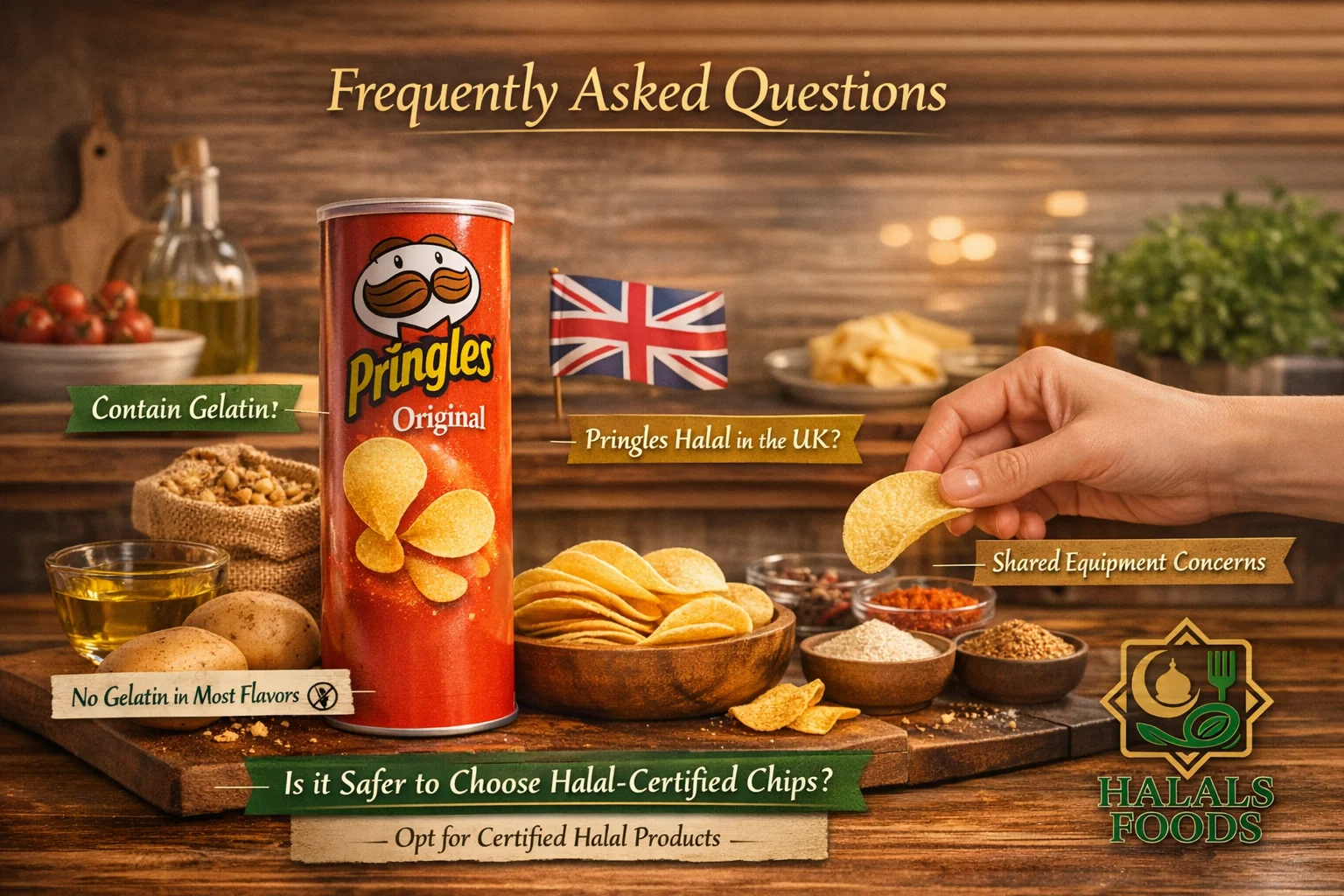
Do Pringles contain pork?
Most standard Pringles ingredient lists do not openly list pork or lard ingredients.
However, flavor systems may still contain doubtful components depending on the variety.
Are Original Pringles halal?
Original flavor is usually considered lower concern because its ingredients are simpler and mostly plant-based.
Still, it often lacks halal certification in Western countries.
Are cheese Pringles halal?
Cheese flavors create more concern because enzyme origins used in dairy production are often not disclosed publicly.
Are Pringles halal in the USA?
Most Pringles sold in America are not officially halal-certified.
Opinions therefore differ among Muslim consumers.
Why do Muslims disagree about Pringles?
The disagreement mainly comes from different levels of halal caution regarding unclear ingredients and certification.
Related Halal Food Guides You May Find Helpful
People searching for “Is [ Is Starburst Halal or Doubtful? ]” are also curious about other foods and ingredients. Below, you’ll find related halal food articles that clearly explain ingredient sources, how products are made, and whether they meet halal requirements.
People searching for “Is [ Are Sour Patch Kids Halal? ]” are also curious about other foods and ingredients. Below, you’ll find related halal food articles that clearly explain ingredient sources, how products are made, and whether they meet halal requirements.
More : [ Are Jolly Ranchers Halal ]
More : [ Is Skittles Halal? ]
More : [ Are Doritos Halal? ]
More : [ Best Halal Chips in Walmart ]