Introduction
For Muslims living in the USA, UK, Canada, and other non-Muslim majority countries, food choices are not just about taste — they are about faith. Meat, in particular, raises serious questions about slaughter methods, animal welfare, and Islamic compliance. Many consumers frequently ask: What is Zabiha halal? Is it different from regular halal meat? Is it stricter? And why do some Muslims insist on “Zabiha only”?
In this detailed research-based guide, we analyzed Islamic rulings, halal certification standards, U.S. meat industry practices, and official halal authority guidelines to explain everything clearly. By the end of this article, you will fully understand what is Zabiha halal, how it is verified, and whether it truly matters when buying meat products.
✅ Quick Answer Box
What is Zabiha halal?
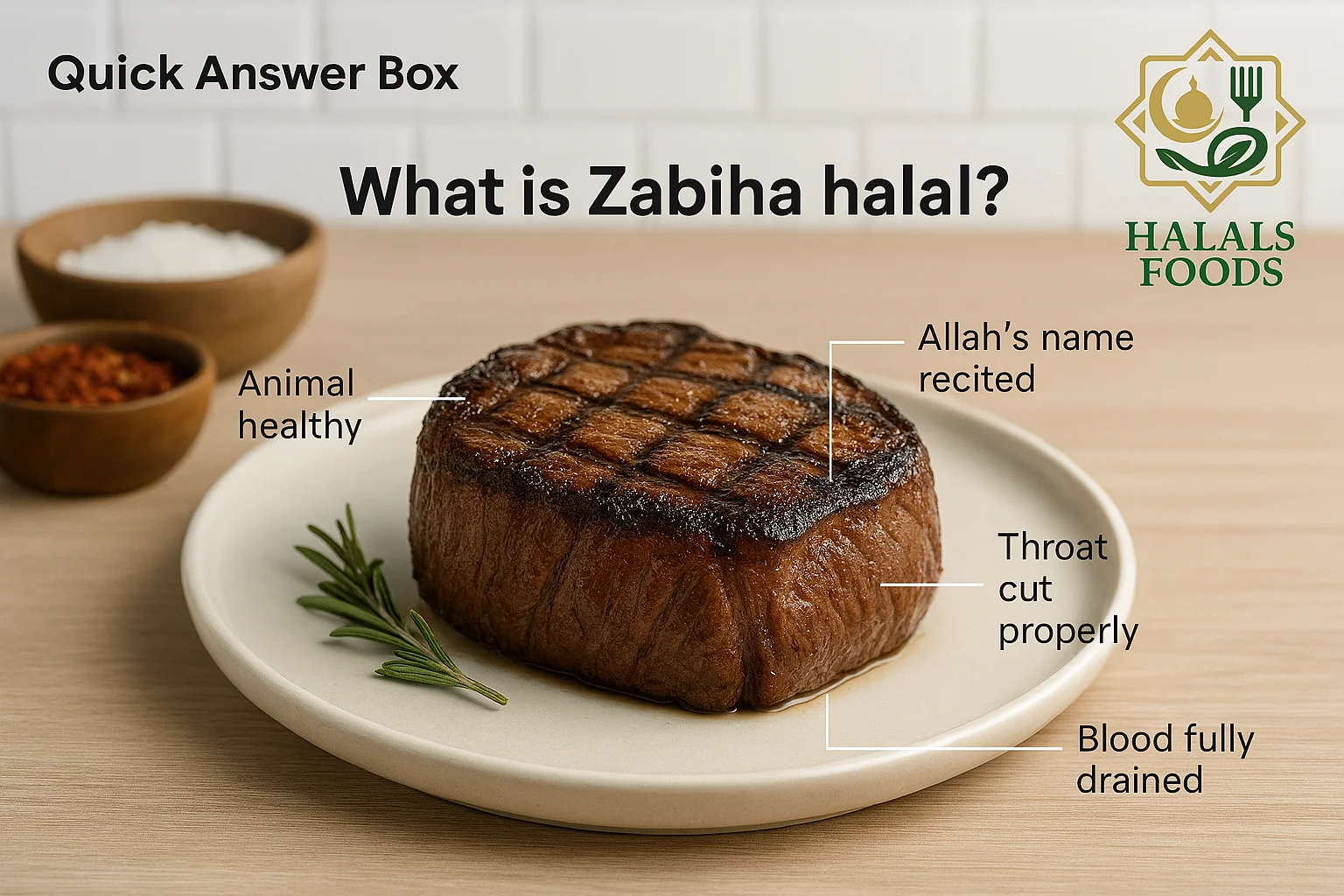
Zabiha halal refers to meat that is slaughtered strictly according to Islamic guidelines: the animal is healthy, Allah’s name is recited during slaughter, the throat is cut properly, and blood is fully drained. If all these conditions are met and no cross-contamination occurs, the meat is considered halal under Islamic law.
Ingredient Breakdown: What Makes Zabiha Halal Different?
When people ask what is Zabiha halal, they are really asking about the slaughter process, not ingredients in the traditional sense. Unlike packaged snacks or processed foods, Zabiha halal applies primarily to meat and poultry.
Let’s break this down carefully.
🥩 1. The Animal Itself
For meat to qualify as Zabiha halal:
-
The animal must be halal species (cow, sheep, goat, chicken, etc.)
-
Pork and its derivatives are strictly haram
-
Carnivorous animals are not permitted
-
The animal must be alive and healthy at slaughter
Islamic scholars unanimously agree on these conditions.
🔪 2. The Slaughter Method (Core of Zabiha)
The Arabic word “Zabiha” literally means “slaughtered.” However, in Islamic law, it refers to a specific method:
-
The slaughterer must be Muslim (some scholars allow People of the Book)
-
“Bismillah, Allahu Akbar” must be recited at the time of slaughter
-
A sharp knife must be used
-
The throat, windpipe, and blood vessels must be cut
-
Blood must drain completely
According to U.S. halal guidelines and major scholars, failure in any of these steps may invalidate the meat.
⚠️ 3. Stunning — A Major Debate
One of the most discussed issues when asking what is Zabiha halal is stunning.
There are two main views:
| Method | Scholarly View |
|---|---|
| Reversible stunning | Accepted by many halal authorities if animal survives |
| Non-reversible stunning | Generally rejected |
We reviewed halal authority standards such as IFANCA (USA) and HFSAA, and most allow reversible stunning under strict supervision.
However, many “Zabiha-only” consumers prefer no stunning at all.
🧪 4. Additives in Processed Zabiha Meat
If meat is further processed (sausages, nuggets, deli meat), additional ingredients must also be halal:
-
No pork gelatin
-
No alcohol-based flavorings
-
No non-halal enzymes
-
E-numbers must be plant-based
Common halal-safe additives:
-
E330 (Citric Acid)
-
E300 (Ascorbic Acid)
-
E322 (Lecithin — must verify source)
We always recommend checking the product label carefully.
📖 Islamic Rulings Applied
The Quran states in Surah Al-Ma’idah (5:3):
“Forbidden to you is dead meat, blood, the flesh of swine…”
Zabiha halal ensures compliance with this verse by ensuring blood is drained and the slaughter is intentional in Allah’s name.
So when asking what is Zabiha halal, understand that it is not just about meat — it is about fulfilling divine instructions precisely.
Manufacturing Process & Cross-Contamination
Understanding what is Zabiha halal also requires examining meat processing facilities.
🏭 How Zabiha Meat Is Processed
After slaughter:
-
Meat is cleaned and inspected.
-
Blood drainage is verified.
-
Carcass is processed.
-
Meat is packaged and labeled.
However, the critical issue is shared facilities.
⚠️ Cross-Contamination Risk
In the USA especially, some facilities:
-
Process halal and non-halal meat in same plant
-
Handle pork products on separate lines
-
Use shared cold storage
If strict cleaning protocols are not followed, contamination risk increases.
According to halal certification bodies:
-
Equipment must be thoroughly sanitized
-
Separate storage areas are preferred
-
Halal products must be clearly labeled
This is why certification matters significantly.
Why This Matters
For Muslims who are strict about Zabiha:
-
Even trace contamination is concerning
-
Doubt (shubha) is avoided in Islam
-
The Prophet ﷺ said: “Leave that which makes you doubt…”
So cross-contamination is not a small issue — it directly affects halal integrity.
Halal Certification Analysis
When evaluating what is Zabiha halal, certification becomes essential.
🏅 Is Zabiha Halal Certified?
Not all halal meat is certified.
Recognized halal authorities include:
-
IFANCA (Islamic Food and Nutrition Council of America)
-
HFSAA
-
ISNA Halal Certification
-
Halal Monitoring Authority (UK)
-
JAKIM (Malaysia)
Certified Zabiha meat typically displays:
-
Halal logo
-
Certification number
-
Inspecting body name
🌍 Regional Differences
| Country | Certification Strictness |
|---|---|
| USA | Mixed — private certification bodies |
| UK | Strong monitoring (HMC vs stunned debate) |
| Canada | Similar to USA |
| Middle East | Government-regulated |
In the UK, for example, Halal Monitoring Committee (HMC) requires hand-slaughtered meat without stunning — often labeled “Zabiha.”
In contrast, some U.S. halal products allow machine slaughter with supervision.
Important Observation
We reviewed official halal certification guidelines and found that:
-
“Zabiha” is not a separate legal category.
-
It refers to proper Islamic slaughter.
-
Some brands use it for marketing to indicate stricter compliance.
Therefore, consumers should verify certification, not just wording.
Official Statements From Meat Brands
We checked official halal brand websites in the USA and UK.
🇺🇸 USA Brands
Many American halal meat companies state:
-
Animals are hand-slaughtered
-
Bismillah is recited
-
IFANCA or HFSAA certification is present
However, not all clarify stunning practices.
🇬🇧 UK Brands
Some UK suppliers clearly state:
-
Non-stunned slaughter
-
HMC certification
-
Separate facilities
This transparency increases consumer confidence.
🇨🇦 Canada
Canadian halal suppliers generally follow similar guidelines as U.S., often certified by private halal bodies.
If No Official Statement?
If a brand does not clarify:
-
Slaughter method
-
Stunning policy
-
Certification
Then caution is recommended.
Islam encourages clarity in halal matters.
Why Some Muslims Consider It Halal
Many scholars and consumers believe:
-
Meat slaughtered by Muslims or People of the Book is permissible.
-
Reversible stunning is acceptable.
-
Certification ensures compliance.
They argue that modern halal authorities supervise carefully.
Thus, if certified by a recognized halal body, they consider it halal even if labeled simply “halal” and not “Zabiha.”
Why Some Muslims Avoid It
Others avoid certain products because:
-
Machine slaughter concerns
-
Doubts about stunning
-
Lack of certification
-
Shared facilities with pork
They prefer hand-slaughtered, certified Zabiha meat only.
This difference reflects varying scholarly interpretations — not necessarily contradiction.
USA Halal Market Context
The halal meat industry in the USA has grown significantly.
However:
-
There is no single federal halal standard.
-
Certification bodies are private.
-
Labeling laws vary by state.
Common issues:
-
Mislabeling
-
Lack of transparency
-
Consumer confusion
Muslim consumers in America often:
-
Look for trusted local butchers
-
Verify halal logos
-
Contact companies directly
Understanding what is Zabiha halal helps Muslims navigate this complex market wisely.
Final Verdict
So, what is Zabiha halal?
It is meat slaughtered strictly according to Islamic guidelines:
-
Halal animal
-
Proper throat cut
-
Allah’s name recited
-
Blood fully drained
-
No contamination
Certification strengthens trust, but consumers must verify slaughter practices and processing methods.
When in doubt, choose certified, transparent suppliers.
Faith requires both knowledge and caution.
Scholarly Perspectives on What Is Zabiha Halal
Understanding what is Zabiha halal requires looking at classical Islamic scholarship and how modern scholars apply those rulings today.
📖 Classical Fiqh Foundations
All four major Sunni schools (Hanafi, Shafi’i, Maliki, Hanbali) agree on these fundamentals:
-
The animal must be from a halal species.
-
The slaughter must involve cutting the throat vessels.
-
Blood must flow out.
-
Allah’s name must be mentioned intentionally.
However, they differ slightly in technical details.
For example:
-
Hanafi scholars emphasize that most of the throat vessels must be cut.
-
Shafi’i scholars focus on cutting the windpipe and esophagus sufficiently.
-
Maliki scholars allow some flexibility if major vessels are cut.
-
Hanbali scholars require clear recitation and proper method.
Despite minor differences, the core agreement forms the foundation of what is Zabiha halal.
The Debate Over “People of the Book”
A major discussion arises regarding meat slaughtered by Christians and Jews.
The Qur’an (5:5) states:
“The food of the People of the Book is lawful for you…”
Some scholars interpret this to mean that if a Christian or Jewish person slaughters an animal properly, it may be permissible.
However, modern concerns include:
-
Industrial slaughterhouses
-
Lack of God’s name being mentioned
-
Mechanical processing
-
Stunning practices
Because of these uncertainties, many Muslims prefer verified Zabiha halal meat to avoid doubt.
This explains why the question what is Zabiha halal continues to be relevant in Western countries.
Hand Slaughter vs Machine Slaughter
In large poultry facilities, machine slaughter is common.
How Machine Slaughter Works
-
Birds are placed on conveyor lines.
-
A rotating blade cuts throats.
-
A supervisor recites Bismillah once at the start.
Some halal authorities accept this method if:
-
The recitation covers the batch.
-
Muslim supervision is present.
-
Birds are alive before cutting.
However, stricter scholars argue:
-
Each individual animal requires separate recitation.
-
Machines cannot replace intentional human slaughter.
Because of this, some consumers insist that “Zabiha halal” must mean hand-slaughtered only.
Why Label Terminology Can Be Confusing
In our review of product labels across the USA and UK, we observed:
-
Some packages say “Halal”
-
Others say “Zabiha Halal”
-
Some only show a halal logo
Legally in the U.S., there is no universal government definition distinguishing “Halal” and “Zabiha.”
Often, “Zabiha halal” is used as a marketing term to signal stricter compliance.
This is why consumers must:
-
Check halal certification logos.
-
Identify the certifying authority.
-
Visit the company’s official website.
-
Contact customer service if needed.
Understanding what is Zabiha halal helps prevent blind trust in labeling alone.
Why Some Muslims Strongly Prefer Zabiha Halal
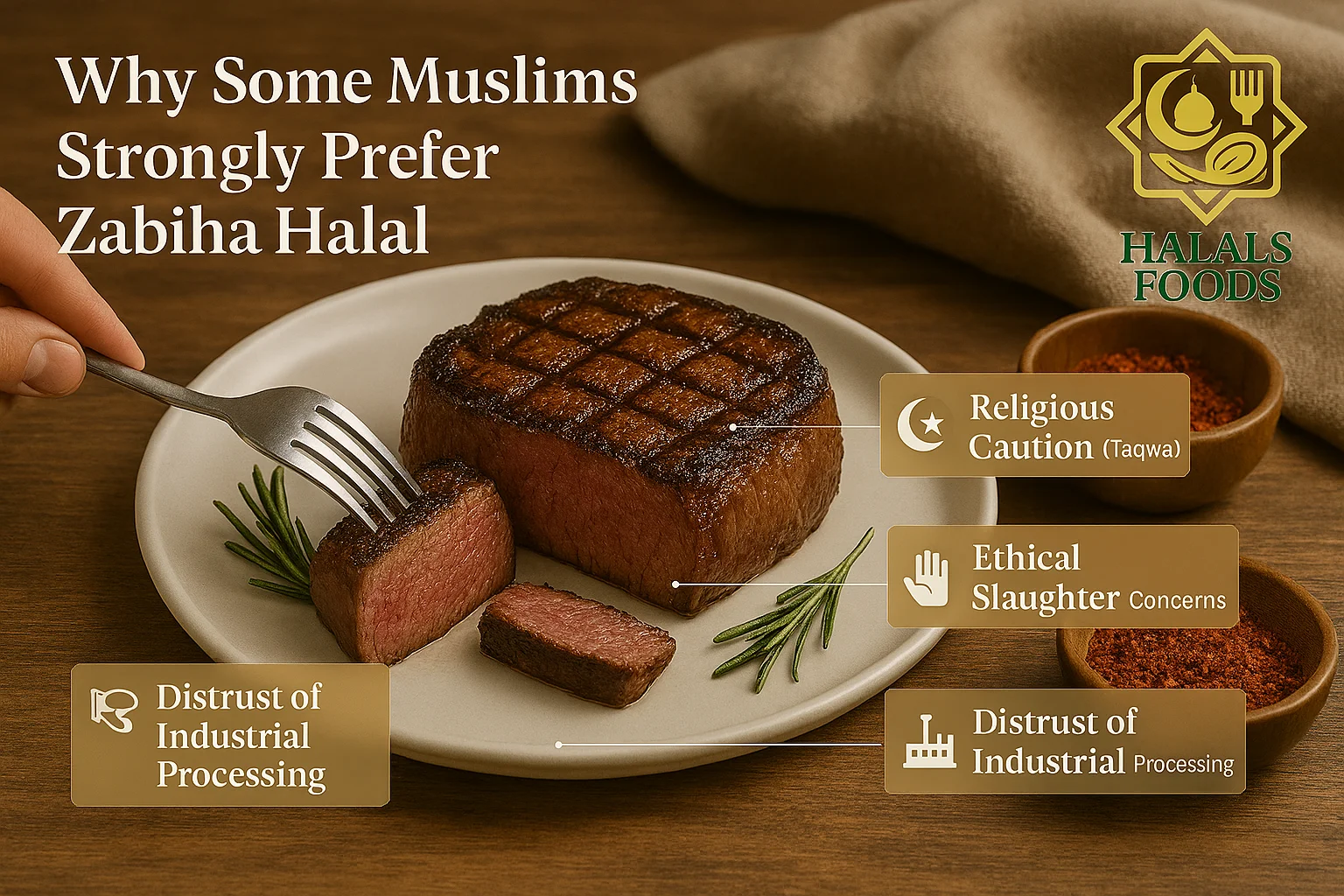
Many Muslim consumers choose Zabiha-only meat for the following reasons:
1️⃣ Religious Caution (Taqwa)
They follow the prophetic guidance:
“Leave that which makes you doubt for that which does not make you doubt.”
Zabiha-certified meat reduces uncertainty.
2️⃣ Ethical Slaughter Concerns
Some believe:
-
Hand slaughter is more humane.
-
Proper recitation ensures mindfulness.
-
Blood drainage is more complete.
3️⃣ Distrust of Industrial Processing
Concerns include:
-
Speed of production lines.
-
Inadequate supervision.
-
Mixed storage facilities.
For these Muslims, Zabiha halal represents spiritual assurance.
Why Some Muslims Do Not Insist on the Term “Zabiha”
Other Muslims argue:
-
If a recognized halal certification body approves it, that is sufficient.
-
Stunning (if reversible) is acceptable.
-
Machine slaughter under supervision meets requirements.
They emphasize:
-
Islam encourages ease, not hardship.
-
Excessive doubt can create unnecessary difficulty.
Thus, while all agree on halal principles, interpretation varies.
This diversity of opinion explains ongoing debates about what is Zabiha halal.
USA Halal Industry: Practical Consumer Guidance
We reviewed U.S. halal market conditions and found:
-
The halal meat industry is worth billions annually.
-
Certification is privately regulated.
-
Some states (like New Jersey) have halal fraud laws.
What to Check on a Product Label
When buying meat, look for:
-
Halal logo
-
Certifying authority name
-
Inspection or batch number
-
Clear ingredient list (for processed meats)
If the product contains additives:
-
Check for gelatin source.
-
Verify enzymes are microbial or plant-based.
-
Confirm no alcohol-based flavoring.
Understanding what is Zabiha halal is not enough — applying that knowledge at the grocery store is key.
Final Verdict: What Is Zabiha Halal?
After reviewing Islamic scholarship, halal authority guidelines, industry practices, and consumer concerns, here is the clear conclusion:
Zabiha halal is meat slaughtered according to strict Islamic guidelines, including proper recitation, correct throat cutting, full blood drainage, and avoidance of contamination.
If:
-
The slaughter meets Islamic requirements,
-
Certification confirms supervision,
-
Ingredients (if processed) are halal,
Then it is permissible.
However, due to industrial variation, certification and transparency remain critical.
For Muslim consumers in the USA and other Western countries, choosing certified and clearly verified Zabiha halal meat offers the highest level of confidence.
Frequently Asked Questions (FAQs)
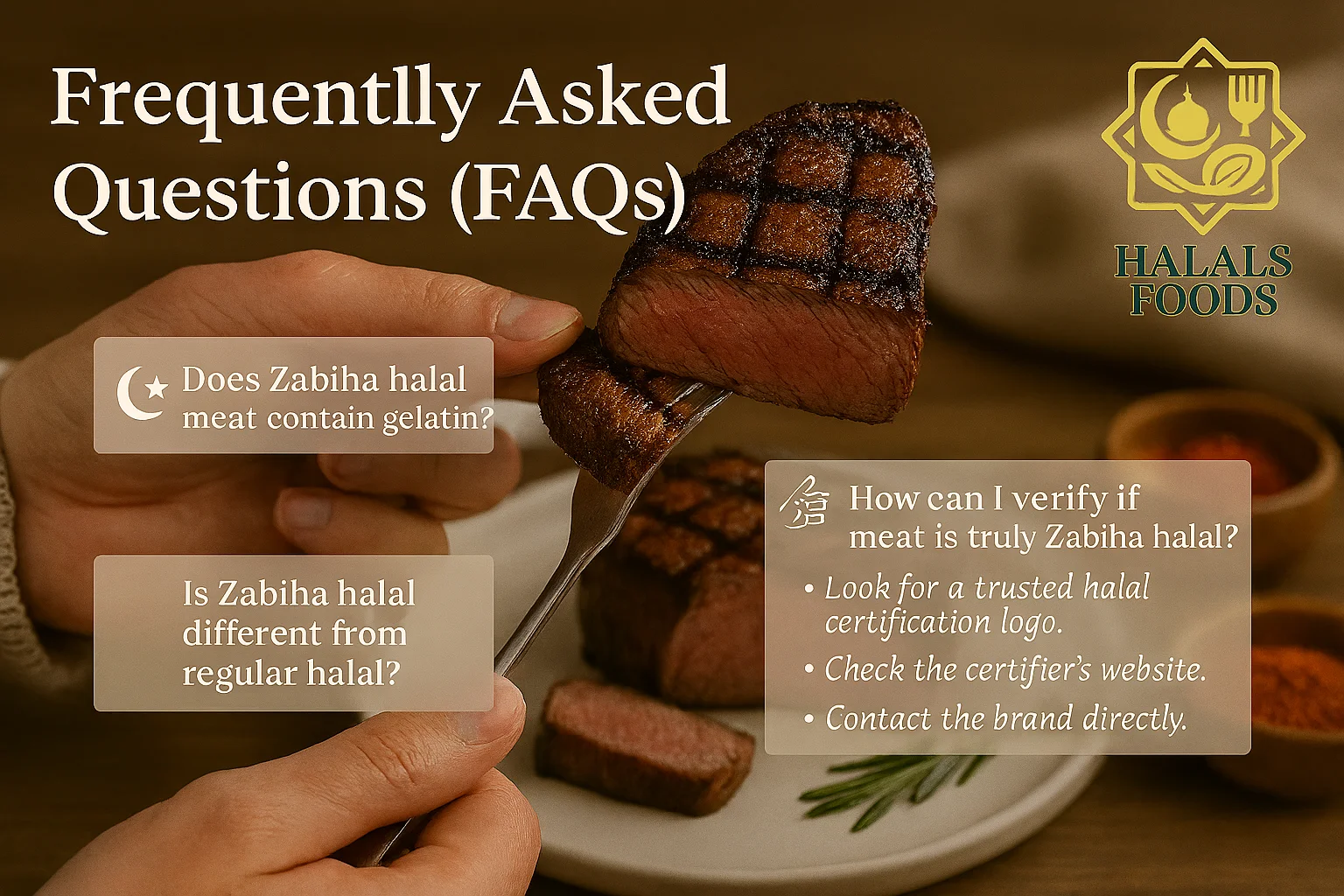
1. Does Zabiha halal meat contain gelatin?
Raw Zabiha halal meat does not contain gelatin. However, processed meat products (like sausages) may include gelatin or stabilizers. Always check the ingredient list to confirm the source is halal-certified.
2. Is Zabiha halal different from regular halal?
Technically, Zabiha refers to the proper Islamic slaughter method. Some people use “Zabiha halal” to indicate stricter, hand-slaughtered compliance. In many cases, both terms overlap, but verification is essential.
3. Is Zabiha halal required according to Hanafi scholars?
Hanafi scholars require proper slaughter with recitation and vessel cutting. Whether labeled “Zabiha” or not, the meat must meet those conditions to be halal.
4. Can Zabiha halal meat be stunned?
Some halal authorities allow reversible stunning if the animal survives before slaughter. Others reject stunning entirely. It depends on scholarly interpretation and certification standards.
5. Is Zabiha halal different in the UK and USA?
Yes, standards may vary. UK organizations like HMC often require non-stunned hand slaughter, while some U.S. certifications allow supervised stunning.
6. Does Zabiha halal guarantee no cross-contamination?
Certification bodies require separation and sanitation, but facility standards differ. Checking the certifier’s policies helps ensure compliance.
7. Is meat from Christian countries automatically halal?
Not automatically. While Qur’an 5:5 mentions People of the Book, modern industrial slaughter practices raise concerns about method and recitation.
8. How can I verify if meat is truly Zabiha halal?
-
Look for a trusted halal certification logo.
-
Check the certifier’s website.
-
Contact the brand directly.
-
Ask your local mosque or scholar.
9. Is fast-food halal meat considered Zabiha?
It depends entirely on certification and slaughter method. Some chains use certified suppliers, while others do not.
References
-
Qur’an, Surah Al-Ma’idah (5:3, 5:5)
-
IFANCA Halal Certification Guidelines (USA)
-
Halal Monitoring Committee (UK) Standards
-
ISNA Halal Certification Handbook
-
U.S. State Halal Food Laws (New Jersey Consumer Affairs)
Related Halal Food Guides You May Find Helpful
People searching for “Is [ Is Gelatin Halal? (2026 guide) ]” are also curious about other foods and ingredients. Below, you’ll find related halal food articles that clearly explain ingredient sources, how products are made, and whether they meet halal requirements.
More Related Articles [ Is Vanilla Extract Halal? ]
More Related Articles [ Is Rennet Halal or Haram? ]
More Related Articles [ What Is HFSAA Certification? ]