Walking through a grocery store sounds simple until you actually start reading ingredient labels carefully. That is where many Muslims suddenly realize something uncomfortable — modern food products are filled with ingredients most people cannot even pronounce, let alone identify as halal or haram.
A yogurt may look harmless.
A candy may say “natural flavors.”
A bread package may only mention “enzymes.”
But here’s the part many people ignore…
The real issue is not always the food itself. The issue is the hidden source behind the ingredients.
Today, food manufacturing is global, industrial, and extremely complex. One ingredient can come from plants, synthetic chemicals, pork fat, insects, alcohol solvents, or non-halal animal sources — and the label often does not clearly tell you which one.
That is why understanding Haram ingredients to avoid has become more important than ever for Muslims living in the USA, UK, Canada, and other non-Muslim majority countries.
Some ingredients are clearly haram.
Some are doubtful.
Some depend on scholarly interpretation.
And honestly, that confusion is exactly why many Muslims feel stressed while shopping.
This guide breaks everything down in simple language so you can understand what actually matters, what to watch for, and how to make smarter halal choices without becoming overwhelmed.
Why Understanding Haram ingredients to avoid Matters Today
Years ago, food was simpler.
People bought meat from local butchers, bread from bakeries, and fresh ingredients from markets. You usually knew where your food came from.
Now?
One frozen pizza can contain over 40 ingredients sourced from multiple countries.
Even products labeled “vegetarian” may still contain questionable additives, alcohol-based flavorings, or animal-derived processing agents.
This creates a serious challenge for Muslims trying to follow halal dietary rules sincerely.
Islam does not only focus on avoiding pork. The halal system also includes:
- Clean sourcing
- Proper slaughter methods
- Avoiding intoxication
- Preventing impurity contamination
- Ethical consumption
That is why learning about Haram ingredients to avoid is not being “too strict.” It is simply part of practicing conscious halal eating.
The Biggest Mistake Muslims Make When Reading Labels
Many people only search for one word:
“Pork.”
If they do not see pork listed, they assume the product is halal.
Unfortunately, food companies rarely use simple words anymore.
Instead, they use technical ingredient names like:
- Gelatin
- Mono- and diglycerides
- Lipase
- Pepsin
- Rennet
- Carmine
- Glycerin
- Natural flavors
And this is where things get tricky.
For example:
Gelatin can come from:
- Pork skin
- Beef bones
- Fish collagen
The label may simply say “gelatin.”
No explanation.
No source.
Nothing.
That uncertainty is why many scholars classify unclear ingredients as mashbooh (doubtful).
Clear Haram ingredients to avoid According to Islamic Teachings
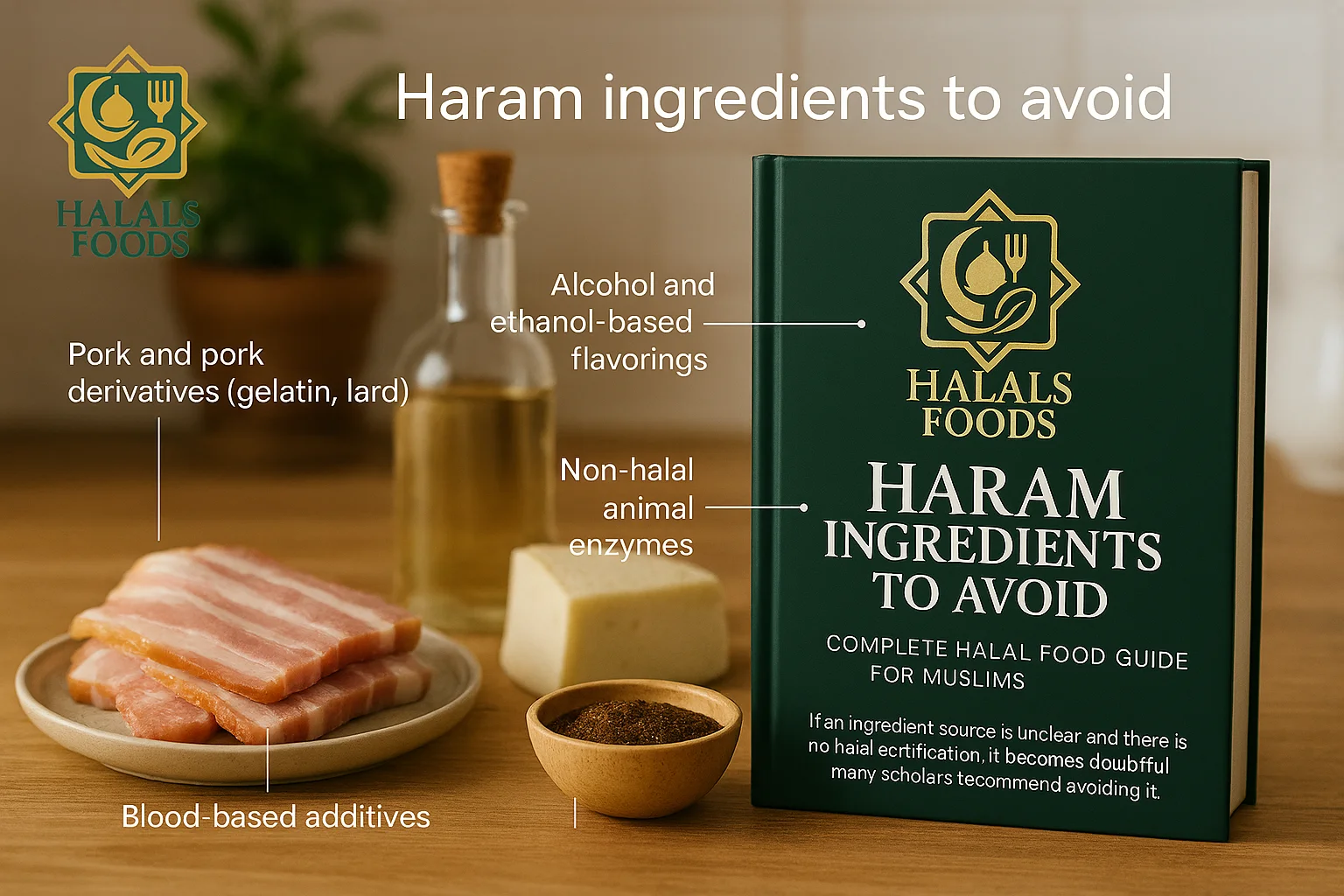
Some ingredients are straightforward and widely agreed upon by scholars.
These include:
1. Pork and Pork By-Products
This is the clearest category.
Allah explicitly prohibited pork in the Quran, and Islamic scholars unanimously agree that pork and its derivatives remain haram.
Common pork-based ingredients include:
- Pork gelatin
- Lard
- Bacon flavoring
- Porcine enzymes
- Ham extracts
- Pork shortening
What surprises many Muslims is how often pork derivatives appear in ordinary products.
You might find them in:
- Marshmallows
- Gummies
- Yogurt
- Cheesecake
- Capsules
- Vitamins
- Ice cream
- Instant noodles
Even some toothpaste and cosmetics may contain animal-derived ingredients linked to pork sources.
Why Gelatin Creates So Much Confusion
Gelatin is probably one of the most discussed Haram ingredients to avoid in the modern food industry.
Here’s why:
Gelatin itself is not automatically haram.
Its source determines the ruling.
If gelatin comes from:
- Halal-slaughtered cattle → potentially halal
- Fish → halal
- Pork → haram
The problem is that many companies never specify the source.
And honestly, this creates frustration for Muslim consumers everywhere.
You may buy candy thinking it is safe because it contains no visible meat products, only to discover later that the gummy texture came from pork gelatin.
This is why halal-certified products are becoming increasingly important.
Alcohol in Food — The Hidden Ingredient Many People Miss
Most Muslims know alcohol in drinks is prohibited.
But many do not realize how frequently alcohol appears inside processed foods.
Alcohol may be used in:
- Vanilla extract
- Cake flavorings
- Chocolates
- Sauces
- Desserts
- Flavor concentrates
- Restaurant marinades
Sometimes it appears directly as:
- Ethanol
- Alcohol
Other times it hides under:
- Natural flavor
- Flavor extract
- Artificial flavoring
You might be confused about this because scholarly discussions around alcohol in food can become complicated.
Some scholars say:
- Any added intoxicating alcohol is haram.
Others differentiate between:
- Tiny processing amounts
- Non-intoxicating traces
- Fully evaporated alcohol
This difference of opinion explains why some Muslims avoid all products containing alcohol-related ingredients, while others follow more lenient rulings.
Still, alcohol-based flavorings remain one of the most discussed Haram ingredients to avoid worldwide.
Cheese Is Not Always Automatically Halal
This shocks many people.
Cheese seems harmless, right?
But traditional cheese production often uses enzymes called rennet.
Rennet helps milk solidify during cheesemaking.
The issue is where the enzyme comes from.
Rennet may come from:
- Halal-slaughtered calves
- Non-halal slaughtered animals
- Pork enzymes
- Microbial fermentation
If the source is unclear, many Muslims avoid the product entirely.
This is why halal cheese products specifically mention:
- Microbial enzymes
- Vegetarian rennet
- Halal-certified enzymes
Without that clarification, cheese can become one of the overlooked Haram ingredients to avoid categories.
The Reality of “Natural Flavors”
The phrase “natural flavors” sounds healthy and harmless.
But here’s the problem…
Food laws in many countries do not require manufacturers to fully disclose what those flavorings contain.
Natural flavors may include:
- Alcohol solvents
- Animal extracts
- Meat-based flavor compounds
And companies are often allowed to protect flavor formulas as proprietary information.
That means Muslims sometimes cannot verify whether the ingredient source is halal.
This uncertainty is exactly why many halal-conscious shoppers contact manufacturers directly before buying products regularly.
E-Numbers Muslims Should Know About
If you buy imported foods, especially from Europe or international brands, you have probably seen E-numbers.
These are food additive codes.
Not every E-number is problematic, but some raise halal concerns.
Common Examples
E120 — Carmine
Derived from crushed cochineal insects.
Used in:
- Red candies
- Yogurt
- Juice drinks
- Lipstick
- Ice cream
Some scholars allow it.
Others prohibit insect-derived ingredients except locusts.
E441 — Gelatin
Usually indicates gelatin.
Source may be pork or beef.
E542 — Bone Phosphate
Can come from animal bones.
E904 — Shellac
Derived from insects and commonly used as a food glaze.
Because ingredient sourcing differs between companies, E-numbers often fall under Haram ingredients to avoid unless verified.
The Problem With Unspecified Animal Ingredients
Modern labels often use vague wording like:
- Animal fat
- Shortening
- Emulsifiers
- Fatty acids
- Lecithin
- Mono- and diglycerides
Some are plant-based.
Some are synthetic.
Some are animal-derived.
And honestly, most consumers cannot tell the difference.
This creates major confusion for Muslims trying to eat halal carefully.
For example:
Mono- and diglycerides may come from:
- Soybean oil
- Palm oil
- Beef fat
- Pork fat
Without halal certification or manufacturer transparency, determining the source becomes difficult.
Why Cross-Contamination Concerns Matter
Even when ingredients appear halal, manufacturing processes can still create concerns.
Many factories process:
- Pork products
- Alcohol-based products
- Non-halal meats
- Halal items
Sometimes all on shared equipment.
Islamic cleanliness laws matter here.
If equipment is contaminated with najis (impurity) and not cleaned properly, scholars may consider the food problematic.
This is why reputable halal certification organizations inspect:
- Production lines
- Cleaning procedures
- Ingredient storage
- Supplier sourcing
Without halal oversight, consumers usually never see what happens behind factory doors.
Why Halal Certification Makes Shopping Easier
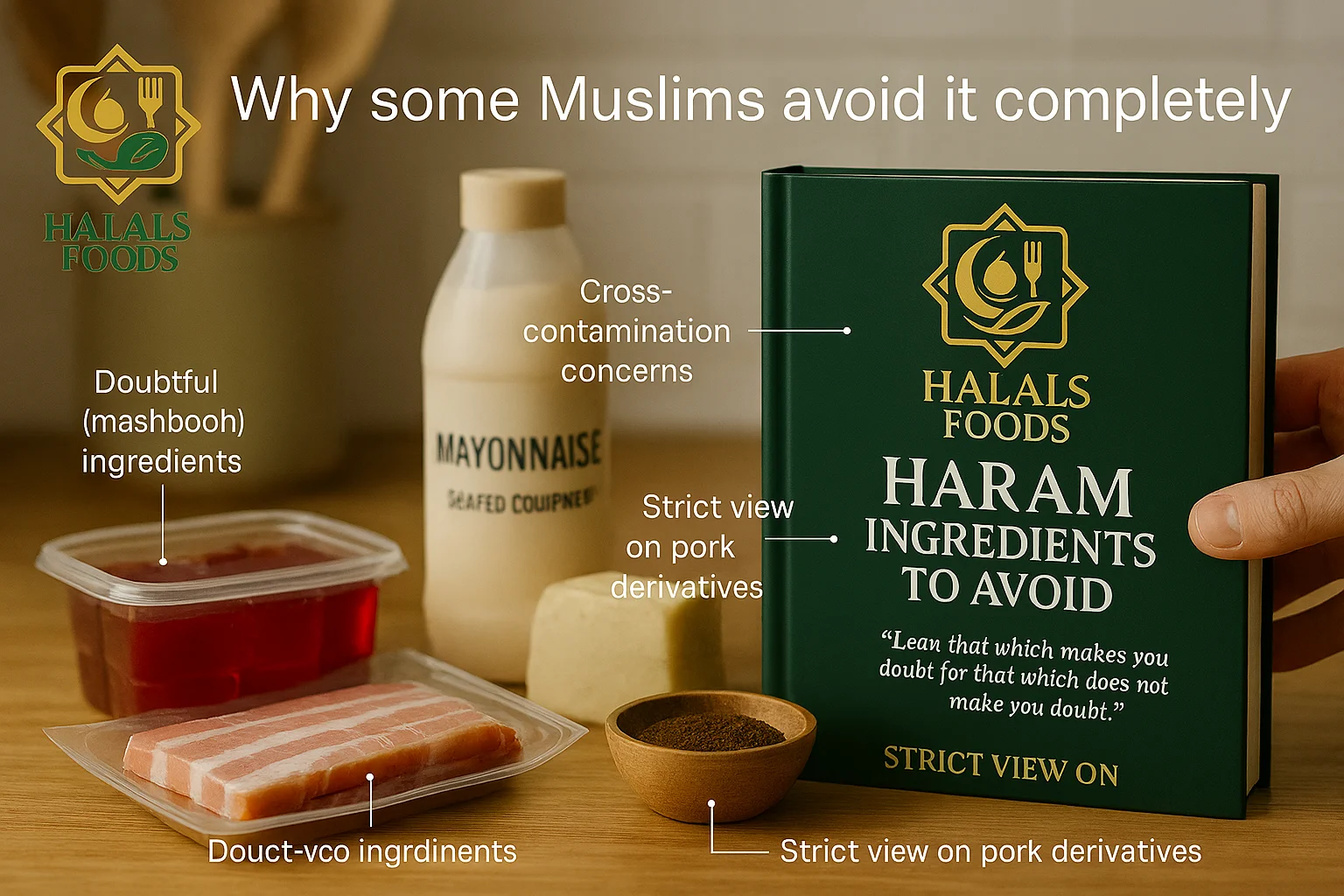
At some point, many Muslims realize checking every single ingredient manually becomes exhausting.
That is why halal certification matters so much.
Reliable halal organizations investigate:
- Ingredient origins
- Processing methods
- Cross-contamination risks
- Supplier chains
- Slaughter methods
Trusted halal certifiers in North America include:
- IFANCA
- ISA
- HFSAA
When a product carries recognized halal certification, it removes much of the uncertainty surrounding Haram ingredients to avoid.
Still, not all halal logos are equally reliable, which is why educated consumers often research certification bodies too.
The Emotional Side of Halal Eating
This topic is not just about ingredients.
For many Muslims, halal eating connects deeply to faith, identity, family, and spirituality.
Parents worry about:
- School snacks
- Birthday candies
- Restaurant meals
- Hidden additives
Young Muslims often feel confused when:
- Friends eat freely
- Labels are unclear
- Scholars differ in opinion
And honestly, navigating modern food systems can feel mentally exhausting sometimes.
But awareness itself is valuable.
The goal is not perfection overnight.
The goal is making informed choices sincerely for the sake of Allah.
Foods That Commonly Contain Haram ingredients to avoid
Some product categories deserve extra caution because problematic ingredients appear frequently.
These include:
Candies and Gummies
Often contain:
- Pork gelatin
- Carmine
- Shellac
Marshmallows
Usually made with gelatin.
Yogurts and Desserts
May contain:
- Gelatin
- Flavor alcohols
- Animal enzymes
Cheese Products
Can contain:
- Animal rennet
- Lipase enzymes
Chips and Snacks
Sometimes include:
- Animal flavor powders
- Cheese enzymes
- Meat extracts
Medicines and Vitamins
Capsules may contain gelatin from pork sources.
Bakery Products
Can include:
- L-cysteine
- Emulsifiers
- Alcohol-based extracts
And this is only scratching the surface.
Because modern food science constantly evolves, new additives appear regularly, making ingredient awareness more important every year.
A Smarter Way to Shop as a Muslim
Instead of becoming paranoid about every product, many experienced halal shoppers follow a simple system:
They:
- Prioritize halal-certified products
- Read labels carefully
- Research doubtful ingredients
- Contact brands when needed
- Avoid clearly haram items
- Follow trusted scholarly guidance
This balanced approach helps reduce stress while still maintaining halal standards seriously. A product can look completely harmless from the outside and still contain ingredients many Muslims would never knowingly consume.
That is the uncomfortable reality of modern food production.
The deeper you go into ingredient research, the more you realize something important: many questionable additives are hidden behind scientific names most ordinary shoppers never investigate.
And honestly, companies know this.
Most consumers never stop long enough to ask:
- Where did this ingredient come from?
- Was it animal-derived?
- Was alcohol used during processing?
- Was halal slaughter involved?
- Was the factory shared with pork products?
For Muslims trying to avoid Haram ingredients to avoid, these questions matter a lot more than people realize.
The Ingredients Most Muslims Overlook Completely
Some ingredients receive attention because they are widely discussed online.
Everyone talks about gelatin.
But there are other ingredients quietly hiding in thousands of products that many Muslims never even notice.
Let’s look at the ones that deserve more attention.
L-Cysteine — The Bakery Ingredient That Surprises Many Muslims
L-Cysteine is commonly used in:
- Bread
- Pizza dough
- Burger buns
- Croissants
- Packaged baked goods
It helps soften dough and improve texture.
Sounds harmless, right?
Here’s the issue…
Traditionally, some forms of L-Cysteine were produced from:
- Human hair
- Duck feathers
- Animal materials
Today, many manufacturers use synthetic or microbial sources, but not all companies clearly disclose this.
This uncertainty places L-Cysteine among the lesser-known Haram ingredients to avoid for cautious Muslim consumers.
Especially in fast-food bakery products, the source is often impossible to verify without contacting the company directly.
Glycerin — Halal or Haram?
Glycerin appears almost everywhere.
You can find it in:
- Candy
- Toothpaste
- Medicines
- Protein bars
- Skincare
- Syrups
- Cosmetics
The problem?
Glycerin can come from:
- Vegetable oils
- Synthetic production
- Animal fat
And yes, animal fat may include pork derivatives.
This is why glycerin becomes a doubtful ingredient unless:
- The product is halal-certified
- The company confirms plant sourcing
Many Muslims do not realize that even personal care products can involve Haram ingredients to avoid.
The Cosmetic Industry Has Its Own Halal Problems
Food is only part of the conversation.
Lipsticks, lotions, makeup, shampoos, and perfumes may also contain questionable ingredients.
Common concerns include:
- Carmine in lipstick
- Alcohol in perfumes
- Animal collagen
- Keratin from unknown sources
- Glycerin
- Placenta extracts
Some Muslims overlook cosmetics entirely because they are not eaten.
But many scholars still encourage avoiding haram-derived ingredients in products absorbed by the body or used regularly.
And honestly, the halal beauty industry is growing rapidly because consumers are finally becoming more aware.
Why “Vegetarian” Does Not Always Mean Halal
This confuses many people.
A product labeled vegetarian may still contain:
- Alcohol flavorings
- Insect-derived colorings
- Non-halal dairy enzymes
- Cross-contamination risks
For example:
- Vegetarian marshmallows may still contain alcohol flavorings.
- Vegetarian desserts may contain vanilla extract with ethanol.
- Vegetarian cheese may still use questionable microbial processing methods.
Halal and vegetarian are not automatically the same thing.
That is an important distinction when identifying Haram ingredients to avoid.
Fast Food — One of the Biggest Areas of Confusion
Fast food creates huge uncertainty for Muslims in America and Europe.
Many restaurants do not clearly disclose:
- Ingredient sourcing
- Oil contamination
- Shared grills
- Flavor additives
- Enzyme origins
Even fries can become questionable if cooked in shared oil with non-halal meat products.
Chicken products may contain:
- Flavor injections
- Alcohol-based marinades
- Non-halal seasonings
Cheese sauces often contain:
- Animal enzymes
- Emulsifiers
- doubtful flavorings
This is why many practicing Muslims prefer:
- Halal-certified restaurants
- Muslim-owned businesses
- Verified halal chains
Because once you investigate the food industry deeply, you realize how difficult it can be to identify every hidden ingredient yourself.
The “Natural Beef Flavor” Problem
One major controversy involved fast-food fries flavored with “natural beef flavor.”
Many Muslims assumed fries were vegetarian.
Later, ingredient disclosures revealed animal-derived flavor components were involved.
This situation taught Muslim consumers an important lesson:
Ingredient names do not always reveal the full story.
Words like:
- Natural flavor
- Savory flavor
- Smoke flavor
- Cream flavor
may contain highly complex formulations.
And companies are not always legally required to explain every detail publicly.
Why Scholars Differ About Some Haram ingredients to avoid
This topic becomes complicated because Islamic scholars approach modern food science differently.
Not every ingredient has unanimous rulings.
That is why you will sometimes hear completely opposite answers from different scholars.
The Concept of Istihalah (Transformation)
One of the biggest debates involves chemical transformation.
Some scholars argue:
If a haram substance completely changes into a new substance chemically, it may become permissible.
Examples often discussed:
- Gelatin transformation
- Alcohol evaporation
- Certain enzyme processing
This principle is called istihalah.
Some Hanafi scholars historically accepted transformation in specific situations.
However, many contemporary scholars still reject pork-derived ingredients regardless of chemical change.
That is why pork gelatin remains one of the most debated Haram ingredients to avoid today.
Why Some Muslims Avoid Doubtful Ingredients Completely
Other Muslims follow a stricter approach called wara’ (precaution).
Their mindset is simple:
“If the source is doubtful, avoid it.”
This approach is based on the famous hadith:
“The halal is clear and the haram is clear, and between them are doubtful matters…”
For these Muslims:
- Unknown gelatin = avoided
- Unclear enzymes = avoided
- Questionable flavorings = avoided
Not because they want difficulty.
But because they want peace of mind.
And honestly, many people feel spiritually more comfortable following this cautious approach.
The USA Food Industry Creates Extra Challenges
Muslims living in Muslim-majority countries often have easier halal access.
In the USA, things are very different.
There is:
- No national halal law
- No federal halal standard
- No mandatory halal inspections
- No requirement to disclose animal sources fully
This creates massive inconsistency.
Two identical-looking products may have completely different ingredient sourcing depending on:
- Country
- factory
- supplier
- production batch
That is why Muslims in America spend so much time researching Haram ingredients to avoid.
Ingredients That Often Require Extra Verification
Experienced halal shoppers usually investigate these carefully:
| Ingredient | Why It’s Questionable |
|---|---|
| Gelatin | May come from pork |
| Mono & diglycerides | Can be animal-derived |
| Enzymes | Source often unclear |
| Rennet | May come from non-halal animals |
| Carmine (E120) | Insect-derived |
| Glycerin | Could be animal fat |
| Lecithin | Usually safe but source matters |
| Natural flavors | May contain alcohol |
| L-cysteine | Sometimes animal/hair sourced |
| Shortening | May contain animal fat |
Not every product containing these ingredients is haram.
But they are among the most researched Haram ingredients to avoid in halal food discussions.
The Rise of Halal-Certified Products
The good news?
Halal awareness is growing rapidly worldwide.
Many major companies now seek halal certification because Muslim consumers are becoming more informed and selective.
Halal-certified products now exist for:
- Candy
- Vitamins
- Cosmetics
- Fast food
- Frozen meals
- Protein supplements
- Snacks
- Beverages
This growth makes halal shopping easier than it was 10 or 15 years ago.
Still, consumers should verify which certification body approved the product.
Not All Halal Logos Are Equally Trusted
This is another important issue.
Some halal certifications are extremely strict.
Others are more relaxed.
Trusted organizations usually:
- Inspect factories
- Verify slaughter
- Audit suppliers
- Check contamination controls
- Review ingredients scientifically
Reliable U.S. halal certifiers include:
- IFANCA
- ISA
- HFSAA
When researching Haram ingredients to avoid, certification credibility matters almost as much as the ingredients themselves.
Restaurant Cross-Contamination Concerns
Many Muslims ask:
“If I order fish or vegetarian food, is it automatically halal?”
Not necessarily.
Questions still remain:
- Was it fried in shared oil?
- Was the grill shared with bacon?
- Were alcohol sauces used nearby?
- Were utensils cleaned properly?
Some restaurants openly admit:
- Shared fryers
- Shared grills
- Mixed preparation stations
This is why some observant Muslims avoid non-halal restaurants entirely, while others make case-by-case decisions.
Practical Tips for Avoiding Haram ingredients to avoid
Trying to research every ingredient manually can become exhausting.
A practical system helps.
1. Prioritize Halal-Certified Products
This removes much of the uncertainty immediately.
Especially for:
- Candy
- Dairy
- Processed foods
- Vitamins
- Meat products
2. Learn the Most Common Doubtful Ingredients
You do not need to memorize hundreds.
Just knowing the major questionable ingredients already helps greatly.
3. Use Halal Ingredient Apps Carefully
Some apps are useful, but not always perfect.
Always cross-check information with reliable halal organizations.
4. Contact Companies Directly
Many brands answer ingredient-source questions through:
- Customer service
- Product FAQs
Especially regarding:
- Gelatin
- Enzymes
- Glycerin
- Flavorings
5. Avoid Products With Unnecessary Doubt
Sometimes the easiest solution is simply choosing an alternative product.
If one candy brand creates confusion but another carries halal certification, the decision becomes much easier.
The Spiritual Wisdom Behind Halal Eating
Islamic dietary rules are not random restrictions.
They build:
- discipline
- awareness
- gratitude
- cleanliness
- self-control
Being careful about Haram ingredients to avoid teaches Muslims to become conscious consumers rather than mindless eaters.
And honestly, that mindfulness affects more than food.
It shapes character too.
Final Verdict on Haram ingredients to avoid
After analyzing modern food manufacturing, Islamic rulings, ingredient sourcing, and halal certification systems, one reality becomes very clear:
Many everyday products contain hidden ingredients Muslims should investigate carefully.
The most important Haram ingredients to avoid include:
- Pork derivatives
- Non-halal gelatin
- Alcohol-based flavorings
- Animal enzymes
- Blood products
- Doubtful emulsifiers
- Insect-derived additives for stricter opinions
At the same time, not every unclear ingredient automatically means haram.
Some issues involve scholarly disagreement.
Others depend entirely on ingredient sourcing.
That is why the safest and simplest long-term approach for Muslims is:
- choosing halal-certified products,
- learning common ingredient names,
- and avoiding doubtful items whenever possible.
In today’s food industry, halal awareness is no longer optional.
It has become an essential part of responsible Muslim consumption.
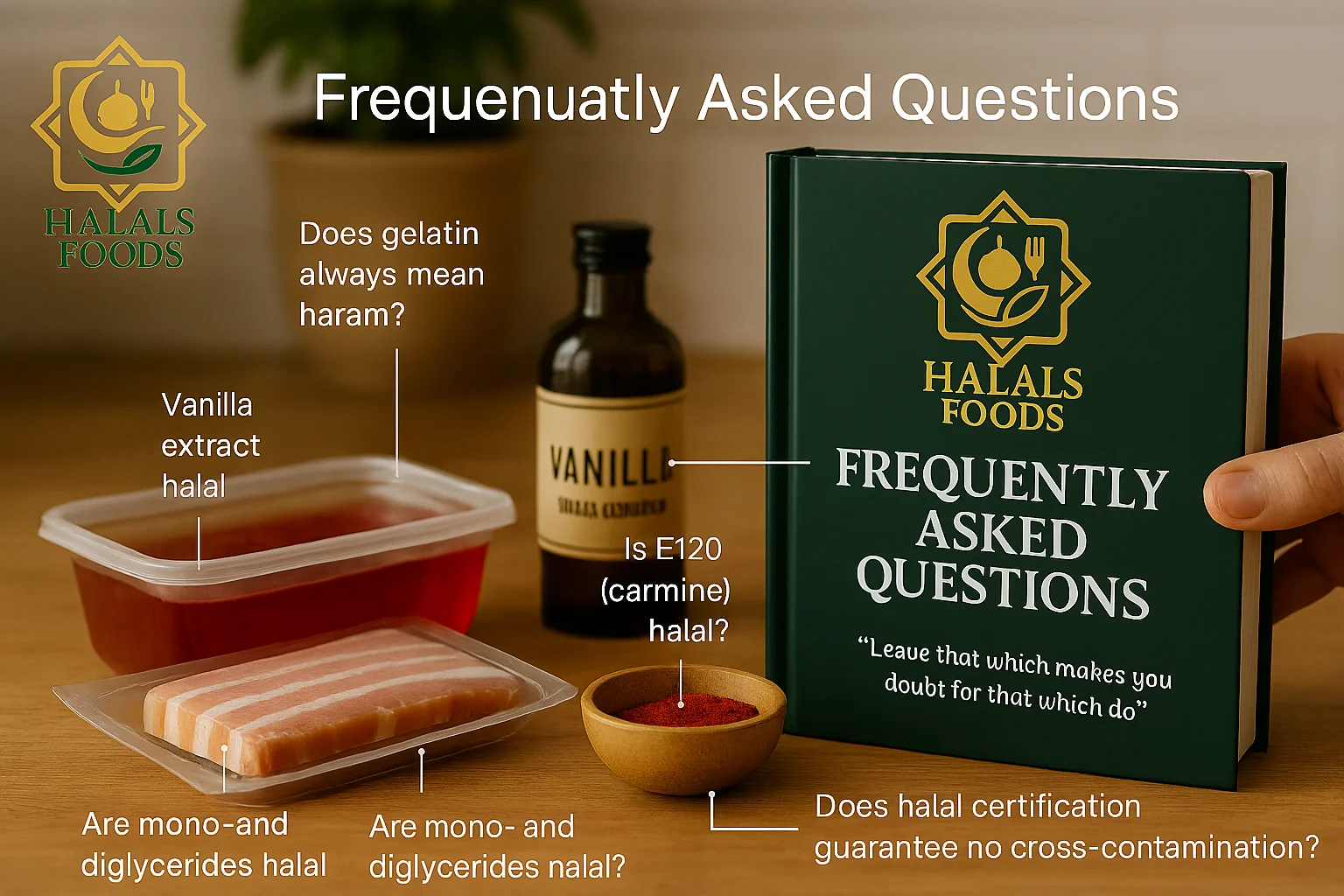
Frequently Asked Questions About Haram ingredients to avoid
Does “gelatin” always mean pork?
No.
Gelatin may come from:
- Pork
- Beef
- Fish
The source determines whether it is halal or haram.
Are all flavorings haram?
No.
Some flavorings are water-based or synthetic.
Others use alcohol solvents.
Always check certification or manufacturer details.
Is carmine halal?
Scholars differ because carmine comes from insects.
Some allow it.
Others avoid it completely.
Are microbial enzymes halal?
Generally yes.
Microbial and plant-based enzymes are usually considered halal.
Why do many Muslims avoid doubtful ingredients?
Because of the Islamic principle of avoiding doubtful matters to protect one’s faith and peace of mind.
People searching for “Is [ Is Rennet Halal or Haram? ]” are also curious about other foods and ingredients. Below, you’ll find related halal food articles that clearly explain ingredient sources, how products are made, and whether they meet halal requirements.
more related [ Is Vanilla Extract Halal ]
more[ Is E120 Halal or Not? ]