The craving usually starts at the worst possible moment.
You’re traveling, running late after work, hanging out with friends, or stuck in a long highway drive somewhere in America. Everyone suddenly wants burgers, fried chicken, tacos, or loaded fries. Then comes the awkward question many Muslims in the USA know too well:
“Is there anything halal here?”
That single question sounds simple, but honestly, it opens a huge discussion. Because finding trustworthy Halal fast-food options in USA is not always easy. Some restaurants claim halal but cannot show certification. Some chains serve halal meat in one state but not another. And then there are places where even the fries become questionable because of shared fryers.
This confusion is exactly why many Muslims end up frustrated, overly cautious, or simply tired of guessing.
The American fast-food industry moves fast. Halal verification? Not always.
Still, things are changing. Muslim consumers today are asking smarter questions. Restaurants are becoming more transparent. Dedicated halal burger spots, fried chicken shops, gyro chains, and halal food trucks are growing rapidly across the country.
And honestly, some of them are now competing directly with mainstream giants.
This guide breaks everything down in a practical and realistic way — without robotic explanations or vague answers. You’ll understand:
- Which fast-food chains are safest
- Which ones need verification
- Common hidden ingredients Muslims overlook
- Why halal standards differ between cities
- What scholars usually recommend
- How to avoid doubtful food without making life difficult
Because when it comes to Halal fast-food options in USA, most people don’t just want food.
They want peace of mind too.
Why Muslims Struggle With Fast Food in America
America has one of the biggest fast-food industries in the world.
But halal standards here are very inconsistent.
One restaurant may advertise “halal chicken” while another uses phrases like:
- “halal-friendly”
- “Muslim-owned”
- “prepared halal-style”
Those phrases sound reassuring, but they do not always mean certified halal meat.
That’s where confusion begins.
Many Muslims assume:
“If there’s no pork in it, it should be okay.”
But halal goes much deeper than simply avoiding pork.
The meat itself matters.
The slaughter process matters.
Cross-contamination matters.
Ingredients matter.
Even flavorings and cheese can matter.
And this becomes complicated in large commercial kitchens where speed matters more than religious dietary handling.
Some chains use:
- Shared grills
- Shared oil fryers
- Frozen meat suppliers
- Unknown seasoning blends
- Cheese with animal enzymes
So even when a burger “looks halal,” the actual sourcing may say otherwise.
This is why experienced Muslim consumers in America rarely trust labels blindly anymore.
The Big Difference Between “Muslim-Owned” and “Halal-Certified”
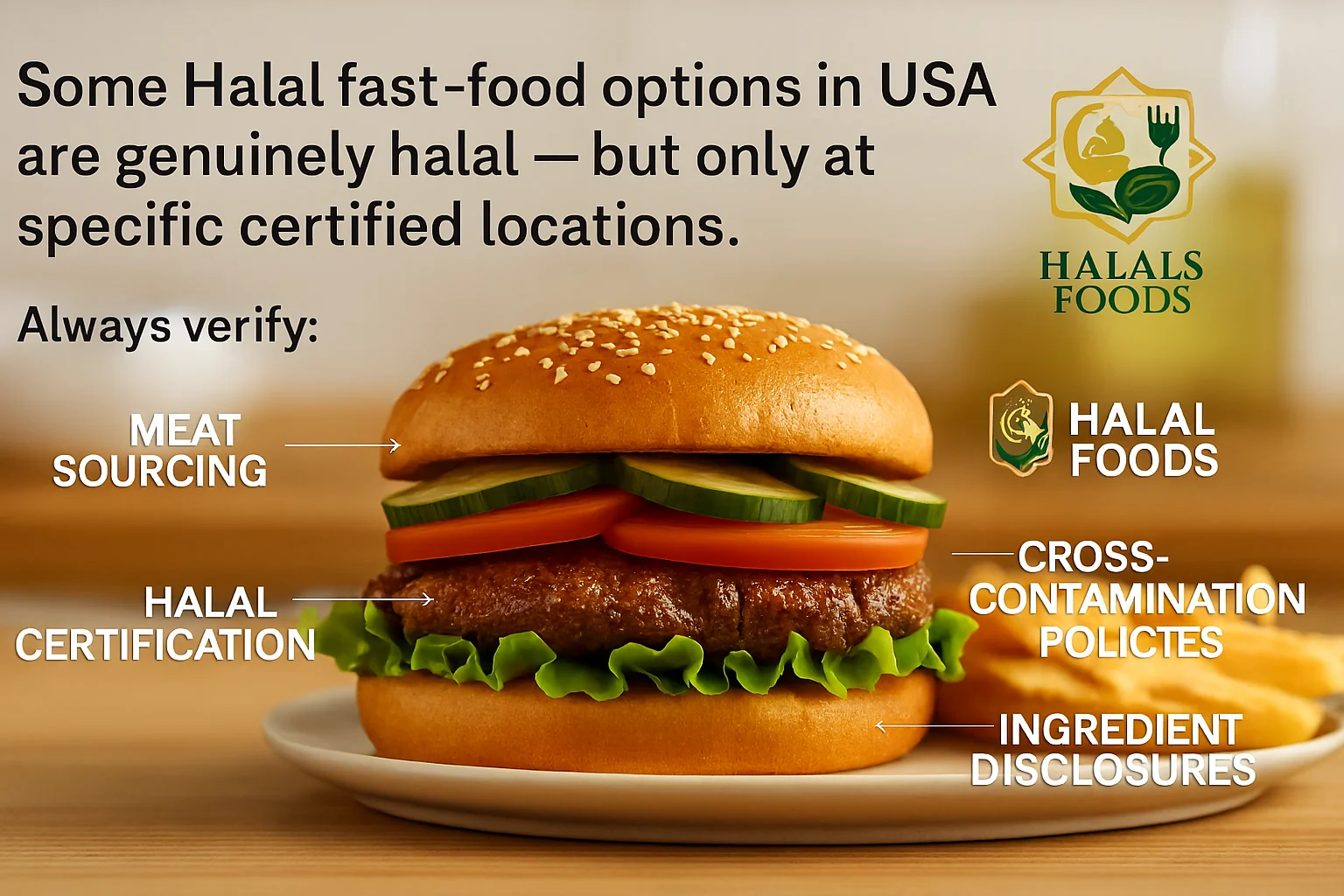
This is one of the biggest misunderstandings in the halal food world.
A restaurant being Muslim-owned does NOT automatically guarantee halal compliance.
That surprises many people.
Some restaurant owners buy regular wholesale meat because:
- It’s cheaper
- Easier to source
- More available locally
Meanwhile, certified halal restaurants usually:
- Buy from approved suppliers
- Maintain invoices and documentation
- Undergo inspections
- Separate halal items carefully
That’s a massive difference.
A true halal certification normally comes from organizations such as:
- IFANCA
- HFSAA
- ISWA
- Local halal authorities
These organizations inspect sourcing and processing standards.
Without certification, customers are often relying only on verbal trust.
And sadly, the halal industry in America has seen fake claims before.
That’s why modern Muslim consumers have become more careful about Halal fast-food options in USA.
So Which Fast Food Chains Are Usually Trusted?
Some names consistently appear in halal discussions across America.
But not all are equal.
Here’s where things become interesting.
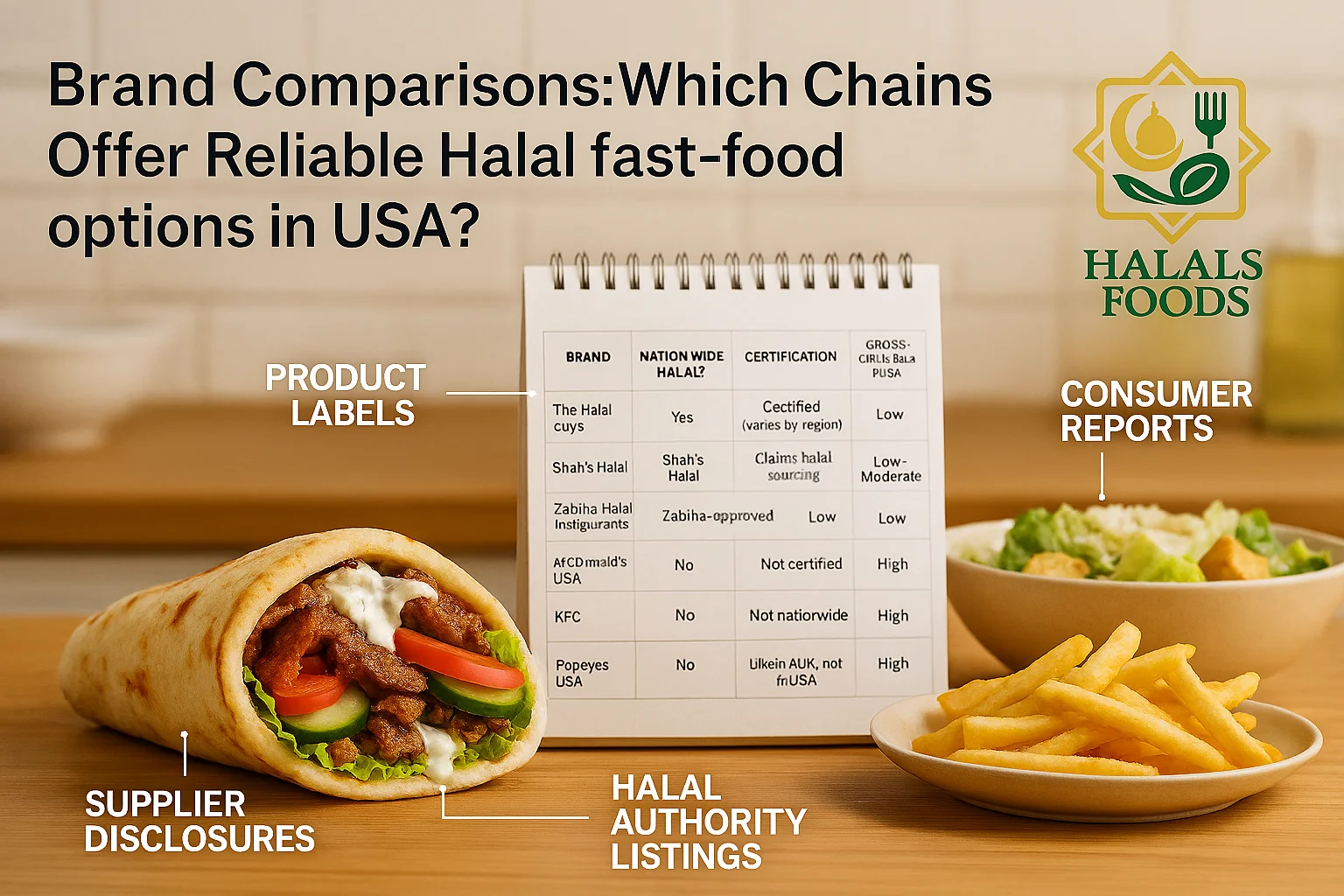
The Halal Guys
Probably one of the most recognizable halal fast-food brands in the USA.
What started as a New York City halal cart became an international brand.
Why Muslims trust them:
- Dedicated halal identity
- Strong halal branding
- Meat sourcing transparency
- Minimal pork-related contamination concerns
Popular items:
- Chicken over rice
- Gyro platters
- White sauce combos
For many Muslims, this became the “safe fast-food option” during travel.
And honestly, their growth proved something important:
Muslims in America were desperate for reliable Halal fast-food options in USA.
Shah’s Halal Food
Another rapidly growing halal chain.
Especially popular in:
- New York
- New Jersey
- Connecticut
- Nearby East Coast regions
Their menu focuses on:
- Rice platters
- Gyros
- Chicken wraps
- Loaded fries
Many locations advertise halal-certified meat sourcing.
Still, location-specific verification remains smart because franchises can vary.
Dave’s Hot Chicken (Some Locations)
This one surprises people.
Not every location is halal.
But several franchises in Muslim-populated areas now serve halal chicken.
Cities with some halal-certified branches include:
- Houston
- Chicago suburbs
- California locations
- Dearborn-area franchises
The important thing:
Never assume every branch follows the same standard.
One halal-certified location does not make the entire chain halal nationwide.
Why Mainstream Chains Still Create Doubts
Here’s the part many Muslims struggle with emotionally.
Chains like:
- McDonald’s
- Burger King
- KFC
- Popeyes
- Wendy’s
- Taco Bell
are incredibly convenient.
They’re everywhere.
Cheap.
Fast.
Familiar.
But convenience does not equal halal compliance.
Most U.S. branches do NOT claim nationwide halal certification.
And many openly state they cannot guarantee separation from pork products.
That alone makes many Muslims uncomfortable.
Especially because industrial meat processing in America often includes:
- Mechanical slaughter
- Stunning procedures
- Unknown supplier chains
- Mixed processing facilities
Some Muslims still choose vegetarian or seafood items from these chains.
Others avoid them completely.
This difference usually comes down to personal religious caution and scholarly opinion.
The Fryer Problem Most People Ignore
A lot of Muslims focus only on the meat.
But fryer contamination is a real discussion too.
Imagine ordering fries that seem harmless.
Now imagine those same fries being cooked in oil shared with:
- Bacon products
- Non-halal chicken
- Pork-coated items
That changes things.
Some restaurants maintain separate fryers.
Many do not.
And staff members often don’t know the answer unless management is asked directly.
This is why some Muslims prefer dedicated halal restaurants entirely instead of trying to “customize” mainstream fast food into something halal-friendly.
Because after a while, constantly investigating every ingredient becomes exhausting.
Cities Where Halal Fast Food Is Actually Growing Fast
Not every American city has the same halal food scene.
Some places now have incredible halal fast-food options.
Others still barely offer anything.
New York City
Honestly, NYC might be the halal fast-food capital of America.
You’ll find:
- Halal carts everywhere
- Certified burger shops
- Halal fried chicken
- Halal cheesesteaks
- Halal pizza
- Halal tacos
The Muslim population heavily influenced the food market there.
In many neighborhoods, halal food is now completely mainstream.
Dearborn, Michigan
Dearborn is another major halal hotspot.
The Arab-American community transformed the restaurant scene.
Many restaurants here openly display:
- Halal certifications
- Supplier information
- Arabic signage
- Zabiha sourcing
For Muslims traveling through Michigan, Dearborn often feels far less stressful food-wise.
Houston & Dallas
Texas has quietly become one of America’s fastest-growing halal markets.
Especially:
- Halal burgers
- Nashville hot chicken
- Fusion fast food
- Pakistani-American burger spots
The younger Muslim generation there is building trendy halal brands that appeal to everyone — not just Muslims.
That shift matters.
Because halal food today is no longer viewed as “niche.”
It’s becoming part of mainstream American food culture.
The Rise of Halal Burgers in America
Ten years ago, halal fast food mostly meant:
- Gyros
- Rice platters
- Kebabs
Now?
Muslim-owned burger chains are exploding in popularity.
And they’re intentionally competing with:
- Shake Shack
- Five Guys
- Smashburger
- Chick-fil-A
Some halal burger spots now focus heavily on:
- Premium beef sourcing
- Hand-smashed patties
- Loaded fries
- Gourmet sauces
- Viral social media marketing
This modern halal food movement changed how younger Muslims view fast food entirely.
Instead of “settling” for limited options, they now expect quality too.
And honestly, that competition is improving the entire halal food industry in America.
Hidden Ingredients Muslims Often Forget to Check
Here’s something many people overlook.
Even if the meat is halal, other ingredients can still become questionable.
For example:
Cheese Enzymes
Some cheese uses animal-derived rennet.
If sourced from non-halal animals, scholars may consider it doubtful.
Many halal-certified restaurants specifically use:
- Microbial enzymes
- Vegetarian rennet
- Certified halal cheese
Mainstream chains rarely explain this clearly.
Sauces & Flavorings
Some sauces contain:
- Alcohol-based extracts
- Unclear “natural flavors”
- Animal-derived additives
Usually the quantities are tiny.
Still, transparency matters for practicing Muslims.
Gelatin in Desserts
Milkshakes, marshmallow toppings, and desserts sometimes include gelatin.
Without halal certification, the gelatin source may remain unknown.
And honestly, this is why many Muslims stick to simple menu choices when eating outside.
Why Younger Muslims Are Asking More Questions
There’s a noticeable shift happening.
Older generations sometimes relied mainly on trust and community recommendations.
But younger Muslims today:
- Read ingredient labels
- Search certification databases
- Watch halal food reviews online
- Expose fake halal claims on social media
That pressure is forcing restaurants to become more transparent.
Which is actually a good thing.
Because clearer halal standards benefit everyone searching for trustworthy Halal fast-food options in USA.
A lot of Muslims think the hardest part about eating halal in America is finding food.
But honestly, the harder part is dealing with uncertainty.
That feeling when you’re standing at the counter wondering:
“Should I trust this place or not?”
Some restaurants confidently say “everything is halal.”
Others hesitate when asked basic questions.
And sometimes even employees themselves are confused about sourcing.
That uncertainty is exactly why Muslims approach Halal fast-food options in USA so differently.
Some people only eat at certified halal restaurants.
Some avoid meat completely unless they cook at home.
Others choose seafood or vegetarian items when traveling.
And then there are Muslims who rely on local community trust.
The reality is:
there isn’t one single approach followed by everyone.
Still, there ARE practical ways to make smarter and safer choices without turning every meal into a stressful investigation.
How to Actually Verify a Halal Restaurant
This is where many people make mistakes.
Seeing the word “halal” on a sign is not enough anymore.
A reliable halal restaurant should usually be able to answer simple questions clearly.
For example:
- Which supplier provides your meat?
- Is the meat certified halal?
- Which organization certifies it?
- Are certificates available to view?
- Are pork items cooked separately?
- Are fryers shared?
A trustworthy restaurant normally answers confidently.
But if responses sound vague like:
- “I think it’s halal”
- “Our owner said it is”
- “Most Muslims eat here”
then caution becomes reasonable.
Because real halal compliance is based on sourcing and process — not popularity.
The “Halal Friendly” Label Can Be Misleading
This phrase has become common recently.
You’ll see restaurants describe themselves as:
- halal-friendly
- Muslim-friendly
- partially halal
At first glance, it sounds positive.
But what does it actually mean?
Sometimes it means:
- halal chicken but non-halal beef
- halal meat but alcohol served nearby
- halal menu items cooked on shared grills
This creates confusion because customers assume the entire restaurant follows halal standards.
That’s not always true.
This is why many scholars encourage Muslims to ask direct questions instead of relying on marketing phrases.
Especially in fast-food environments where kitchens move quickly and cross-contact can happen easily.
Seafood: The Easier Option for Many Muslims
When Muslims cannot verify meat, seafood often becomes the safest alternative.
That’s why many travelers choose:
- fish sandwiches
- grilled salmon
- shrimp meals
- tuna wraps
Most scholars consider seafood halal.
But there’s still one issue people forget:
Preparation methods.
If fish is fried in oil shared with non-halal meat products, some Muslims become uncomfortable with it.
Others consider it acceptable if direct contamination is limited.
This difference comes from varying scholarly opinions and personal caution levels.
Still, seafood remains one of the most commonly chosen backup options in mainstream American fast food.
Why Some Muslims Avoid Mainstream Chains Completely
For many practicing Muslims, avoiding doubtful food brings peace of mind.
And honestly, that emotional comfort matters.
Some people simply don’t want constant uncertainty every time they eat outside.
So they choose:
- dedicated halal restaurants only
- vegetarian meals
- home-cooked food
- local Muslim-owned businesses
Their reasoning is simple:
“If halal certainty exists elsewhere, why take unnecessary doubts?”
This mindset became more common after awareness increased about:
- industrial slaughter methods
- hidden additives
- false halal claims
- cross-contamination issues
And because information spreads quickly online now, consumers are much more informed than before.
The Food Truck Culture Changed Halal Fast Food in America
One of the most interesting parts of the halal food story in the USA is how food trucks transformed everything.
Especially in cities like:
- New York
- Chicago
- Philadelphia
- Houston
Halal food trucks became cultural icons.
At first, many mainly served Muslim taxi drivers and night-shift workers.
Then non-Muslim customers started trying:
- chicken over rice
- lamb gyros
- white sauce platters
And suddenly halal street food exploded in popularity.
Today, some halal food trucks have lines longer than mainstream fast-food restaurants.
That growth proved something important:
Good halal food attracts everyone — not only Muslims.
And honestly, that helped normalize halal food across America.
Social Media Is Exposing Fake Halal Claims Fast
Years ago, restaurants could claim halal without much scrutiny.
That’s much harder today.
Now customers:
- post supplier invoices online
- review certifications publicly
- discuss restaurants in Muslim Facebook groups
- create halal verification videos on TikTok and YouTube
If a restaurant makes misleading claims, word spreads quickly.
This has pressured many businesses to improve transparency.
Some restaurants now proudly display:
- certification logos
- supplier details
- halal inspection reports
Because modern Muslim consumers expect proof — not just promises.
The Difference Between Halal in USA vs UK
This confuses many travelers.
A Muslim may visit London and see halal-certified:
- KFC branches
- Subway locations
- fried chicken shops
Then they arrive in America expecting the same thing.
But halal policies differ by country.
In the UK:
- Muslim populations are concentrated in major cities
- halal demand is extremely high
- some chains adapted locally
In the USA:
- halal implementation is less standardized
- chains rarely certify nationwide
- franchise rules vary heavily
That’s why a chain being halal abroad does NOT automatically mean it’s halal in America.
This misunderstanding causes many accidental assumptions.
The Rise of Premium Halal Fast Food
Something else is changing too.
Halal fast food is no longer only about affordability.
Now many halal restaurants focus on:
- gourmet burgers
- premium steaks
- Nashville hot chicken
- loaded fries
- artisan sauces
- smash burgers
- fusion tacos
The younger Muslim generation wants halal food that feels modern and exciting.
Not just “acceptable.”
And honestly, this trend is making halal restaurants far more competitive.
Some halal burger spots now outperform mainstream restaurants in:
- taste
- branding
- social media engagement
- customer loyalty
That’s a huge shift from the past.
Common Mistakes Muslims Make When Choosing Fast Food
People often assume they’re being careful, but a few mistakes happen repeatedly.
Assuming “Chicken” Automatically Means Halal
This is probably the most common misunderstanding.
Many fast-food chicken products in America are conventionally slaughtered unless explicitly certified halal.
Even if there’s no pork involved, the slaughter method still matters.
Trusting Viral Videos Without Verification
Sometimes influencers label restaurants halal without checking sourcing properly.
A crowded restaurant does not automatically equal halal compliance.
Always verify independently.
Forgetting About Ingredients Beyond Meat
People focus heavily on burgers and chicken but forget:
- cheese enzymes
- sauces
- gelatin desserts
- seasoning powders
These ingredients can matter too.
Not Checking Individual Locations
One halal-certified franchise does not make every branch halal nationwide.
Location-specific verification is extremely important.
Especially for chains operating under different owners.
Best Types of Reliable Halal fast-food options in USA
If someone wants the safest and easiest halal fast-food experience, these categories are usually strongest.
Dedicated Halal Burger Chains
These restaurants often:
- source certified meat
- avoid pork entirely
- separate equipment properly
Many now compete directly with mainstream burger giants.
Halal Chicken Restaurants
Popular in urban Muslim communities.
Usually inspired by:
- Nashville hot chicken
- fried chicken sandwiches
- spicy tenders
- wings
Some locations even offer fully halal fast-food drive-thrus now.
Halal Mediterranean Chains
Still among the most reliable categories overall.
Examples include:
- gyro platters
- shawarma wraps
- rice bowls
- kebab meals
These businesses often built their identity around halal compliance from the beginning.
What Scholars Usually Recommend
Islamic scholars in North America generally emphasize caution with doubtful meat.
Many contemporary scholars recommend:
- certified halal meat whenever possible
- avoiding assumptions
- prioritizing certainty over convenience
At the same time, scholars also understand real-life difficulties Muslims face while living in non-Muslim countries.
That’s why opinions sometimes differ regarding:
- People of the Book slaughter
- cross-contamination
- trace ingredients
- shared fryers
This is why Muslims may reach different conclusions while still acting sincerely according to their understanding.
But across nearly all opinions, one principle remains consistent:
Clear halal certification brings the strongest confidence.
A Simple Checklist Before Ordering Fast Food
Before ordering from any restaurant, quickly check:
✔ Does the restaurant clearly state halal certification?
✔ Can staff explain meat sourcing confidently?
✔ Are pork items separated?
✔ Are certificates visible?
✔ Is the restaurant trusted by local Muslim communities?
✔ Are online reviews mentioning halal verification?
If multiple answers feel uncertain, it may be smarter to choose another option.
The Future of Halal fast-food options in USA
The halal market in America is growing extremely fast.
And not just because of Muslim consumers.
Many non-Muslims now choose halal food because they associate it with:
- cleaner sourcing
- ethical slaughter
- freshness
- better meat quality
That wider appeal is pushing more entrepreneurs into the halal fast-food industry.
Over the next few years, experts expect growth in:
- halal drive-thrus
- halal food delivery apps
- certified halal franchises
- Muslim-owned fast-food startups
This means future Muslim travelers in America may face far fewer struggles than previous generations did.
And honestly, that’s already starting to happen in major cities.
Final Verdict: Are Reliable Halal fast-food options in USA Available?
Yes — definitely.
But reliable halal fast food in America usually comes from:
- dedicated halal restaurants
- certified local chains
- verified independent businesses
- trusted halal food trucks
Mainstream national chains still remain questionable in most cases because:
- halal certification is rare
- meat sourcing is unclear
- cross-contamination risks exist
That’s why careful verification matters.
The good news is that Muslims today have far more options than before.
From halal smash burgers to spicy chicken sandwiches and famous rice platters, the halal fast-food scene in America is evolving rapidly.
And honestly, some of these halal spots are now better than the mainstream chains people used to depend on.
At the end of the day, choosing Halal fast-food options in USA is not only about convenience.
It’s about eating with confidence, clarity, and peace of mind.
Frequently Asked Questions
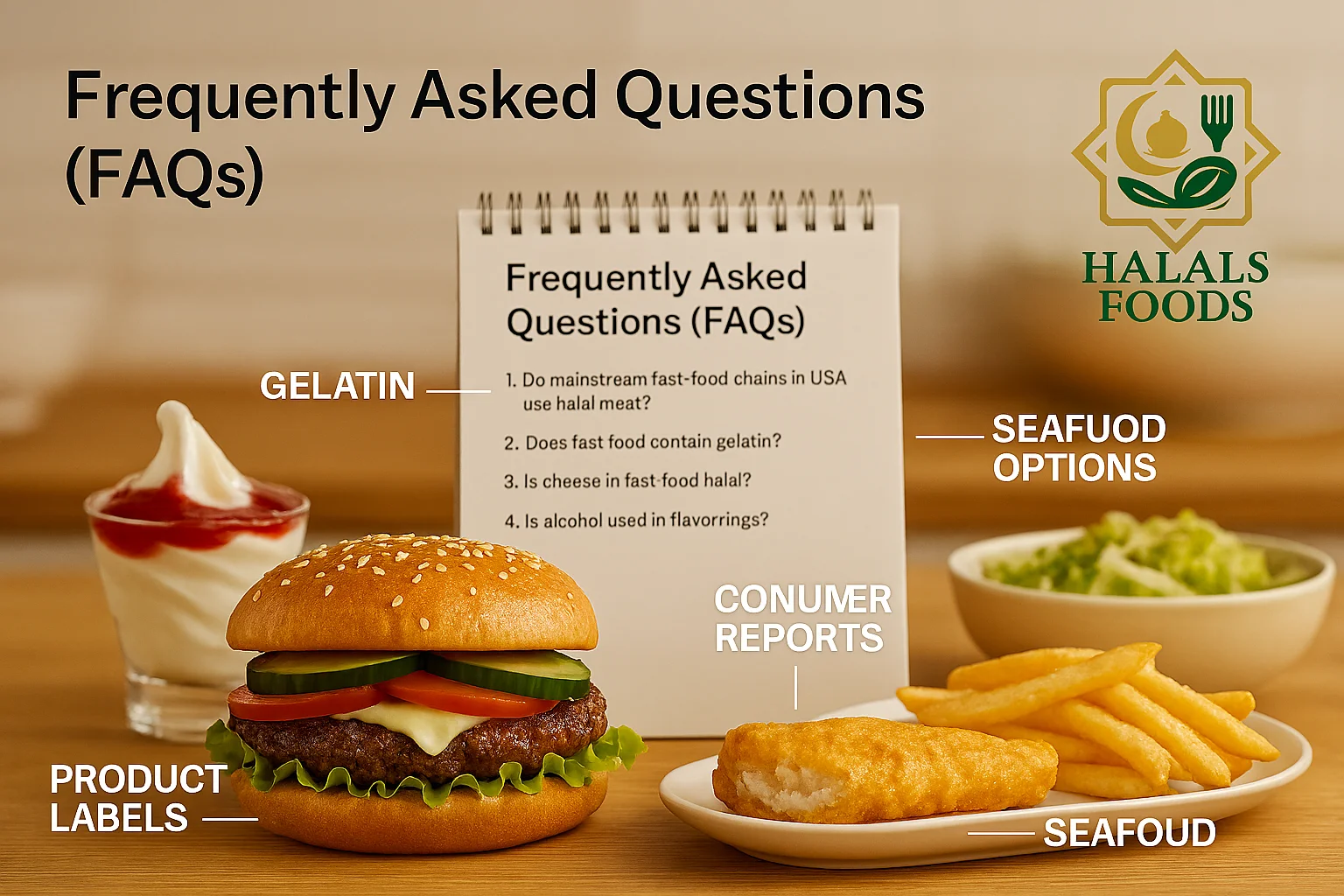
Are McDonald’s USA burgers halal?
No, McDonald’s USA does not offer nationwide halal-certified burgers or chicken.
Which fast-food chain is most trusted by Muslims in America?
The Halal Guys is one of the most recognized halal fast-food brands in the USA.
Are fries halal in American fast-food chains?
The potatoes themselves usually are, but shared fryers may create contamination concerns.
Can Muslims eat vegetarian fast food in non-halal restaurants?
Many scholars allow it if no haram ingredients or major cross-contamination issues exist.
Are halal food trucks reliable?
Many are, especially in cities with large Muslim populations. Still, certification verification is recommended.
People searching for “Is [Is Burger King Halal ]” are also curious about other foods and ingredients. Below, you’ll find related halal food articles that clearly explain ingredient sources, how products are made, and whether they meet halal requirements.
More Related Articles [ Is McDonald’s Halal in USA? ]
[ Is Subway Halal or Haram? ]
[ Is KFC Halal? ]