That ingredient is called Is E120 Halal, also known as carmine or cochineal extract, and for years Muslims across the world have debated whether it is halal, haram, or somewhere in between.
The confusing part?
Some labels simply write “natural coloring.” Others only mention “E120,” which most people never bother searching.
And honestly, that’s why this topic matters so much.
A lot of Muslims try hard to avoid pork, alcohol, and non-halal meat, but food additives often slip under the radar. Tiny ingredients hidden in chocolates, juices, desserts, medicines, and even makeup can completely change the halal status of a product.
So in this guide, we’re going deep into the reality of Is E120 Halal.
Not just surface-level answers.
We’ll break down:
- What E120 actually is
- How it’s made
- Why scholars disagree
- Which Islamic schools allow or reject it
- Why many halal certification bodies avoid it
- What Muslims in the USA, UK, and other countries should know
And yes, we’ll explain everything in simple human language without making it feel like a chemistry class.
What Exactly Is E120?
Let’s start with the basic question first.
E120 is a red coloring ingredient used in food and cosmetics.
Its common names include:
- Carmine
- Cochineal extract
- Natural Red 4
- Crimson lake
- Carminic acid
Manufacturers use it because it creates a strong, stable red or pink color that lasts longer than many artificial dyes.
You’ll often find E120 in:
- Candies
- Gummies
- Yogurts
- Ice cream
- Cakes
- Bakery fillings
- Juice drinks
- Strawberry milk
- Lipsticks
- Medicines
- Energy drinks
At first glance, nothing seems suspicious.
But then comes the uncomfortable part…
Where Does E120 Come From?
Is E120 Halal becomes controversial because of its source.
E120 is made from cochineal insects.
These tiny insects live mainly on cactus plants in parts of South America and Mexico.
To produce the coloring:
- The insects are collected
- Dried under heat
- Crushed into powder
- Processed to extract red pigment
That red pigment becomes carmine.
Yes… the red color in some foods literally comes from crushed bugs.
A lot of Muslims first discover this online and think it must be fake.
But it’s real.
Even food authorities like the FDA openly confirm that carmine comes from insects.
And once people hear this, the next question naturally becomes:
“If it comes from insects, how can it be halal?”
That’s where Islamic rulings enter the discussion.
Why Muslims Are Concerned About Is E120 Halal
For Muslims, halal is not only about avoiding pork.
The source of every ingredient matters.
Islamic dietary rules care about:
- Where something comes from
- How it was processed
- Whether it is pure or impure
- Whether it causes doubt
Most Islamic scholars agree on one major principle:
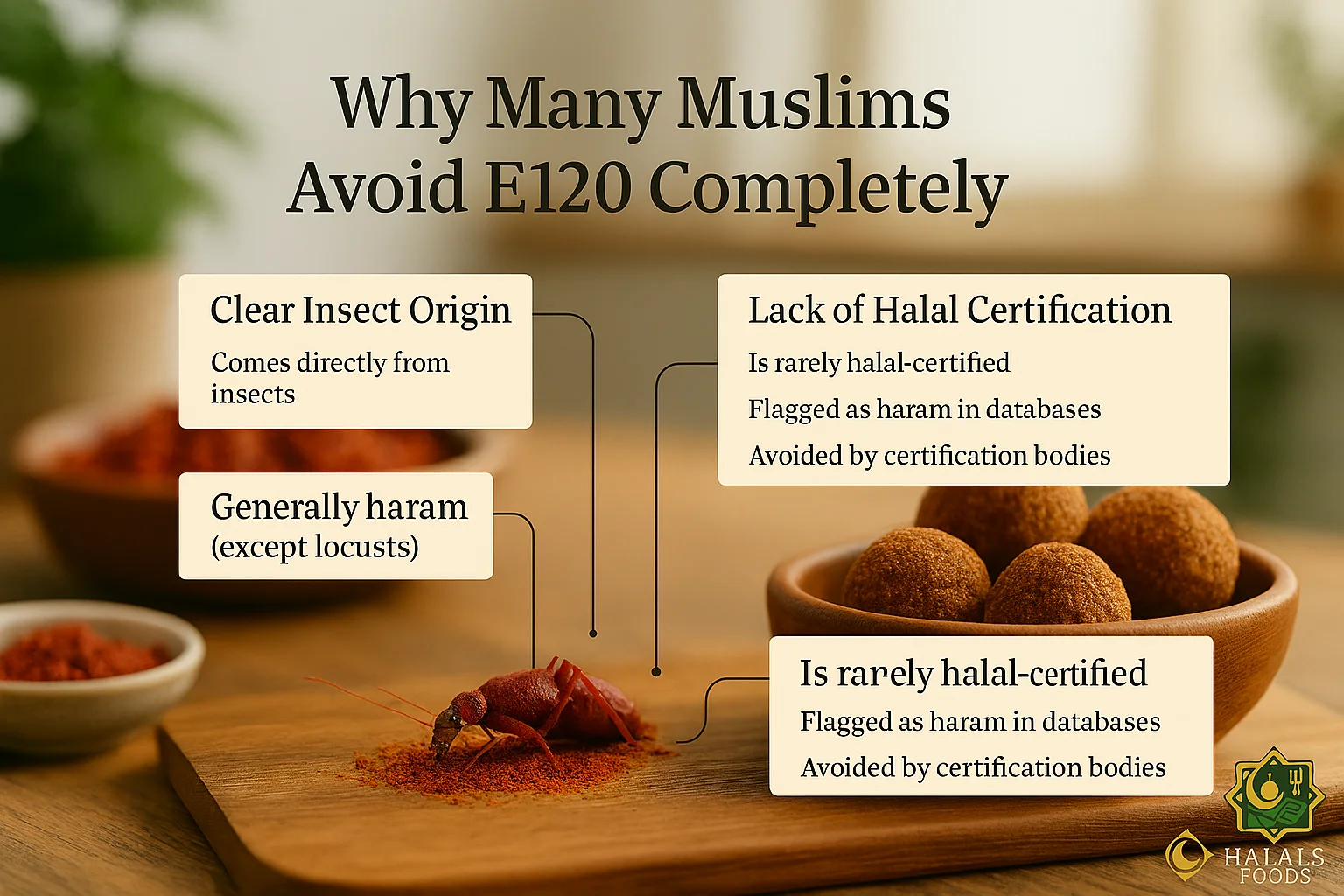
Most insects are not permissible to eat.
The famous exception is locusts, which are specifically allowed in Islamic texts.
But insects in general?
Most scholars from the Hanafi, Shafi’i, and Hanbali schools consider them impermissible.
That’s why E120 immediately becomes problematic.
Because unlike accidental contamination, this ingredient is intentionally produced from insects.
And that changes everything.
The Quick Islamic Answer on Is E120 Halal
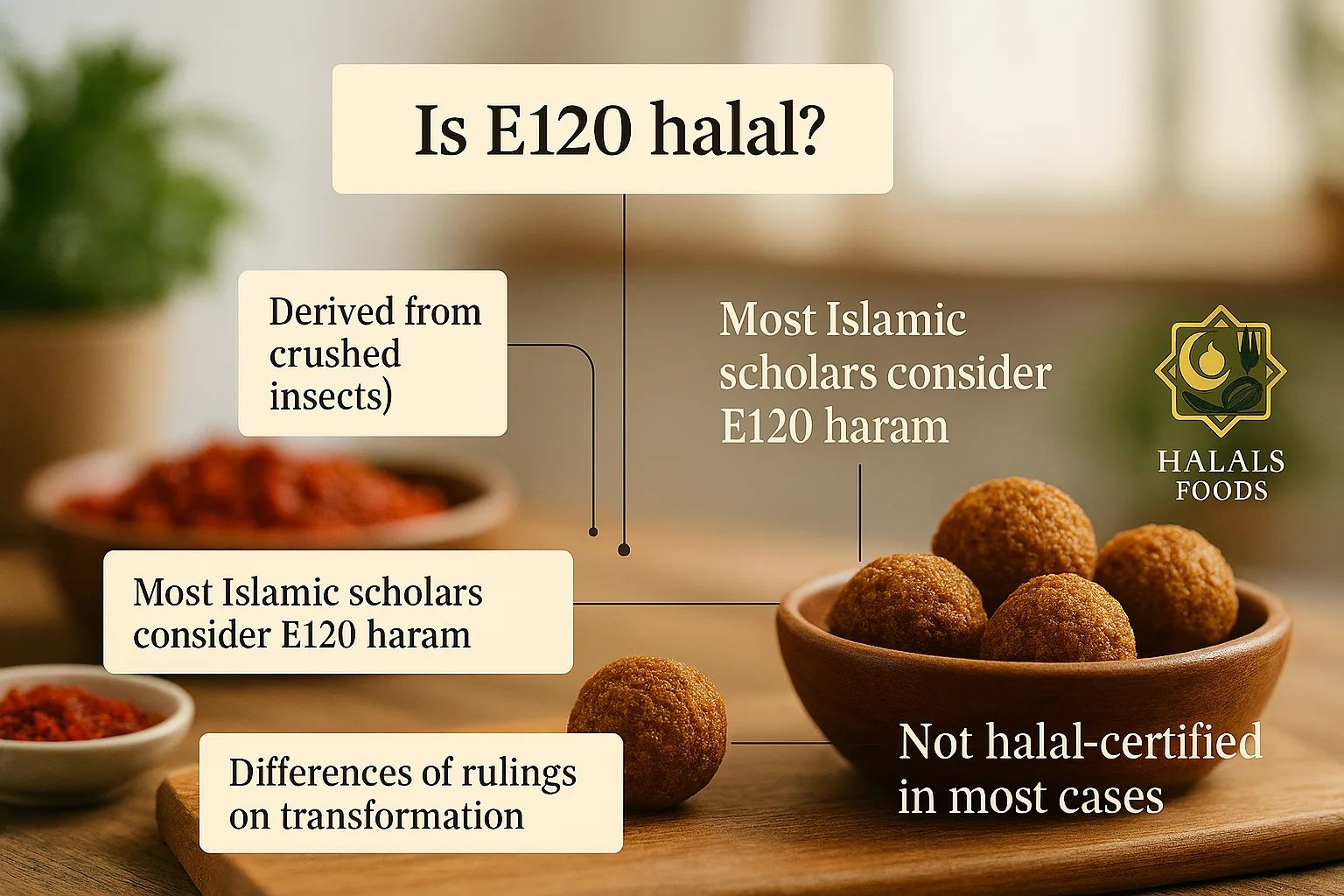
If you want the short version before we dive deeper, here it is:
➡️ The majority of scholars consider E120 haram or at least highly doubtful because it is derived directly from crushed insects.
However…
Some Maliki scholars consider it permissible due to different rulings regarding insects and transformation during processing.
So the answer is not completely black and white across every school of thought.
But globally, most halal certification organizations avoid approving E120.
That’s an important point many people ignore.
Why Manufacturers Love Using E120
You might wonder:
“If it’s controversial, why don’t companies just stop using it?”
Simple answer: performance.
E120 works extremely well as a coloring agent.
Compared to some artificial colors, carmine:
- Produces brighter shades
- Lasts longer
- Handles heat better
- Stays stable in acidic foods
- Looks more “natural” to consumers
Food companies care a lot about appearance.
A strawberry yogurt without rich pink color often looks less appealing to customers.
So manufacturers keep using E120 because it’s effective and relatively cheap.
But Muslim consumers often see things differently.
For many Muslims, appearance is not more important than halal certainty.
The Hidden Label Problem
One reason this issue keeps growing is because labels are often unclear.
Here’s the frustrating part most people don’t realize…
Companies do not always write “crushed insects.”
Instead, labels may say:
- E120
- Carmine
- Natural color
- Cochineal extract
- Crimson pigment
Many consumers never connect those names to insects.
And honestly, some brands benefit from that confusion.
Especially in Western countries, food labels can be technical enough that average shoppers simply don’t notice questionable ingredients.
That’s why Muslim consumers have become much more aware of E-numbers over recent years.
Is E120 Natural or Artificial?
Technically, E120 is natural.
But “natural” does NOT automatically mean halal.
This is where many people get confused.
Alcohol is natural.
Blood is natural.
Certain harmful substances are natural too.
Halal depends on Islamic permissibility — not whether something comes from nature.
So when companies advertise products as:
- “Made with natural coloring”
- “Naturally colored”
- “No artificial dyes”
…it does not guarantee halal compliance.
That marketing language can sometimes mislead Muslim consumers.
How Scholars Analyze Is E120 Halal
Islamic scholars usually examine three major things:
1. Source
The original source matters heavily in Islam.
Since E120 comes from insects, many scholars reject it immediately.
Especially scholars from:
- Hanafi school
- Shafi’i school
- Hanbali school
Their reasoning is straightforward:
- Insects are generally not halal
- Crushing them into food coloring does not change the ruling
2. Transformation (Istihala)
Some scholars discuss something called istihala.
This means transformation.
The argument goes like this:
“If a substance changes completely into something new, its ruling may also change.”
Supporters of E120 sometimes claim:
- The insect is chemically processed
- The final pigment becomes a new substance
- Therefore, it may become permissible
But many scholars disagree.
They argue that:
- The source remains identifiable
- The pigment still directly comes from insects
- The transformation is incomplete
This disagreement is one major reason the debate continues today.
3. Doubtful Ingredients
Islam encourages Muslims to avoid doubtful matters.
And honestly, this principle alone causes many Muslims to stay away from E120 entirely.
Because even if scholars differ, many consumers think:
“Why take the risk when halal alternatives exist?”
That mindset has become increasingly common, especially among younger Muslims in the USA, UK, and Canada.
The Maliki Opinion on Is E120 Halal
Now here’s the part many articles oversimplify.
Not all Islamic schools view insects the same way.
The Maliki school traditionally has a broader view regarding certain insects.
Some Maliki scholars say:
- Insects are permissible unless harmful
- Purity rules differ compared to other schools
- Therefore, insect-derived ingredients may be allowed
This is why some Muslims from Maliki backgrounds may accept E120.
But even among Maliki scholars, opinions are not always identical.
And many modern halal organizations still avoid certifying it due to global consumer concerns.
So while the Maliki opinion exists, it is still considered a minority position worldwide.
Does Quantity Matter?
Another common question:
“If only a tiny amount of E120 is used, does it still matter?”
Some people argue:
- The quantity is extremely small
- It’s only for coloring
- It’s not consumed directly as food
But many scholars reject this reasoning.
Their position is:
A haram source does not become halal simply because the amount is small.
And honestly, this logic is consistent with many other halal rulings too.
Common Foods That May Contain E120
This is where things get practical.
Products that commonly contain E120 include:
- Red velvet cake
- Strawberry yogurt
- Pink donuts
- Fruit candies
- Jelly sweets
- Ice cream
- Milkshakes
- Juice drinks
- Processed desserts
- Colored frosting
And surprisingly…
Even some “healthy” products may contain it because companies prefer natural coloring over synthetic dyes.
That’s why reading labels matters more than marketing claims.
What About Cosmetics?
Here’s something many Muslims forget:
E120 is not limited to food.
It also appears in:
- Lipsticks
- Blush
- Eye shadows
- Shampoo
- Soap
- Skincare products
Some scholars are stricter with consumption than external use.
Others still prefer avoiding it completely.
So Muslims concerned about halal cosmetics often check for carmine-free products too.
Why Many Halal Brands Avoid E120
A huge clue comes from the halal industry itself.
Most trusted halal-certified brands intentionally avoid E120.
Why?
Because it creates unnecessary controversy.
Instead, many brands now use plant-based alternatives like:
- Beetroot extract
- Paprika extract
- Anthocyanins
- Lycopene
These alternatives are easier to certify and more widely accepted by Muslim consumers.
That shift tells you a lot about how the halal market views E120 today.
The Bigger Issue Behind Is E120 Halal
Honestly, this topic is about more than one food dye.
It reveals a much bigger issue:
Modern food ingredients are becoming increasingly complex.
A product can look completely halal on the outside while hiding questionable additives inside.
That’s why Muslims today are researching:
- E-numbers
- Emulsifiers
- Gelatin sources
- Enzymes
- Flavorings
- Color additives
People are becoming more careful.
And companies are slowly realizing Muslim consumers actually read ingredient labels now.
Here’s the Part Most People Ignore…
Many debates online become emotional very quickly.
One side says:
“Obviously haram.”
Another side says:
“It’s only a tiny ingredient.”
But real halal research requires balance.
The reality is:
- There IS scholarly disagreement
- Majority opinion leans toward impermissible
- Some minority opinions allow it
- Halal certification bodies mostly reject it
- Consumers ultimately choose based on their level of caution
And that nuance matters.
Because oversimplifying Islamic rulings often creates even more confusion.
The discussion around Is E120 Halal becomes even more interesting when you look at manufacturing methods, alcohol usage during processing, halal certification standards, and why some Muslim countries quietly allow products that others reject completely.
And honestly… that’s where the debate gets much deeper.
The debate around Is E120 Halal becomes much more complicated once you move beyond simple ingredient lists.
Because for many Muslims, the real question is not only:
“Does it come from insects?”
But also:
- Does processing change the ruling?
- What do halal certification bodies actually say?
- Why do some countries allow it while others reject it?
- Can necessity make it permissible?
- And how should an average Muslim handle doubtful ingredients today?
That’s where things become deeper than a quick Google answer.
How E120 Is Actually Manufactured
Most people hear “insect-based coloring” and imagine companies simply crushing bugs directly into food.
The reality is more industrial than that.
The manufacturing process for E120 usually includes:
- Harvesting cochineal insects from cactus plants
- Drying the insects using heat or sunlight
- Crushing them into powder
- Extracting pigment compounds
- Filtering impurities
- Concentrating the final red coloring
The main coloring compound is called carminic acid.
That compound creates the deep red shade companies want.
Now here’s why this matters Islamically…
The insects are intentionally processed for consumption purposes.
This is not accidental contamination.
The entire production system depends on insect extraction.
That fact alone causes many scholars to classify it as haram.
Does Chemical Processing Make Is E120 Halal?
This is one of the biggest arguments supporters use.
They say:
“The insect changes chemically during processing, so the final substance becomes different.”
This argument is based on the Islamic concept of istihala.
But scholars disagree heavily about whether E120 truly qualifies.
Scholars Who Reject the Transformation Argument
Many scholars argue:
- The original source remains identifiable
- The red pigment still comes directly from insects
- The chemical structure is still linked to insect extraction
Their conclusion:
Transformation is incomplete.
Therefore, the ruling does not change.
This opinion is dominant among many modern halal authorities.
Scholars Who Accept Transformation
A smaller group believes:
- Extensive processing changes the substance
- The original insect form disappears
- The final product behaves differently chemically
Because of this, they consider E120 potentially permissible.
But again, this remains a minority opinion globally.
And for cautious consumers, the existence of disagreement itself becomes enough reason to avoid it.
Alcohol Use During Production
Here’s another detail many consumers never hear about.
Some E120 manufacturing methods use alcohol solvents during extraction.
Usually ethanol.
Now manufacturers often claim:
“The alcohol evaporates later.”
But from a halal perspective, this still creates concern because:
- Processing details are rarely transparent
- Solvent sources may vary
- Consumers cannot easily verify purification methods
And honestly, this is where modern food systems become frustrating for Muslims.
A simple yogurt cup suddenly requires ingredient research, fiqh understanding, and manufacturing knowledge just to decide whether it’s halal.
Why Halal Certification Bodies Mostly Reject E120
This part is extremely important.
Many Muslims assume:
“If products are sold publicly, they must already be acceptable.”
But halal certification organizations operate differently.
Their job is to remove doubt.
And because E120 already creates major scholarly concerns, most halal certifiers avoid approving it altogether.
Organizations that commonly reject or avoid E120 include:
- IFANCA
- Halal Monitoring Committee UK
- HFSAA
- JAKIM Malaysia
- Various Gulf halal authorities
Their reasoning usually includes:
- Insect origin
- Lack of clear permissibility
- Consumer confusion
- Availability of halal alternatives
That last point matters a lot.
When halal substitutes already exist, scholars often prefer safer options.
Why Some Countries Still Allow Products With E120
This confuses many Muslims.
They wonder:
“If it’s problematic, why is it still sold everywhere?”
Simple answer:
Food legality and halal permissibility are different things.
Governments only check:
- Safety
- Health standards
- Labeling laws
They do NOT determine Islamic halal rulings.
So a product being legally sold in:
- America
- Canada
- UK
- Europe
…does not automatically mean it is halal.
This distinction is critical.
The USA Market and Hidden Ingredients
In the USA especially, many Muslims unknowingly consume E120 because labeling can be confusing.
Some products clearly state:
- Carmine
- Cochineal extract
Others only mention:
- Natural color
- Artificial and natural coloring
- Color added
And honestly, many consumers never research further.
That’s why awareness about halal ingredients has grown massively over recent years.
Muslims now regularly search:
- Is gelatin halal?
- Are enzymes halal?
- Is Red 40 halal?
- Are emulsifiers halal?
- Is E120 Halal
The halal food conversation is evolving beyond meat alone.
Why Younger Muslims Are More Careful Today
A noticeable shift is happening globally.
Younger Muslim consumers are becoming extremely ingredient-aware.
Not because they want life to become difficult…
But because processed food has become more complicated than ever.
Many Muslims now prefer:
- Halal-certified snacks
- Plant-based coloring
- Transparent ingredient lists
- Simple foods with fewer additives
And honestly, brands are noticing this change.
That’s one reason many companies are replacing E120 with plant alternatives.
Not only for Muslims…
But also for:
- Vegans
- Vegetarians
- Ethical consumers
- People uncomfortable with insect-derived ingredients
The Psychology Behind “Natural” Marketing
Here’s something interesting.
Manufacturers know consumers trust the word “natural.”
So E120 often gets marketed as:
- Natural coloring
- Natural red dye
- Naturally sourced pigment
Technically, that’s true.
But emotionally, consumers often imagine fruits or vegetables — not insects.
That marketing gap creates confusion.
Especially for Muslim consumers who assume natural automatically means safer or halal-friendly.
What Should Muslims Do Practically?
This is the real-life question most people care about.
Because average Muslims don’t want to become food scientists every time they shop.
So what’s the practical approach?
Option 1: Follow Majority Opinion and Avoid It
This is the most common approach.
Many Muslims simply avoid E120 because:
- Majority scholars reject it
- Halal bodies avoid it
- Doubt exists
- Alternatives are available
This approach prioritizes caution.
Option 2: Follow a Minority Scholarly Opinion
Some Muslims follow scholars who permit E120 based on:
- Maliki rulings
- Transformation arguments
- Necessity or hardship
While this opinion exists, it is less commonly accepted internationally.
Option 3: Choose Only Halal-Certified Products
This has become one of the easiest solutions.
Instead of researching every ingredient manually, many Muslims simply buy products carrying trusted halal certification.
That removes much of the uncertainty.
Foods Muslims Often Forget May Contain E120
Most people check candy.
But E120 can appear in unexpected products too.
Including:
- Strawberry yogurt
- Protein shakes
- Cheesecake toppings
- Breakfast pastries
- Flavored milk
- Ice cream syrups
- Energy drinks
- Cough syrups
- Gummies
- Vitamin supplements
Even some “organic” products may contain it because companies prefer natural color sources.
So organic does not automatically mean halal either.
The Difference Between Red 40 and E120
A common question online is:
“Why is Red 40 considered halal but E120 often considered haram?”
The answer comes down to source.
Red 40
Usually synthetic.
Not derived from insects or animals.
So while health concerns may exist, halal concerns are generally lower.
E120
Directly insect-derived.
That creates the Islamic issue.
So even though some people dislike artificial colors more, halal rulings focus heavily on source origin.
Can E120 Be Allowed in Emergencies?
Some scholars discuss necessity.
For example:
- Certain medicines
- Essential treatments
- Lack of alternatives
In those situations, Islamic law sometimes allows otherwise prohibited substances temporarily.
But for regular foods like:
- Candy
- Desserts
- Yogurt
…the necessity argument usually becomes much weaker because alternatives exist.
Why Many Muslims Prefer Staying Away Entirely
Honestly, many Muslims reach a simple conclusion:
“There are already enough halal options available.”
And that’s reasonable.
If someone can choose:
- Beetroot coloring
- Fruit-based pigments
- Halal-certified snacks
…then avoiding E120 becomes easy.
This is why the halal market increasingly promotes:
- Carmine-free products
- Vegan coloring
- Plant-based alternatives
Consumer demand is changing the industry slowly.
Halal Alternatives to E120
Here are some common alternatives brands now use:
| Alternative | Source | Halal Status |
|---|---|---|
| E162 | Beetroot | Generally halal |
| E163 | Fruits/berries | Halal |
| Lycopene | Tomatoes | Halal |
| Paprika extract | Peppers | Halal |
These ingredients provide similar coloring without insect concerns.
That’s one major reason many halal companies completely avoid E120 now.
The Core Islamic Principle Many Muslims Follow
At the heart of this discussion is one famous Islamic principle:
“Leave what causes you doubt for what does not cause you doubt.”
For many Muslims, Is E120 Halal falls directly into doubtful territory.
And when halal alternatives exist, avoiding doubtful ingredients feels easier spiritually.
That’s why even Muslims who know about minority permissibility opinions may still personally avoid it.
Final Verdict on Is E120 Halal
After reviewing:
- Ingredient origins
- Manufacturing methods
- Scholarly opinions
- Halal certifications
- Industry practices
- Modern halal standards
…the strongest overall conclusion is this:
➡️ The majority of Islamic scholars and halal certification authorities consider E120 haram or highly doubtful because it is derived from crushed insects.
A minority opinion — mainly connected to Maliki fiqh and transformation arguments — allows it under certain interpretations.
However, globally:
- Most halal organizations avoid certifying it
- Most cautious Muslim consumers avoid it
- Halal alternatives are widely available
So for Muslims wanting the safest and clearest halal choice:
Avoiding products containing E120 is generally the preferred option.
Frequently Asked Questions About Is E120 Halal
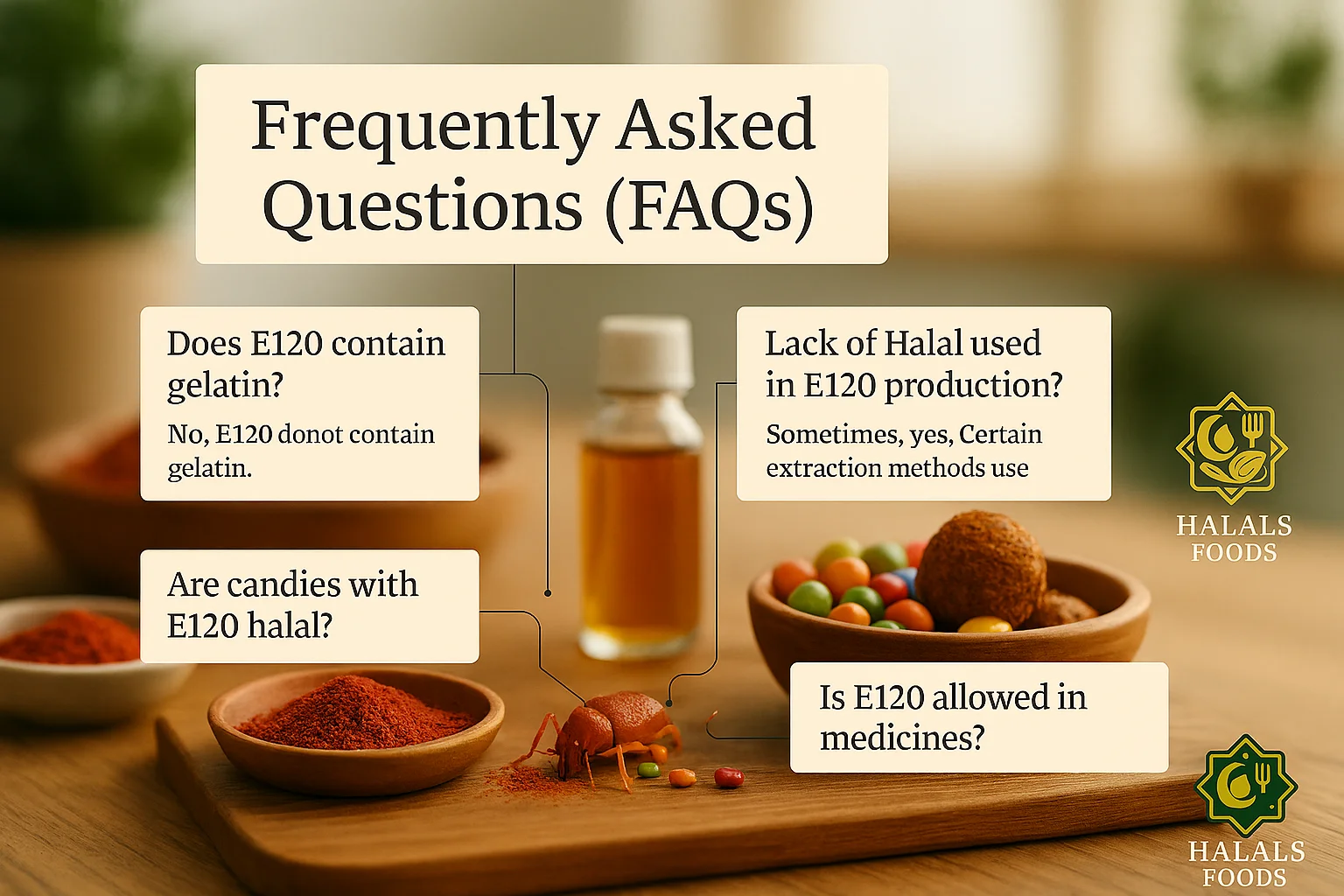
1. Is E120 made from bugs?
Yes. E120 is produced from cochineal insects that are dried and crushed to extract red pigment.
2. Is carmine the same as E120?
Yes. Carmine, cochineal extract, and E120 all refer to the same coloring ingredient.
3. Is Is E120 Halal according to Hanafi scholars?
Most Hanafi scholars consider E120 impermissible because it comes from insects.
4. Is E120 vegan?
No. Since it is derived from insects, E120 is not considered vegan.
5. Why do companies still use E120?
Because it creates a strong, stable natural red color that lasts longer than many alternatives.
6. Is E120 used in makeup too?
Yes. Carmine is commonly found in lipsticks, blushes, and cosmetic products.
7. What should Muslims look for on labels?
Watch for terms like:
- Carmine
- Cochineal
- E120
- Natural Red 4
8. Is E120 banned in halal foods?
Many halal-certified brands avoid it, but regulations vary depending on scholars and certification standards.
9. Are all red-colored foods haram?
No. Many red food colorings come from halal plant sources like beetroot or berries.
10. Is E120 worse than artificial dyes?
From a halal perspective, the issue is its insect origin — not necessarily health risk.
more related [ Is Vanilla Extract Halal ]
more[ Haram Ingredients to Avoid ]