If you’ve ever stood in a store holding a pack of Skittles and wondering “Can I eat this or not? Is Skittles Halal ?” — you’re definitely not alone.
I’ve personally checked this product more than once, especially because it looks harmless. It’s just a fruity candy, right? No chocolate, no obvious gelatin texture like gummies. But halal decisions aren’t always that simple.
The truth Is Skittles Halal sit in a gray zone. Not clearly haram, not fully halal-certified either.
So instead of giving you a one-line answer, let’s break it down in a real, practical way — the way most Muslims actually think when buying snacks.
Is Skittles Halal What’s Actually Inside These Candies?
Let’s start with what we can see — the ingredient list.
Most Skittles packs (especially from the U.S. and UK) include:
- Sugar
- Corn syrup
- Hydrogenated palm kernel oil
- Citric acid
- Natural and artificial flavors
- Food colorings (Red 40, Yellow 5, Yellow 6, Blue 1)
- Modified corn starch
- Tapioca dextrin
- Sodium citrate
- Carnauba wax
At first glance, everything looks pretty standard.
When I checked the label myself, nothing jumped out as obviously haram. No gelatin listed, no animal fats, nothing like that.
But halal checking isn’t just about what’s written clearly — it’s also about hidden sources and processes.
Is Skittles Halal Ingredient-by-Ingredient: What’s Safe and What’s Not?
To make things clearer, here’s a quick breakdown:
✔ Clearly Halal Ingredients
- Sugar
- Corn syrup
- Corn starch
- Palm oil
- Citric acid
- Carnauba wax
All of these are plant-based or synthetic. No real debate here.
⚠️ The “Doubtful Zone” Ingredients
- Natural flavors
- Artificial flavors
This is where things get tricky.
These flavors can be:
- Plant-based (perfectly halal)
- Animal-derived (not always halal)
- Processed using alcohol (debated issue)
And the biggest issue?
👉 The company doesn’t fully explain their source.
Quick Ingredient Verdict Table
Here’s a simple table you can use (and even reuse in your articles):
| Ingredient | Source Type | Halal Status | Notes |
|---|---|---|---|
| Sugar | Plant | Halal | Standard |
| Corn Syrup | Plant | Halal | No issue |
| Palm Oil | Plant | Halal | Widely accepted |
| Citric Acid | Fermentation | Halal | No alcohol remains |
| Modified Corn Starch | Plant | Halal | Safe |
| Carnauba Wax | Plant | Halal | Used for shine |
| Food Colors (E-numbers) | Synthetic | Halal | Except E120 |
| Natural Flavors | Unknown | Doubtful | Not disclosed |
| Artificial Flavors | Synthetic/Mixed | Doubtful | Depends on process |
The One Ingredient That Makes People Pause
If you ask scholars or even regular halal-conscious consumers, almost everyone points to the same thing:
👉 Flavors
Why?
Because “natural flavor” is basically a black box.
It can include:
- Plant extracts
- Animal extracts
- Alcohol-based solvents
And companies like Mars/Wrigley usually respond with:
“Our flavors are proprietary.”
Which basically means… they won’t tell you.
What About Gelatin? (Big Question)
This is usually the first thing Muslims check in candy.
✔ Good News:
Modern Skittles do NOT contain gelatin
That’s a big reason why they became popular among Muslims.
❗ But Here’s Something Many People Don’t Know
Older versions — especially in the UK before 2010 — did contain gelatin.
So if someone still thinks Skittles are haram because of gelatin, they’re likely referring to old formulations.
Colors: Safe or Not?
Food coloring is another major concern.
✔ Synthetic Colors (Safe)
- Red 40
- Yellow 5
- Yellow 6
- Blue 1
These are synthetic and generally considered halal.
❗ The Problem: Carmine (E120)
Carmine is:
- Made from crushed insects
- Clearly haram
Now here’s the key point:
👉 U.S. and UK Skittles DO NOT use E120
But…
👉 Some imported versions might
That’s why checking labels is still important — especially in regions like:
- Middle East
- Asia
- Imported candy shops
The Good, The Bad, and the Doubtful
Let’s simplify everything so far:
✔ The Good
- No gelatin
- Mostly plant-based ingredients
- Synthetic colors in major markets
⚠️ The Doubtful
- Flavor sources unknown
- Possible alcohol in processing
- No certification
❌ The Risk (in some regions)
- Possible E120 in imported versions
How These Candies Are Actually Made
Now let’s talk about something most people ignore:
👉 Manufacturing
Even if Is Skittles Halal ingredients look halal, production still matters.
Skittles are made by Mars/Wrigley, a huge global company.
They also produce:
- Starburst (often contains gelatin)
- Other chewy candies
- Products with animal-derived ingredients
Cross-Contamination Risks Explained
Here’s the concern:
- Same factories
- Sometimes same equipment
- Different products
Now yes, factories clean their machines.
But…
👉 They follow food safety standards, not halal standards
This means:
- No guarantee of complete halal separation
- No halal supervision
For strict Muslims, this is a serious issue.
From Factory to Pack: What We Don’t Know
There are a few things the company doesn’t clearly confirm:
- Are Skittles made on dedicated lines?
- Are flavoring processes alcohol-free?
- Are suppliers halal-compliant?
Because of this, halal authorities usually say:
👉 “Ingredients look permissible, but we cannot certify it.”
Real-Life Comparison (Makes It Easier)
Let’s compare Skittles with other popular candies:
| Product | Gelatin | Certification | Halal Status |
|---|---|---|---|
| Skittles | No | No | Halal-friendly |
| Starburst | Yes | No | Usually Haram |
| Sour Patch Kids | No | No | Similar to Skittles |
| Haribo Gummies | Yes | Sometimes | Often Haram |
So if someone is choosing casually, Skittles are often seen as a “better option” — but not perfect.
A Shopper’s Perspective (Real Talk)
When I personally checked Skittles in-store, here’s what stood out:
- Ingredient list looked clean
- No gelatin mentioned
- No obvious haram additives
But at the same time:
- No halal logo
- No detailed explanation of flavors
That’s exactly why this product feels safe but not fully certain.
Why This Question Even Exists
If Skittles removed gelatin and use synthetic colors, why is there still confusion?
Because halal isn’t just about ingredients.
It’s about:
- Source
- Process
- Certification
- Transparency
And Skittles lack that last part — transparency.
Where Most Muslims Stand Today
From what I’ve seen:
Majority View (especially in U.S./UK)
👉 Eat it without much concern
Careful View
👉 Eat occasionally but remain cautious
Strict View
👉 Avoid completely unless certified
Are They Really Halal-Certified? Let’s Clear This Up
One of the biggest misunderstandings about Skittles is that people assume:
👉 “If it looks halal, it must be halal.”
But in reality, halal certification works very differently.
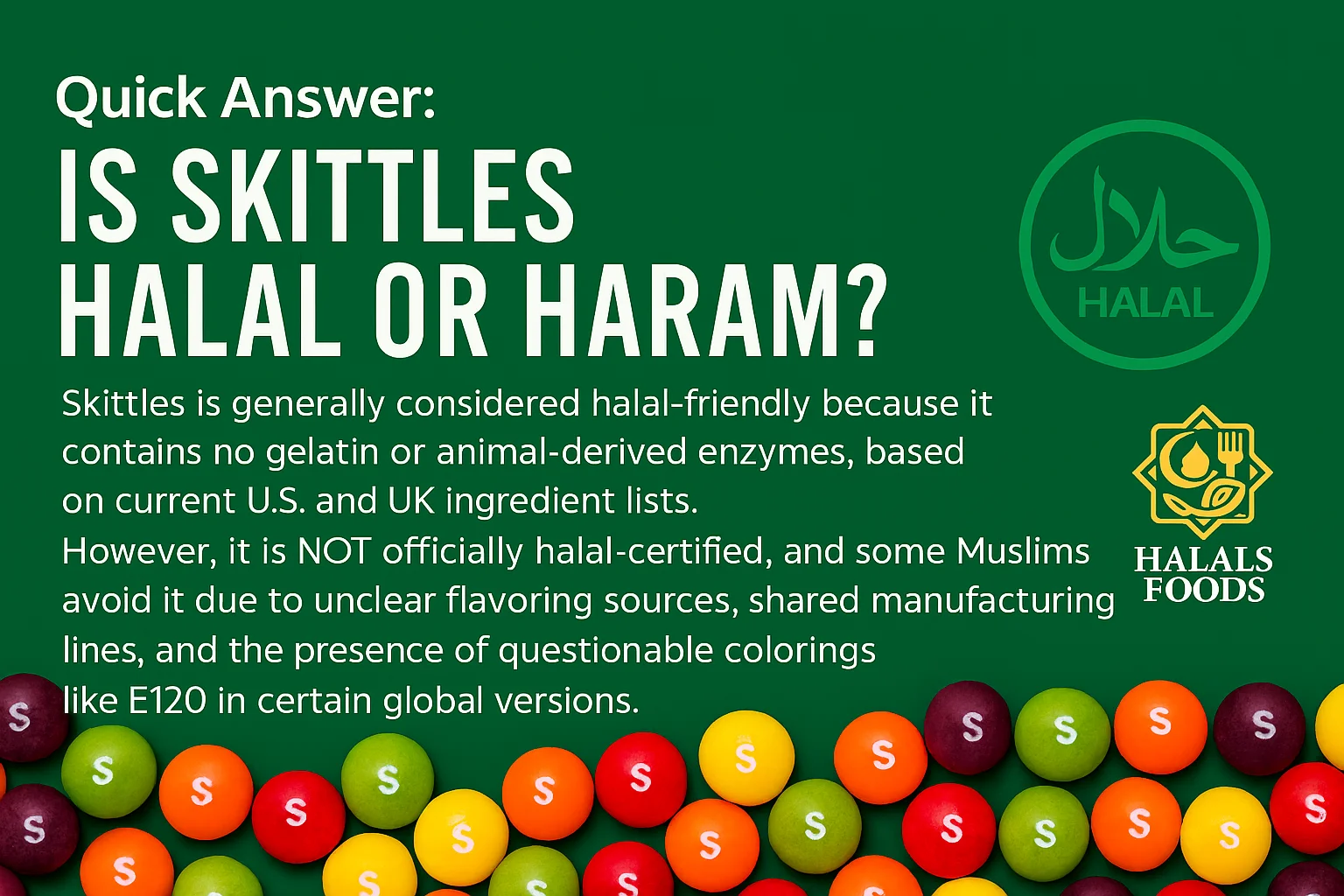
Skittles is NOT halal-certified — anywhere in the world.
I checked multiple halal authority listings and databases, including:
- IFANCA (USA)
- HFSAA
- Halal Food Authority (UK)
- HMC (UK)
None of them list Skittles as certified.
And that alone is enough for some Muslims to completely avoid it.
Why Isn’t Skittles Halal-Certified?
This is actually an important question.
Because if Skittles already removed gelatin and uses mostly plant-based ingredients, why not just get certified?
Here are the real reasons:
1. Global Supply Chain Complexity
Skittles is sold worldwide, and ingredients may come from different suppliers.
To get halal certification, a company must:
- Track every ingredient source
- Ensure all suppliers are halal-compliant
- Maintain consistency across regions
That’s not easy for a global brand.
2. Flavor Transparency Issues
As we discussed earlier, flavors are the biggest gray area.
Halal certification requires:
- Full disclosure of ingredients
- Clear confirmation of no alcohol use
Mars/Wrigley keeps this information proprietary, which blocks certification.
3. Shared Production Facilities
To become halal-certified, companies often need:
- Dedicated halal production lines
- Or strict segregation protocols
Since Mars produces multiple types of candies (including non-halal ones), this becomes complicated and costly.
4. Business Decision (Simple Reality)
Let’s be honest:
👉 Skittles is a global mainstream product, not specifically targeting halal markets.
So from a business perspective, they may not see enough reason to go through the certification process.
Checking Is Skittles Halal Validity in the U.S. vs Other Countries
This part is really important — because Skittles is not the same everywhere.
🇺🇸 United States
- No gelatin
- No carmine (E120)
- Synthetic colors used
- No certification
👉 Generally considered halal-friendly
🇬🇧 United Kingdom
- Similar to U.S. formula
- Transparent labeling
- No gelatin
👉 Many UK Muslims are comfortable consuming it
🌍 Middle East & Asia
- Some products are imported
- Possible variation in color ingredients
- Small risk of E120 in certain batches
👉 Needs extra label checking
🇨🇦 Canada
- Similar to U.S.
- No certification
👉 Same ruling: halal-friendly but not guaranteed
Certification vs “Halal-Friendly” — Big Difference
A lot of people mix these two up.
Here’s a simple comparison:
| Category | Meaning |
|---|---|
| Halal-Certified | Fully verified by an authority |
| Halal-Friendly | Ingredients look permissible but not verified |
| Mushbooh (Doubtful) | Some uncertainty exists |
👉 Skittles falls into: Halal-friendly / Mushbooh
What Scholars Actually Say
Different scholars look at Skittles differently.
Hanafi Perspective (Generally Stricter)
Many Hanafi scholars are cautious because:
- Flavor sources are unknown
- Possible alcohol use in extraction
- No certification
👉 Result: Often labeled mushbooh (doubtful)
Shafi’i Perspective (More Flexible in Some Cases)
Some Shafi’i scholars allow:
- Ingredients that undergo transformation (istihalah)
- Products where no alcohol remains in final form
👉 Result: May consider Skittles permissible
Common Ground
Almost all scholars agree on this:
👉 If you want to be 100% safe → choose certified halal
👉 If you accept some uncertainty → Skittles may be okay
Common Mistakes Consumers Make
A lot of people make these mistakes when checking halal snacks:
❌ Mistake 1: “No gelatin = 100% halal”
Not always true. Flavors and processing still matter.
❌ Mistake 2: Ignoring E-numbers
Especially E120 (carmine) — always check this.
❌ Mistake 3: Assuming all countries use the same formula
They don’t. Ingredients can change by region.
❌ Mistake 4: Trusting brand popularity
Just because it’s famous doesn’t mean it’s halal.
Quick Tips for Halal Shoppers
If you’re buying Skittles (or any candy), keep this simple checklist:
- ✔ Check for gelatin
- ✔ Look for E120 (carmine)
- ✔ Check halal logo (if available)
- ✔ Avoid imported unknown variants
- ✔ Prefer products with simple ingredients
The Good, The Bad, and the Reality
Let’s be completely honest here.
✔ Why Is Skittles Halal Feels Safe
- No gelatin anymore
- Mostly plant-based ingredients
- Widely consumed by Muslims
⚠️ Why It’s Still Questioned
- No halal certification
- Flavor sources unclear
- Possible alcohol in processing
- Shared factories
👉 The Reality
It’s not clearly haram.
But it’s also not 100% guaranteed halal.
My Safe Picks for Halal Candy (Better Alternatives)
If you want to avoid confusion completely, here are better options:
- Halal-certified gummies (look for official logos)
- Brands like Ziyad, Halal Candies, or certified Haribo lines
- Local halal stores (more reliable sourcing)
Compared to Skittles, these give peace of mind.
What I Personally Recommend
Here’s the most practical advice:
✔ If you’re a casual consumer:
You can eat Skittles (especially U.S./UK versions) without overthinking.
✔ If you’re moderately careful:
Eat occasionally, but avoid imported or unknown versions.
✔ If you’re strict about halal:
👉 Skip Skittles and go for certified options.
Final Verdict (Simple Answer)
Let’s make it crystal clear:
👉 Skittles is halal-friendly but NOT halal-certified
- No gelatin
- No obvious haram ingredients
- But lacks transparency and certification
So:
✔ Acceptable for many Muslims
✘ Doubtful for strict followers
Frequently Asked Questions
Is Skittles Halal for kids?
Same ruling applies. Many parents allow them, but stricter families avoid.
Do Skittles contain alcohol?
Not in the final product, but extraction methods are unclear.
Are Sour Skittles different?
No, same ruling as regular Skittles.
Are Skittles vegan?
Yes — which is one reason many assume they are halal.
Is vegan equal to halal?
No. Vegan just means no animal ingredients — halal also includes processing and sourcing rules.
Checklist for Safe Candy Choices
Before buying any candy, ask:
- Does it contain gelatin?
- Does it contain E120?
- Is it halal-certified?
- Are flavor sources clear?
If any answer is unclear → it becomes doubtful.
Final Thought (Real Talk)
At the end of the day, this isn’t just about Skittles.
It’s about how you approach halal:
- Some people prioritize convenience
- Some prioritize certainty
And both approaches exist within the Muslim community.
Skittles just happens to sit right in the middle of that line.
Related Halal Food Guides You May Find Helpful
People searching for “Is [ Is Starburst Halal or Doubtful? ]” often explore similar halal food guides to better understand ingredients and halal status.
People searching for “Is [ Are Sour Patch Kids Halal? ]” are also interested in related snacks and their halal rulings based on ingredients and processing.
More : [ Are Jolly Ranchers Halal ]
More : [ Are Doritos Halal? ]