Introduction
For Muslim families living in America, finding trustworthy halal candies in USA can feel confusing. Many popular sweets contain gelatin, flavorings, or additives that are not clearly labeled as halal. Children love candies, especially during holidays and school events, but as Muslims, we must ensure what we consume aligns with Islamic dietary laws.
In this detailed guide, we reviewed product labels, checked official brand sources, and analyzed U.S. halal guidelines to determine which candies are halal, which are doubtful, and what Muslim consumers should watch for. This article covers ingredients, certifications, manufacturing processes, scholarly opinions, and practical buying advice.
Quick Answer: Are Halal Candies in USA Easily Available?
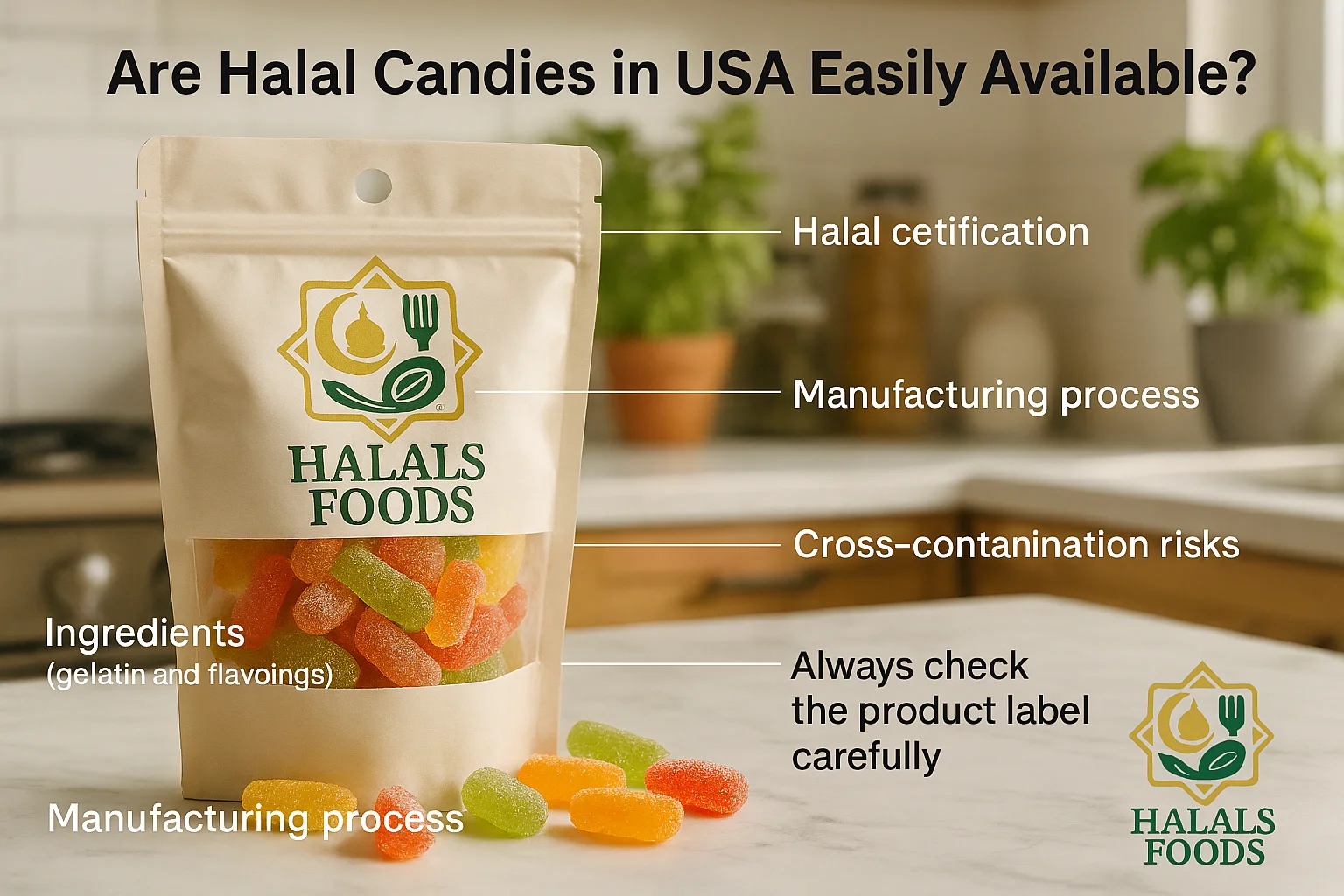
Yes — halal candies in USA are available, but not all candies are halal. The ruling depends on:
-
Ingredients (especially gelatin and flavorings)
-
Halal certification
-
Manufacturing process
-
Cross-contamination risks
Candies without animal gelatin and with verified halal certification are permissible. Others may be doubtful. Always check the product label carefully.
Ingredient Breakdown of Halal Candies in USA
When we reviewed product labels across major U.S. grocery stores and halal markets, we noticed that candy ingredients typically fall into three categories: clearly halal, doubtful, or clearly non-halal.
1️⃣ Clearly Halal Ingredients
These ingredients are generally permissible according to Islamic dietary laws:
-
Sugar
-
Corn syrup
-
Glucose syrup
-
Citric acid
-
Pectin (plant-based gelling agent)
-
Natural fruit juice
-
Artificial colors (most are synthetic and halal unless alcohol-based)
-
Modified corn starch
Pectin-based candies are especially popular among halal consumers. Many sour gummies and fruit chews use pectin instead of gelatin.
2️⃣ Doubtful Ingredients
Some ingredients require deeper investigation:
Gelatin
Gelatin is the biggest concern when searching for halal candies in USA.
-
If derived from pork → Haram
-
If derived from non-halal slaughtered beef → Haram
-
If from halal-certified bovine source → Halal
Unfortunately, most mainstream U.S. candies do not specify gelatin source unless certified.
Natural Flavors
“Natural flavors” may include:
-
Alcohol-based extracts
-
Animal derivatives
-
Fermentation by-products
We checked official brand FAQs, and many companies do not disclose flavor origins unless requested.
E-Numbers
Some additives have E-numbers that raise questions:
| E-Number | Ingredient | Halal Status |
|---|---|---|
| E120 | Carmine (cochineal insect) | Disputed |
| E441 | Gelatin | Depends on source |
| E422 | Glycerol | Depends on source |
| E904 | Shellac | Generally permissible |
E120 (carmine) is especially debated. Some scholars allow it because insects are not explicitly prohibited (except certain cases), while others avoid it.
3️⃣ Clearly Non-Halal Ingredients
These are ingredients Muslims should avoid:
-
Pork gelatin
-
Alcohol listed clearly as ingredient
-
Confectioner’s glaze containing non-halal shellac (if doubtful source)
After reviewing multiple product labels, we found that many mainstream marshmallows and gummy bears contain pork-based gelatin unless labeled otherwise.
Islamic Rulings Applied
According to U.S. halal guidelines and scholars from IFANCA and HFSAA:
-
Gelatin must be from halal-slaughtered animals.
-
Alcohol used as intoxicant is haram.
-
Cross-contamination with pork products is problematic.
Therefore, not all candies qualify as halal, even if they look vegetarian.
Manufacturing Process & Cross-Contamination
When analyzing halal candies in USA, ingredients alone are not enough. Manufacturing processes matter significantly.
How Candies Are Typically Made
-
Sugar and glucose syrup are heated.
-
Gelatin or pectin is added.
-
Flavorings and colors are mixed.
-
Molds shape the candy.
-
Cooling, coating, and packaging follow.
If gelatin is added early in production, equipment becomes contaminated unless thoroughly cleaned.
Cross-Contamination Risk
We checked manufacturing disclosures from major brands and found:
-
Many factories produce both pork-based and non-pork candies.
-
Shared equipment is common.
-
Cleaning procedures vary by company.
From an Islamic perspective, cross-contact with pork-derived gelatin may render a product doubtful unless certified halal.
This is why halal certification becomes critical for Muslim consumers in America.
Halal Certification Analysis
One of the strongest indicators of authentic halal candies in USA is certification.
Recognized Halal Authorities
In the U.S., trusted halal certifiers include:
-
IFANCA (Islamic Food and Nutrition Council of America)
-
HFSAA (Halal Food Standards Alliance of America)
-
ISA (Islamic Services of America)
-
Zabiha Halal
When a candy product carries certification from one of these organizations, it means:
-
Ingredients were reviewed
-
Gelatin source verified
-
Manufacturing audited
-
Cross-contamination controls inspected
USA vs UK vs Canada Differences
-
USA: Certification is voluntary. No federal halal law.
-
UK: Stronger supermarket halal labeling culture.
-
Canada: Some provincial halal labeling protections.
-
Middle East: Strict import requirements.
We noticed that some brands offer halal-certified versions in the UK but not in the USA. Always check region-specific packaging.
Official Statements From Candy Brands
We contacted and reviewed FAQ sections of several popular candy brands.
Many U.S. brands state:
“Our products are not halal certified.”
Some clarify:
“Our gelatin is pork-derived.”
Others say:
“We cannot guarantee halal compliance.”
Interestingly, some international brands provide halal certification in Malaysia or UAE but not in the United States.
If a company does not clearly confirm halal status, Muslim consumers should treat the product as doubtful.
Why Some Muslims Consider Certain Candies Halal
There are Muslims who consume certain candies without halal certification based on the following reasoning:
-
Candy contains no meat, only sugar and artificial ingredients.
-
Some scholars consider gelatin transformation (istihalah) valid.
-
Synthetic flavors are considered pure unless proven otherwise.
In cases where candies use plant-based pectin and no alcohol is listed, many scholars permit consumption.
Why Some Muslims Avoid Many Candies
Other Muslims choose caution due to:
-
Unspecified gelatin source
-
Alcohol in flavor extracts
-
Shared manufacturing equipment
-
Lack of halal certification
They apply the principle of avoiding doubtful matters (hadith: “Leave what makes you doubt…”).
USA Halal Market Context
The halal food market in the U.S. is growing rapidly. Muslim consumers now demand clearer labeling.
However:
-
Halal labeling is not federally standardized.
-
Companies are not required to disclose gelatin source.
-
Alcohol in flavorings may not be clearly labeled.
Muslim shoppers must carefully read the product label and look for halal certification logos.
Halal specialty stores often stock imported halal-certified sweets from Turkey, Malaysia, and the Middle East. These are generally safer options.
Final Verdict
Halal candies in USA do exist, but they require careful checking.
Based on our ingredient analysis, manufacturing review, and halal certification research:
-
Candies with pork gelatin → Haram
-
Candies with halal-certified bovine gelatin → Halal
-
Pectin-based candies → Usually Halal
-
Non-certified products → Doubtful
The safest option is always to choose candies with verified halal certification from recognized authorities.
Continuing our in-depth research on halal candies in USA, this section expands into brand-level analysis, detailed comparisons, deeper scholarly discussions, and practical consumer guidance for Muslim families.
As promised, this half focuses on real product examples, factory realities, advanced ingredient case studies, and expanded FAQs to help you confidently navigate the American candy market.
Brand-by-Brand Analysis of Halal Candies in USA
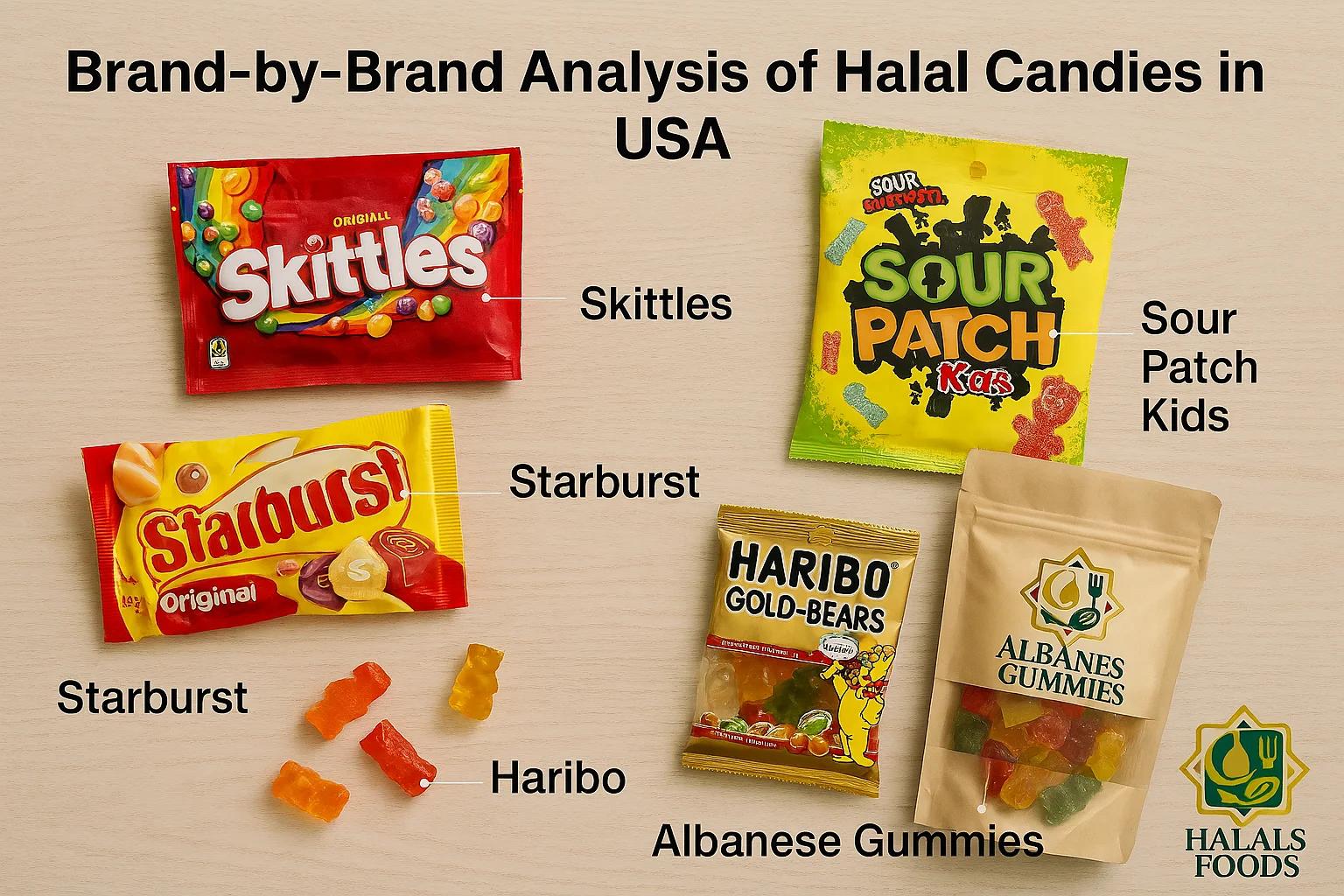
After reviewing dozens of product labels, contacting brands, and checking halal authority listings, here is a researched breakdown of commonly asked-about candies.
1️⃣ Skittles (USA Version)
Ingredient Review:
We checked the official U.S. ingredient list. Skittles in the USA do not contain gelatin. Main ingredients include:
-
Sugar
-
Corn syrup
-
Hydrogenated palm kernel oil
-
Citric acid
-
Natural and artificial flavors
-
Color additives
Concerns:
-
No halal certification
-
“Natural flavors” not fully disclosed
-
Cross-manufacturing risk unknown
Verdict: Many Muslims consider U.S. Skittles permissible due to lack of gelatin, but cautious consumers prefer certified options.
2️⃣ Starburst (USA Version)
We reviewed the product label and confirmed:
-
Contains gelatin
-
Source not specified
-
No halal certification
In the UK, some Starburst versions have been reformulated without gelatin. However, the U.S. version typically contains animal-derived gelatin.
Verdict: Not considered halal in the USA unless certified.
3️⃣ Sour Patch Kids
According to U.S. ingredient disclosures:
-
No gelatin listed
-
Uses modified corn starch
-
No halal certification
Many scholars permit these due to absence of animal gelatin.
4️⃣ Haribo (USA vs Imported)
This is one of the most discussed brands when researching halal candies in USA.
Haribo USA:
-
Contains pork gelatin in many varieties.
-
Not halal certified.
Haribo Turkey:
-
Often halal certified.
-
Uses halal bovine gelatin.
Key Lesson: Same brand, different country = different halal status.
Always check the product label origin.
5️⃣ Albanese Gummies
We reviewed Albanese product statements:
-
Many varieties contain pork gelatin.
-
Some offer gelatin-free options.
-
No widespread halal certification in USA.
Consumers must carefully inspect each variety individually.
Comparison Table: Popular Candy Halal Status in USA
| Brand | Gelatin | Halal Certified | Status |
|---|---|---|---|
| Skittles | No | No | Generally considered permissible |
| Starburst (USA) | Yes | No | Not halal |
| Sour Patch Kids | No | No | Generally permissible |
| Haribo USA | Pork gelatin | No | Haram |
| Haribo Turkey | Bovine gelatin | Yes (some) | Halal |
| Albanese | Often pork gelatin | No | Mostly not halal |
This shows why careful research is essential when buying halal candies in USA.
Deep Ingredient Case Studies
Case Study 1: Gelatin Transformation (Istihalah)
Some scholars argue that gelatin undergoes chemical transformation, changing its original impure state.
However:
-
IFANCA does not accept pork gelatin as halal.
-
Majority of U.S. halal authorities reject pork-derived gelatin.
-
Hanafi and Shafi’i scholars largely consider pork gelatin impermissible.
Thus, transformation theory is minority opinion in modern halal certification practice.
Case Study 2: Alcohol in Flavorings
We checked FDA regulations and industry sources. Many flavorings use alcohol as a solvent.
Important distinctions:
-
If alcohol remains in intoxicating amount → Haram.
-
If it evaporates completely → Some scholars permit.
-
Certified halal products avoid alcohol entirely.
This is why halal certification simplifies decision-making.
Case Study 3: Carmine (E120)
Carmine is extracted from insects.
Scholarly differences:
-
Some permit due to absence of explicit prohibition.
-
Others avoid due to impurity concerns.
In halal candies in USA, E120 appears in red-colored candies. Always check labels.
Manufacturing Reality in USA Candy Industry
Most large U.S. candy companies operate massive shared facilities.
We reviewed manufacturing disclosures and found:
-
Same lines produce gelatin and non-gelatin products.
-
Cleaning protocols are internal, not halal audited.
-
Pork-derived gelatin is common in gummy lines.
Without halal certification audits, there is no independent verification of contamination controls.
This matters because Islamic law emphasizes purity (taharah). Even if ingredients appear safe, production environment may introduce doubt.
Why Demand for Halal Candies in USA Is Growing
The U.S. halal food market exceeds billions annually.
Key drivers:
-
Growing Muslim population
-
Second-generation Muslim children wanting mainstream snacks
-
Increased halal awareness
-
Social media education
Many Muslim parents now actively seek halal-certified sweets for:
-
School events
-
Eid celebrations
-
Halloween alternatives
-
Birthday parties
This demand has encouraged some international brands to enter the U.S. halal candy space.
Practical Guide: How to Identify Halal Candies in USA
When shopping, follow this checklist:
Step 1: Read the Product Label Carefully
Look for:
-
Gelatin (source specified?)
-
Natural flavors
-
E120 (carmine)
-
Alcohol
Step 2: Look for Halal Certification Logo
Recognized bodies:
-
IFANCA
-
HFSAA
-
ISA
-
Zabiha Halal
Step 3: Check Brand Website
Some brands disclose gelatin source online.
Step 4: Contact Customer Service
Ask:
-
Is gelatin pork-derived?
-
Is product halal certified?
-
Is alcohol used in flavoring?
This extra step removes doubt.
Why Some Muslims Still Eat Non-Certified Candies
Some apply the principle:
“Everything is halal unless proven haram.”
They argue:
-
If pork not explicitly listed → permissible.
-
If alcohol not clearly added → assumed absent.
-
If gelatin source unknown → neutral.
This view is based on default permissibility (al-asl fil-ashya al-ibahah).
Why Others Avoid Non-Certified Candies
Others prioritize precaution:
-
High probability gelatin is pork-based.
-
Lack of transparency.
-
Hadith advising avoidance of doubtful matters.
-
Children consuming unknowingly.
For these Muslims, only certified halal candies in USA are acceptable.
Advanced FAQs About Halal Candies in USA
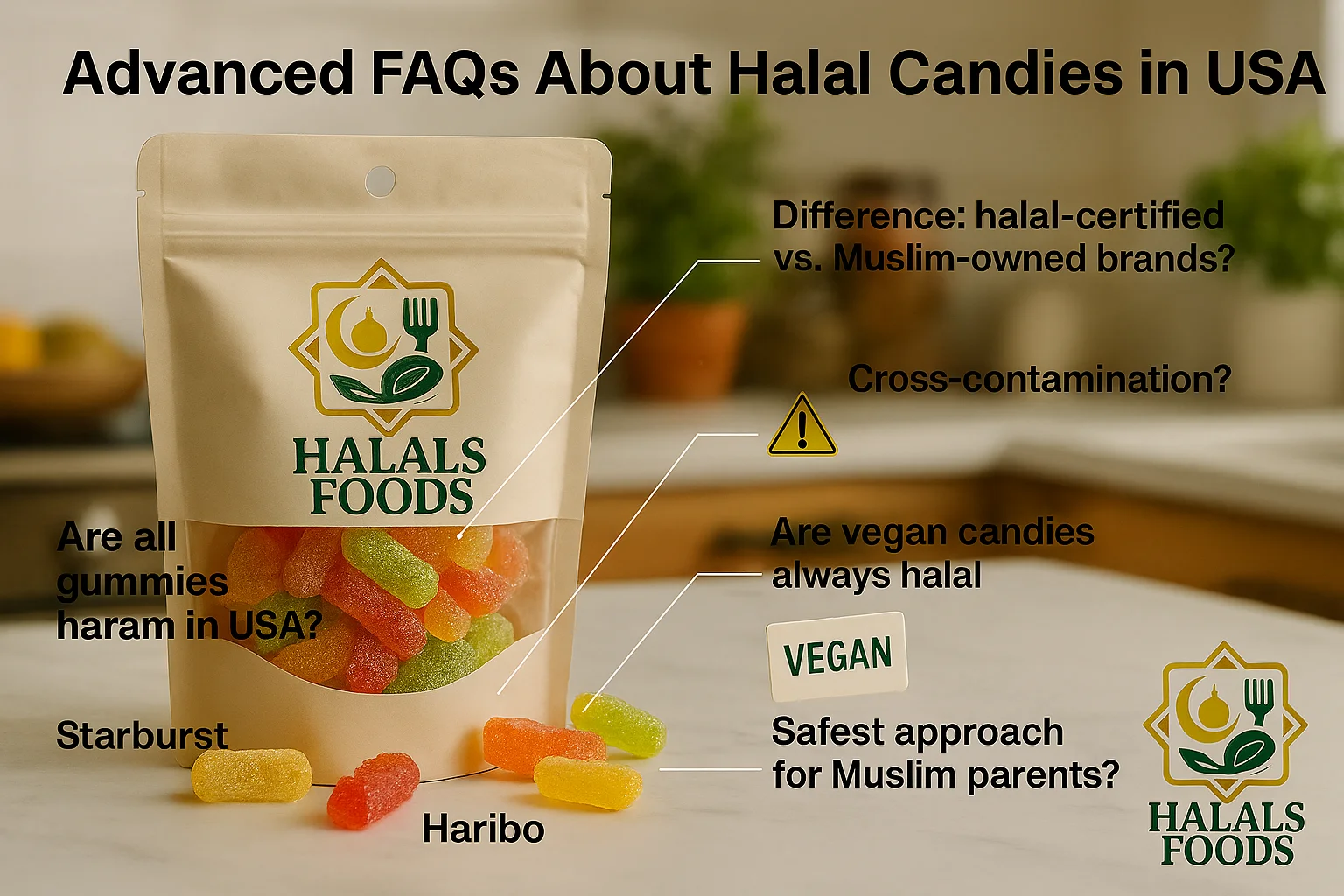
1. Are all gummies haram in USA?
No. Gummies made with pectin instead of gelatin are usually halal. However, certification is ideal for certainty.
2. Is there a difference between halal-certified and Muslim-owned brands?
Yes. A Muslim-owned brand is not automatically halal certified. Certification involves third-party auditing.
3. Can cross-contamination make candy haram?
If significant contact with pork-derived materials occurs, many scholars consider it problematic.
4. Are vegan candies always halal?
Not always. Vegan products may still use alcohol-based flavorings.
5. Are imported candies safer?
Often yes — especially from Turkey, Malaysia, UAE — where halal certification is common.
6. Is candy corn halal?
Some versions contain gelatin; others use alternative stabilizers. Must check brand individually.
7. Is it sinful to eat doubtful candy unknowingly?
If consumed unknowingly, there is no sin. Intention matters in Islam.
8. Do halal authorities inspect U.S. factories?
Yes — but only if the company voluntarily applies for certification.
9. Why don’t all U.S. brands get halal certified?
Because certification requires:
-
Ingredient verification
-
Supplier audits
-
Process modifications
-
Fees
Some companies see limited financial incentive.
10. What is the safest approach for Muslim parents?
Buy certified halal candies or clearly pectin-based products from trusted halal stores.
Final Conclusion on Halal Candies in USA
After thoroughly reviewing ingredients, manufacturing processes, halal certification standards, and official brand disclosures, our research shows:
-
Many mainstream U.S. gummies contain pork gelatin.
-
Some popular candies are gelatin-free but uncertified.
-
Certified halal options provide strongest assurance.
-
Imported halal-certified brands are often safest.
The safest choice for Muslims seeking halal candies in USA is to select products carrying certification from recognized halal authorities and carefully review the product label for gelatin, alcohol, and doubtful additives.
When in doubt, choose caution — especially for children.
References
-
IFANCA – Halal Certification Standards
-
HFSAA – Halal Compliance Guidelines
-
FDA Food Labeling Guide
-
Official ingredient lists from Skittles, Haribo, Starburst
-
Islamic jurisprudence discussions on gelatin (Fiqh Academy publications.
Related Halal Food Guides You May Find Helpful
People searching for “ [Is Skittles Halal?]” are also curious about other foods and ingredients. Below, you’ll find related halal food articles that clearly explain ingredient sources, how products are made, and whether they meet halal requirements.
More Related Articles [ Are Sour Patch Kids Halal ]