Introduction
For many Muslims living in Western countries, packaged snacks raise an important question: are they halal or not? Potato chips are one of the most widely consumed snack foods worldwide, and Pringles is among the most recognizable brands in this category. However, despite being made primarily from potatoes, processed snacks can contain additives, flavorings, and manufacturing processes that raise halal concerns.
Many Muslims frequently ask: Are Pringles halal? The answer is nt always straightforward because it depends on the ingredients, flavor type, regional manufacturing standards, and halal certification status.
In this article, we carefully reviewed the product label, ingredient lists, official brand information, and halal guidelines used in the United States and other regions. We will break down the ingredients, analyze possible doubtful components, evaluate halal certification status, and explain why some Muslims consider Pringles halal while others avoid them.
Quick Answer: Are Pringles Halal?
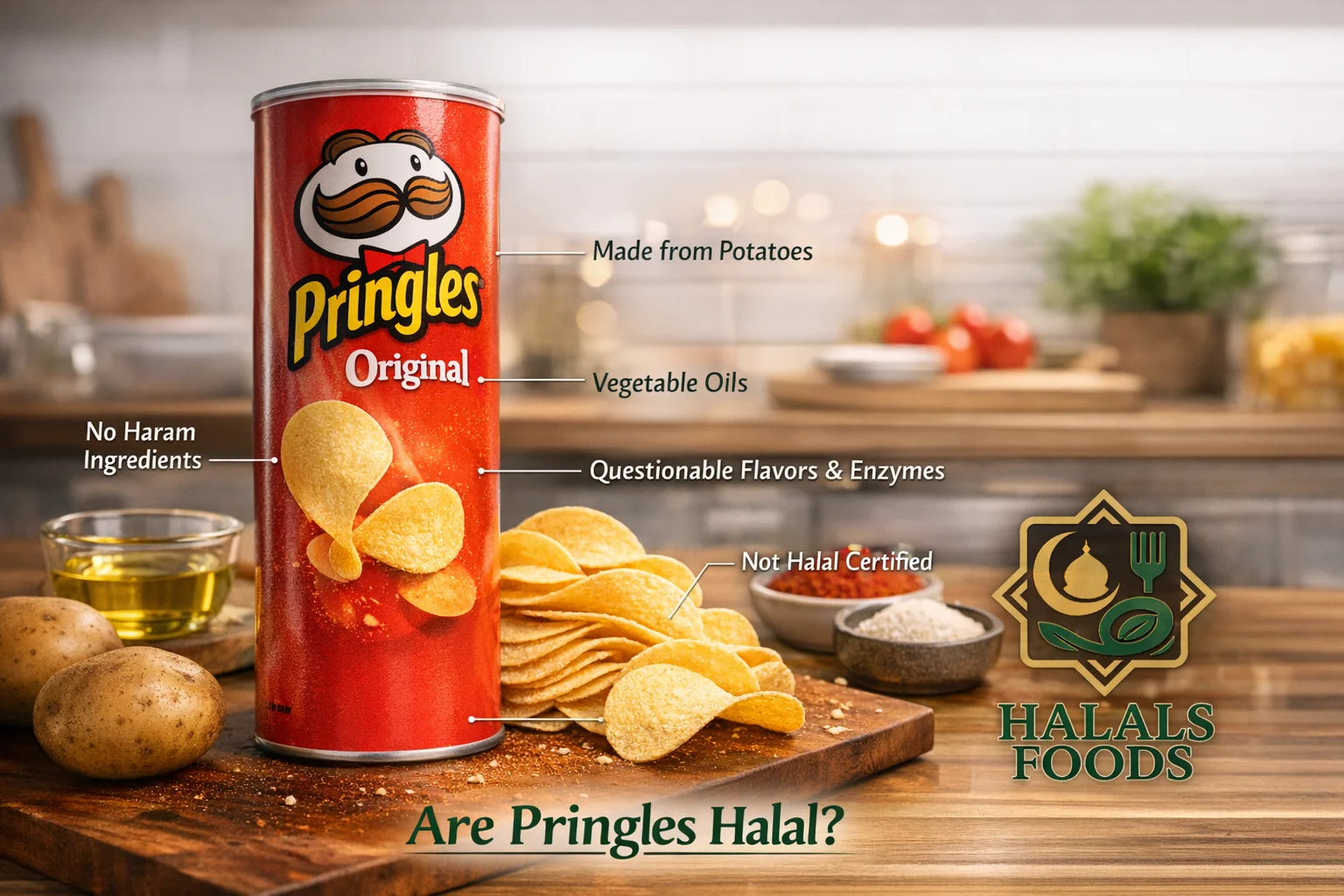
In general, plain Pringles flavors may be considered halal by some Muslims, because their main ingredients are potatoes, vegetable oils, and seasonings without obvious haram components.
However, many Pringles flavors are not halal-certified, and some varieties may contain questionable flavorings, enzymes, or dairy derivatives. Because of this, many scholars recommend caution unless the specific product has clear halal certification or verified ingredients.
Ingredient Breakdown
To properly determine are Pringles halal, we first reviewed the ingredient list used in common Pringles varieties sold in the United States and similar markets.
While ingredients vary slightly depending on flavor, the base ingredients typically include:
| Ingredient | Halal Status | Notes |
|---|---|---|
| Dried potatoes | Halal | Basic plant ingredient |
| Vegetable oil (corn, cottonseed, sunflower) | Halal | Usually permissible |
| Rice flour | Halal | Grain-based ingredient |
| Wheat starch | Halal | Derived from wheat |
| Maltodextrin | Usually halal | Derived from corn or starch |
| Salt | Halal | Mineral ingredient |
| Seasonings / natural flavors | Potentially doubtful | Depends on source |
Let’s analyze these ingredients more carefully.
1. Dried Potatoes
Pringles are not made from sliced potatoes like traditional chips. Instead, they are made from dehydrated potato flakes mixed with other starches and shaped into uniform chips.
From an Islamic dietary perspective, potatoes are fully halal, since they are plant-based and do not involve any animal-derived processing.
2. Vegetable Oils
Pringles commonly use vegetable oils such as:
-
Corn oil
-
Cottonseed oil
-
Sunflower oil
-
High oleic oils
According to U.S. halal guidelines, vegetable oils are generally halal as long as they are not mixed with animal fats or processed using non-halal additives.
We reviewed the product label and found no mention of animal fat in standard Pringles varieties.
3. Rice Flour and Wheat Starch
Both ingredients are plant-based starches used to help give Pringles their characteristic crisp texture.
Islamic scholars generally classify these ingredients as permissible (halal) because they are derived from grains and do not involve animal sources.
However, Muslims with gluten intolerance or allergies should note that wheat starch contains gluten.
4. Maltodextrin
Maltodextrin is a processed carbohydrate commonly used in snack foods to improve texture and flavor distribution.
It is typically derived from:
-
Corn
-
Potato
-
Rice
-
Wheat
According to most halal authorities, maltodextrin is halal when produced from plant sources, which is the most common method used in the United States.
However, some Muslims still investigate the processing enzymes used in its production.
5. Natural Flavors
This is where the halal discussion becomes more complex.
Many Pringles flavors list natural flavors or artificial flavors without specifying their exact origin.
These flavors may sometimes contain:
-
Dairy enzymes
-
Animal-derived flavor enhancers
-
Alcohol-based flavor carriers
While many flavorings are halal, the lack of transparency on labels means Muslim consumers cannot always verify the source.
This is one of the main reasons people ask “Are Pringles halal?”
6. Dairy-Based Ingredients
Certain flavors include dairy components such as:
-
Whey powder
-
Cheese powder
-
Buttermilk
-
Lactose
These ingredients themselves can be halal if the enzymes used in cheese production are halal. However, cheese enzymes sometimes come from non-halal animal sources.
Because Pringles does not always specify enzyme sources, some halal consumers remain cautious.
7. E-Numbers and Additives
Pringles may also contain food additives commonly labeled as E-numbers in international markets.
Examples include:
-
E330 (citric acid) – halal
-
E621 (monosodium glutamate / MSG) – generally halal
-
E160c (paprika extract) – halal
Most additives found in Pringles are considered permissible according to halal ingredient databases.
However, Muslim consumers sometimes double-check these additives because the source material and processing method can vary by manufacturer.
Ingredient Summary
Based on our ingredient analysis:
Clearly halal ingredients
-
Potatoes
-
Vegetable oils
-
Rice flour
-
Wheat starch
-
Salt
Potentially doubtful ingredients
-
Natural flavors
-
Cheese powders (enzyme source unknown)
-
Flavor carriers that may contain alcohol
This means the answer to “Are Pringles halal?” depends heavily on flavor variety and production transparency.
Manufacturing Process & Cross-Contamination
Beyond ingredients, the manufacturing process also plays a role in determining halal status.
Pringles are manufactured through a unique industrial process that differs from traditional potato chips.
How Pringles Are Made
The production process generally includes:
-
Potato dehydration – potatoes are turned into flakes or powder
-
Mixing stage – potato flakes are combined with starches and water
-
Sheet formation – the dough is rolled into thin sheets
-
Cutting and shaping – chips are cut and molded into the iconic curved shape
-
Frying process – chips are fried in vegetable oil
-
Seasoning – flavor powders are added
-
Packaging – chips are stacked into the well-known tube container
From a halal standpoint, most of this process appears acceptable because it involves plant-based ingredients and vegetable oils.
However, cross-contamination remains an important consideration.
Shared Equipment Concerns
Large snack manufacturers often produce multiple flavors in the same facility.
This may include flavors containing:
-
cheese powders
-
dairy derivatives
-
other additives
If equipment is shared without proper cleaning protocols, trace contamination could occur.
While this contamination is usually minimal, strict halal consumers may still be concerned.
Flavoring Production
Another issue involves external suppliers of flavorings.
Flavor compounds may be produced in facilities that handle:
-
alcohol-based solvents
-
animal-derived ingredients
Because brands rarely disclose detailed supply chain information, it becomes difficult for consumers to verify whether the product fully meets halal standards.
This is another reason the question “Are Pringles halal?” often receives different answers depending on the source.
Halal Certification Analysis
One of the easiest ways for Muslims to determine whether a snack is permissible is through recognized halal certification.
Unfortunately, most Pringles products sold in the United States do not carry official halal certification.
Major halal authorities that typically certify snack foods include:
-
IFANCA (Islamic Food and Nutrition Council of America)
-
HFSAA (Halal Food Standards Alliance of America)
-
ISA (Islamic Services of America)
When a product carries certification from these organizations, it means the manufacturer has allowed full ingredient and supply chain verification.
Certification Status of Pringles
Our review of available product packaging and official company statements indicates:
-
Most Pringles products in the U.S. are NOT halal-certified
-
Some international markets may have certified versions
-
Certification varies by region and factory
This means that even though the base ingredients may appear halal, the absence of certification leaves some uncertainty for strict halal consumers.
Regional Differences
Halal certification can differ significantly across countries.
For example:
United Kingdom
Some Pringles flavors sold in the UK have been reviewed by halal organizations, though not all are certified.
Middle East
In certain Gulf countries, snack manufacturers sometimes produce halal-certified batches specifically for that region.
United States
The U.S. halal market is growing, but many mainstream snack brands still do not pursue certification, even if their ingredients are technically permissible.
Because of these regional differences, Muslims frequently ask again: Are Pringles halal in one country but not another?
Often, the answer is yes — depending on the manufacturing location and certification process.
Official Statements From the Brand
To better understand are Pringles halal, we reviewed official information from the manufacturer, Kellanova, the company that produces Pringles worldwide.
According to information published on the official Pringles website and customer service responses, the company generally states that Pringles are not specifically produced as halal-certified products in most regions, including the United States.
Ingredient Transparency
The brand explains that ingredients are clearly listed on the product label, and consumers should review the packaging to determine whether a product meets their dietary requirements.
Typical label statements indicate that Pringles products may contain or be produced in facilities handling:
-
milk
-
wheat
-
soy
-
other allergens
However, the brand does not typically provide detailed information about halal compliance, such as the source of enzymes or flavor carriers.
From a halal research perspective, this lack of detailed sourcing information is important. Many processed snack foods contain complex flavor systems supplied by third-party ingredient companies. Without certification or supplier transparency, Muslim consumers may not be able to confirm whether all components meet halal standards.
Regional Statements
We also examined statements from different markets where Pringles are sold.
United States
Pringles products in the U.S. are not generally halal-certified, and the company does not officially market them as halal.
United Kingdom
In the UK, there have been past discussions about halal status, but most flavors still lack official halal certification. Muslim consumers are encouraged to check ingredients individually.
Canada
In Canada, Pringles products also do not typically carry halal certification labels, even though many ingredients appear permissible.
This regional pattern highlights a common situation in the food industry: a product may not contain obvious haram ingredients, yet still lack official halal verification.
For Muslims who follow strict halal standards, certification from recognized authorities is often the deciding factor.
Why Some Muslims Consider Pringles Halal
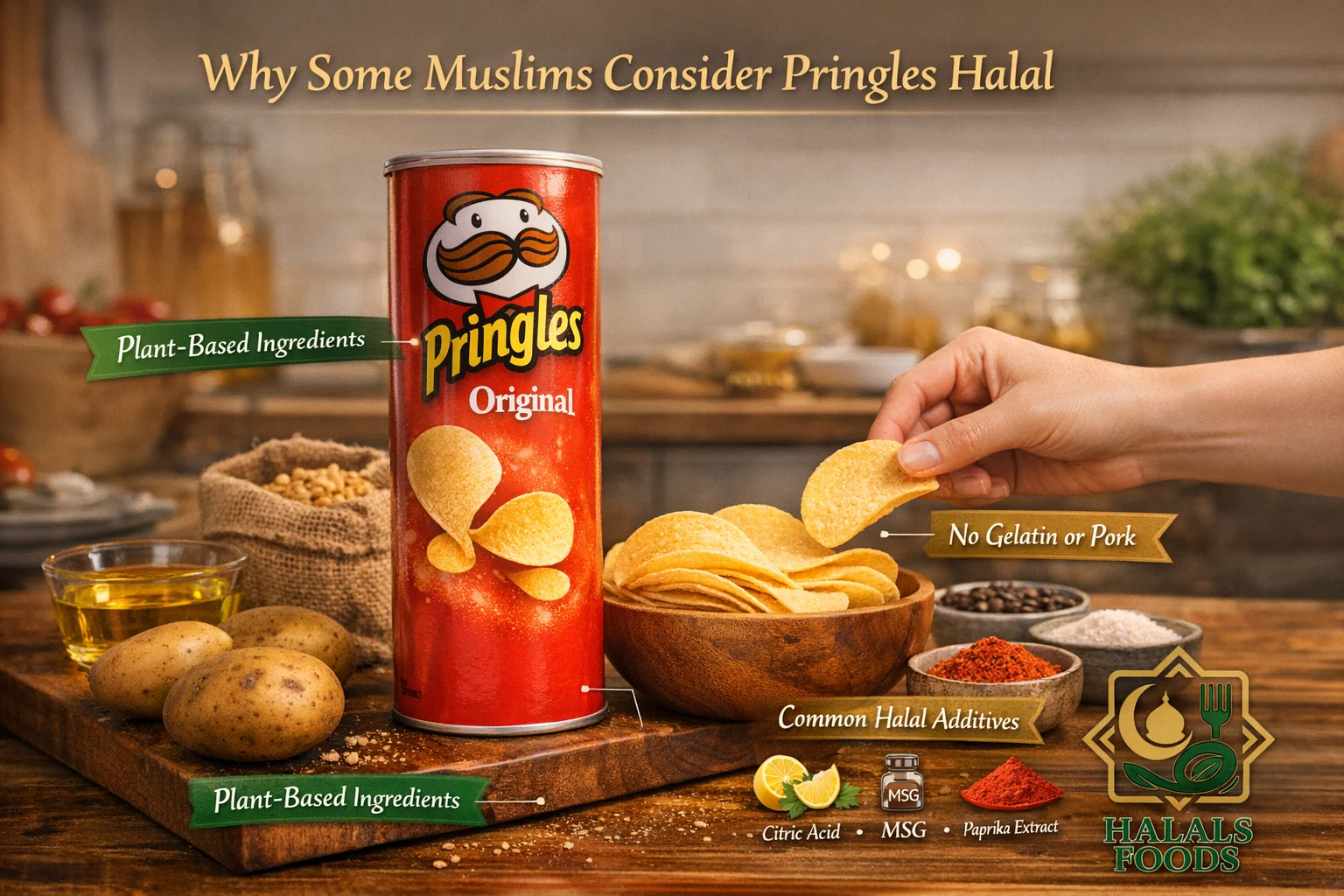
Despite the lack of halal certification, many Muslims still consider certain Pringles flavors permissible. Their reasoning is usually based on ingredient analysis and Islamic legal principles regarding doubtful foods.
1. Plant-Based Core Ingredients
The base formula of Pringles consists mostly of:
-
potatoes
-
vegetable oils
-
grain starches
-
salt
All of these ingredients are clearly halal according to Islamic dietary rules.
For this reason, some scholars argue that the default assumption (asl) in Islamic jurisprudence is that foods are permissible unless proven otherwise.
2. Absence of Gelatin or Pork Ingredients
Another important factor is that Pringles ingredient lists do not mention pork, lard, or gelatin.
Since gelatin is one of the most common problematic ingredients in processed snacks, its absence reassures some consumers.
3. Widely Accepted Additives
Many of the additives used in Pringles, such as:
-
citric acid
-
MSG
-
paprika extract
are generally considered halal by ingredient databases maintained by halal authorities.
4. Principle of Avoiding Excessive Hardship
Some Islamic scholars also mention the principle that Muslims should not face unnecessary hardship when halal alternatives are unclear.
Because Pringles ingredients appear largely plant-based, some consumers believe it is acceptable to eat flavors without obvious animal-derived components.
As a result, many Muslims who analyze the ingredient list conclude that certain Pringles varieties may be halal, especially plain or lightly seasoned flavors.
Why Some Muslims Avoid Pringles
On the other hand, many Muslims choose to avoid Pringles entirely due to uncertainty and lack of halal certification.
1. Natural Flavor Ambiguity
The ingredient term “natural flavors” is one of the biggest concerns.
Food regulations allow manufacturers to group multiple ingredients under this label, which may include:
-
animal-derived flavor extracts
-
alcohol-based solvents
-
fermentation products
Because these sources are not always disclosed, strict halal consumers prefer avoiding products with ambiguous flavoring systems.
2. Dairy Enzymes
Flavors containing cheese or whey may involve enzymes used in cheese production.
These enzymes sometimes come from:
-
microbial sources (halal)
-
plant sources (halal)
-
animal rennet (may be non-halal)
Without clarification from the manufacturer, Muslim consumers cannot always confirm the enzyme origin.
3. Lack of Halal Certification
Another reason many Muslims avoid Pringles is the absence of certification from trusted halal authorities such as:
-
Islamic Food and Nutrition Council of America
-
Halal Food Standards Alliance of America
-
Islamic Services of America
When a product carries certification from these organizations, consumers know that ingredients, processing methods, and suppliers have all been verified.
Without that verification, cautious consumers often choose certified alternatives instead.
4. Cross-Contamination Concerns
Because snack factories often produce many flavors on the same production lines, some Muslims worry about possible cross-contact with ingredients that may not meet halal standards.
Even though the risk may be small, it still leads some consumers to avoid the product.
USA Halal Market Context
Understanding the halal status of processed snacks like Pringles also requires looking at the broader halal food industry in the United States.
The U.S. halal food market has grown rapidly over the past two decades due to the expanding Muslim population.
According to market estimates, the American halal food sector is worth billions of dollars annually, covering products such as:
-
halal meat
-
snacks
-
frozen meals
-
beverages
However, unlike some Muslim-majority countries, the United States does not have a single national halal regulatory system.
Instead, halal certification is provided by private organizations such as:
-
Islamic Food and Nutrition Council of America
-
Islamic Services of America
-
Halal Food Standards Alliance of America
Companies must voluntarily apply for certification.
Many large food brands choose not to pursue halal certification because:
-
their products are sold globally with different regulations
-
certification requires supply-chain audits
-
it adds cost to production
As a result, many snack foods in U.S. supermarkets are technically halal based on ingredients but not officially certified.
For Muslim consumers, this creates a common dilemma: whether to rely on ingredient analysis or only purchase certified products.
Final Verdict: Are Pringles Halal?
After reviewing the ingredients, manufacturing process, brand statements, and halal certification status, the answer to “Are Pringles halal?” depends on how strictly halal standards are applied.
Our research found that the core ingredients in Pringles are generally halal, including potatoes, vegetable oils, starches, and salt.
However, several factors create uncertainty:
-
many flavors contain natural flavoring systems with unclear sources
-
cheese-based varieties may involve unknown enzyme origins
-
most products lack halal certification from recognized authorities
Because of these factors, some Muslims consider certain Pringles flavors permissible, while others prefer to avoid them unless halal-certified.
For strict halal observance, the safest approach is to choose snack brands that carry verified halal certification.
Frequently Asked Questions
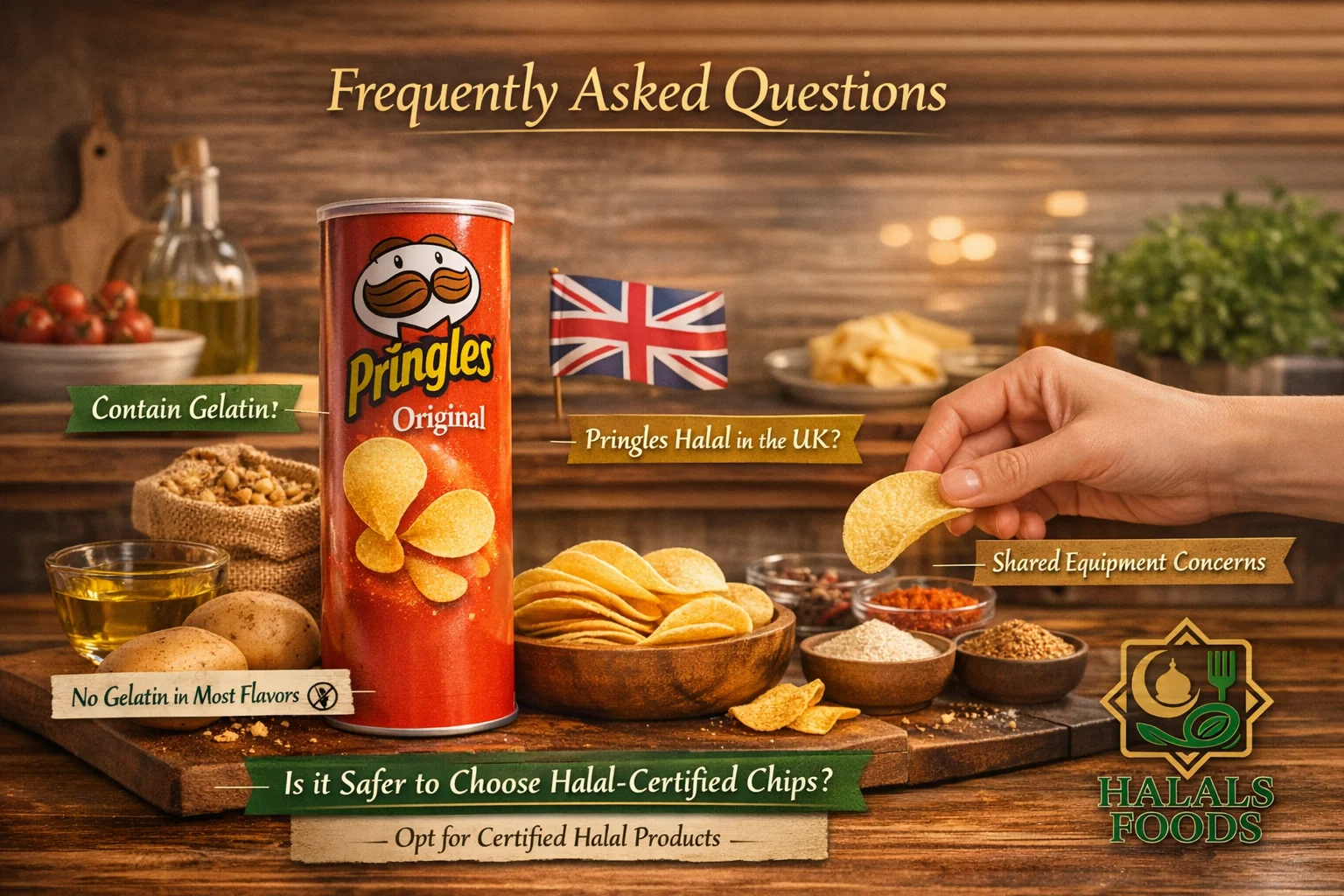
1. Do Pringles contain gelatin?
Most Pringles ingredient lists do not include gelatin, which is commonly derived from animal sources such as pork or beef.
However, while gelatin is absent, some flavors still contain natural flavorings or dairy ingredients, which may raise separate halal questions.
2. Are original Pringles halal?
The original flavor of Pringles generally contains simpler ingredients such as potatoes, vegetable oil, wheat starch, and salt.
Because these ingredients are plant-based, many Muslims consider this flavor more likely to be halal compared to cheese or meat-flavored varieties.
However, it still lacks official halal certification.
3. Are Pringles halal in the UK?
Some Muslim consumers in the UK consider certain Pringles flavors permissible based on ingredient analysis.
However, most varieties do not carry halal certification, so opinions differ among consumers and scholars.
4. Are Pringles halal in the USA?
In the United States, Pringles products are generally not halal-certified.
Although many ingredients appear permissible, the absence of certification and detailed ingredient sourcing means some Muslims avoid them.
5. Do Pringles contain alcohol in flavorings?
Certain processed food flavorings can use alcohol-based carriers during production.
While the final amount in food products is typically extremely small, companies do not always disclose the details of flavor production.
This uncertainty is another reason some Muslims question are Pringles halal.
6. Are cheese Pringles halal?
Cheese-flavored Pringles contain dairy ingredients such as whey or cheese powder.
These products may involve enzymes used in cheese production, which could come from animal sources unless verified otherwise.
Because of this, many Muslims prefer avoiding cheese-flavored varieties unless certified halal.
7. Do Pringles factories process non-halal ingredients?
Large snack factories often produce many different flavors on shared equipment.
While this does not necessarily mean haram contamination occurs, it can create concerns about cross-contact during production.
Halal certification usually requires strict cleaning and separation procedures.
8. Is it safer to choose halal-certified chips instead?
Yes. For Muslims who want full certainty, choosing chips that carry recognized halal certification is the safest option.
Certified products ensure that:
-
ingredients are verified
-
processing methods meet halal standards
-
cross-contamination risks are controlled
References
-
Official Pringles ingredient and product information
-
Islamic Food and Nutrition Council of America halal ingredient guidelines
-
Halal Food Standards Alliance of America certification standards
-
Food additive databases for halal ingredient classification
Related Halal Food Guides You May Find Helpful
People searching for “Is [ Is Starburst Halal or Doubtful? ]” are also curious about other foods and ingredients. Below, you’ll find related halal food articles that clearly explain ingredient sources, how products are made, and whether they meet halal requirements.
People searching for “Is [ Are Sour Patch Kids Halal? ]” are also curious about other foods and ingredients. Below, you’ll find related halal food articles that clearly explain ingredient sources, how products are made, and whether they meet halal requirements.
More : [ Are Jolly Ranchers Halal ]
More : [ Is Skittles Halal? ]
More : [ Are Doritos Halal? ]
More : [ Best Halal Chips in Walmart ]