That bright orange dust, the crunchy texture, the spicy kick from Flamin’ Hot flavors — Cheetos are one of those snacks people keep grabbing without thinking twice. Kids love them. Teenagers practically live on them. Even adults secretly finish an entire bag while watching Netflix at night.
But for Muslims, snacks are not always “just snacks.”
A simple bag of chips can suddenly raise uncomfortable questions:
- Does it contain pork enzymes?
- Is the cheese made with halal rennet?
- What exactly are “natural flavors”?
- Why don’t many Cheetos products have halal certification?
And honestly, this is where many Muslims get confused.
Some people confidently say Cheetos are completely halal. Others call them haram immediately. Then another group says they are “mashbooh” — doubtful.
So what’s actually true?
The reality is more complicated than most websites explain.
This guide breaks down the ingredients, manufacturing process, cheese enzymes, country differences, halal certifications, and the hidden issues most people ignore when discussing Are Cheetos halal.
And yes… some answers may surprise you.
Why So Many Muslims Question Are Cheetos halal
A lot of people think halal only means “no pork.”
But Islamic dietary rules go much deeper than that.
Food can become questionable because of:
- animal-derived enzymes
- alcohol-based flavor processing
- cross-contamination
- hidden additives
- unclear sourcing
- manufacturing methods
This is exactly why cheese snacks often create confusion in the Muslim community.
Cheetos are not plain salted corn chips. They are heavily flavored snacks with cheese powders, seasoning blends, additives, acids, and flavor compounds.
That changes everything.
Especially when companies are not fully transparent about ingredient sourcing.
Quick Answer: Are Cheetos halal or Not?
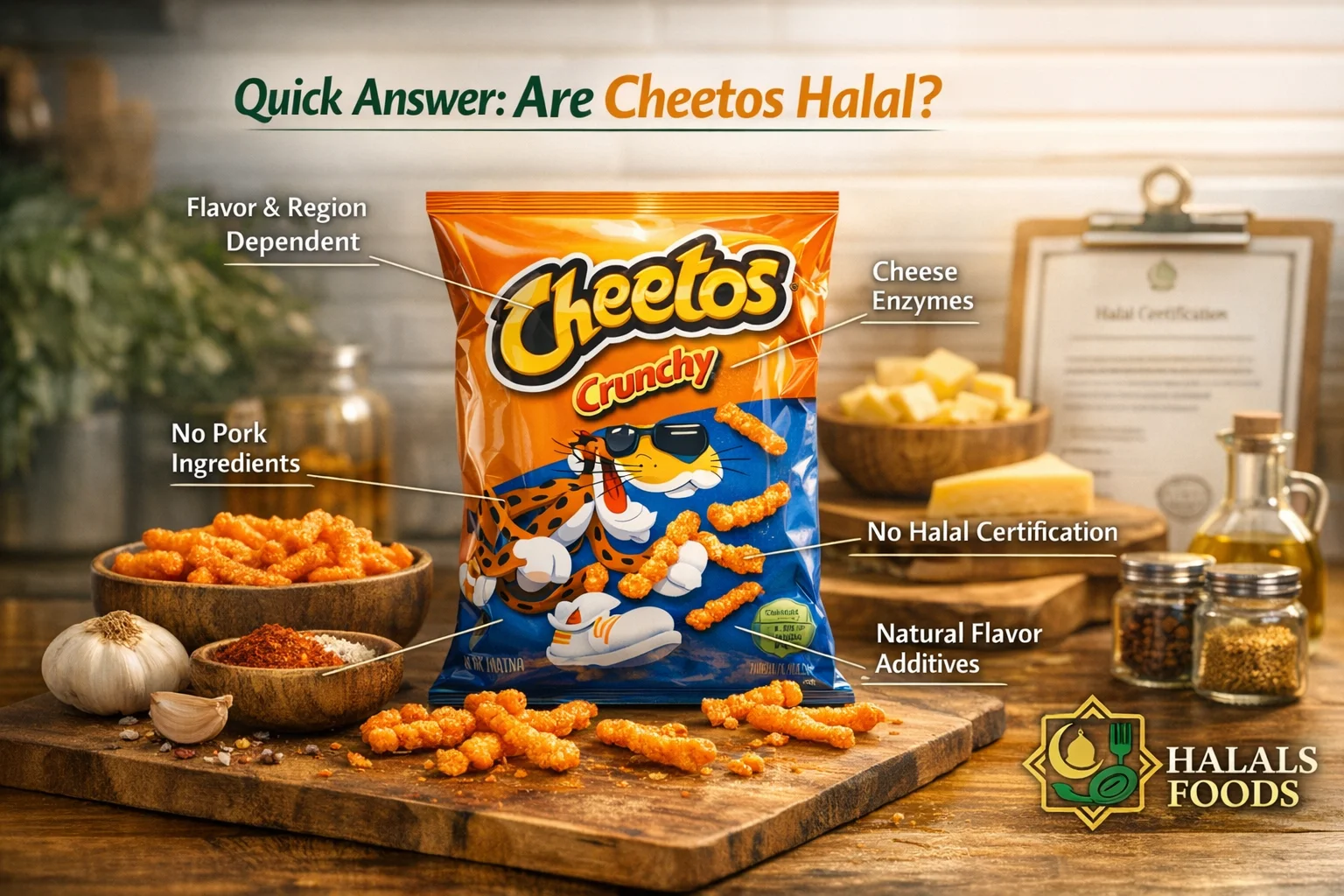
Here’s the short version first.
Most Cheetos products sold in the United States are NOT officially halal certified.
That does not automatically mean they are haram.
However, several ingredients remain questionable because their exact source is not publicly confirmed.
The main concerns include:
- cheese enzymes
- natural flavors
- possible cross-contamination
- flavor processing methods
So the answer usually falls into this category:
Some Muslims consider certain Cheetos flavors halal enough to eat.
Others avoid them because the ingredients are doubtful.
That’s the honest answer.
Now let’s go deeper into what’s really inside the bag.
The First Thing Muslims Should Check: The Cheese Powder
Here’s the part most people ignore…
The biggest halal concern in Cheetos is not the corn. Not the spice. Not even the food coloring.
It’s the cheese.
Cheese production often requires enzymes or rennet to separate milk into curds.
These enzymes can come from:
| Enzyme Source | Halal Status |
|---|---|
| Plant-based enzymes | Halal |
| Microbial enzymes | Usually halal |
| Animal-derived enzymes | Depends on slaughter method |
If the enzyme comes from an animal not slaughtered according to Islamic law, many scholars consider it haram.
And this is where things become unclear with Cheetos.
Most packaging simply says things like:
- cheddar cheese
- cheese culture
- enzymes
But it rarely explains WHAT kind of enzymes were used.
That missing detail is exactly why Muslims continue debating Are Cheetos halal.
Are Cheese Enzymes Usually Halal Today?
Interestingly, modern food manufacturing has changed a lot.
Years ago, animal rennet was very common.
Today, many large food companies use microbial enzymes because they are:
- cheaper
- easier to produce
- more stable
- vegetarian-friendly
That sounds good for Muslims, right?
Yes… but there’s still a problem.
Most companies never officially confirm this publicly for every product line.
So while the enzymes MAY be microbial, consumers are often left guessing.
Some Muslims feel comfortable assuming modern enzymes are microbial.
Others say:
“If there’s no proof, I’d rather avoid doubtful food.”
Both views exist in the halal community.
What About Flamin’ Hot Cheetos?
Flamin’ Hot Cheetos are probably the most searched version online when people ask:
“Are Cheetos halal?”
The spicy flavor itself is not the issue.
The concern still comes back to:
- cheese seasoning
- flavor compounds
- natural flavors
- enzyme sourcing
Many people assume spicy snacks contain meat ingredients because of the intense flavor.
But most Flamin’ Hot Cheetos do not list obvious meat ingredients.
Still, they usually lack halal certification in the USA.
So they remain questionable for stricter halal consumers.
The “Natural Flavors” Problem Nobody Explains Clearly
This single ingredient creates confusion in thousands of products.
Natural flavors.
Sounds harmless, right?
Not always.
In food labeling, “natural flavors” can legally include substances derived from:
- plants
- animals
- fermentation
- dairy compounds
Sometimes extraction methods may even involve alcohol-based solvents during processing.
Now before people panic — this does NOT automatically make the product haram.
But the issue is transparency.
Companies usually do not reveal the complete formula because flavor recipes are considered proprietary.
So Muslim consumers cannot fully verify the source.
This uncertainty is why many scholars classify such products as mashbooh (doubtful).
And honestly, this is one of the biggest reasons why the question Are Cheetos halal never fully disappears online.
Ingredient Breakdown of Popular Cheetos Flavors
Let’s simplify the common ingredients found in many Cheetos products.
| Ingredient | Halal Concern Level |
|---|---|
| Cornmeal | Safe |
| Vegetable oil | Usually halal |
| Salt | Halal |
| Whey | Usually halal |
| Cheese powder | Potential concern |
| Natural flavors | Doubtful |
| MSG | Generally halal |
| Artificial colors | Usually halal |
| Citric acid | Halal |
| Maltodextrin | Halal |
Most ingredients are actually fine.
The uncertainty comes from only a few specific components.
But in halal eating, even one unclear ingredient matters to many Muslims.
The Manufacturing Side Most Websites Forget to Mention
Ingredients are only half the story.
Factories matter too.
Large snack companies produce massive quantities every day using industrial systems.
A single facility may process:
- cheese snacks
- meat-flavored chips
- barbecue seasonings
- dairy powders
- spicy coatings
Sometimes the same machines are used for multiple products.
This creates possible cross-contamination concerns.
For example:
If pork-based flavoring powder is processed on shared equipment, traces could potentially remain unless proper cleaning occurs.
Now, companies do clean equipment.
But halal standards often require verified halal cleaning procedures.
Without halal certification, Muslims usually cannot confirm those standards independently.
That’s why some people avoid mainstream snack brands completely unless certified halal.
Why Halal Certification Changes Everything
A halal logo may seem small on packaging, but it means a lot.
When a product is halal certified, a halal authority usually checks:
- ingredient sourcing
- enzyme origins
- supplier chains
- production process
- contamination risks
- factory procedures
Without certification, consumers are left analyzing ingredient labels themselves.
That’s exactly what happens with many Cheetos products in North America.
And honestly, ingredient labels never tell the full story.
Are Cheetos Halal Certified in America?
In the United States, most Cheetos products do NOT carry recognized halal certification.
That’s the key point.
No IFANCA logo.
No HFSAA certification.
No ISA approval on most packaging.
This does not prove they are haram.
But it also means there is no official halal verification.
For cautious Muslims, that uncertainty matters.
Why Cheetos in Muslim Countries Can Be Different
Here’s something many people don’t realize.
Cheetos are not produced exactly the same everywhere.
The product sold in Malaysia may differ from the one sold in America.
The version sold in Saudi Arabia may use different suppliers than Canada.
Some Muslim-majority countries require stricter halal compliance for imported or locally manufactured foods.
That means certain international Cheetos products may actually carry halal certification.
Especially in places like:
- Malaysia
- Indonesia
- UAE
- Saudi Arabia
This is why someone in Dubai may confidently say:
“Cheetos are halal.”
While someone in the United States says:
“They’re doubtful.”
Both people might technically be correct based on regional production.
The E631, E627 & E635 Ingredient Fear
You’ve probably seen Muslims online panic about these ingredient codes.
Especially in spicy snacks.
Let’s clear this up properly.
These flavor enhancers can come from:
- plant sources
- tapioca
- sugarcane
- animal sources
The problem is the source is not always specified.
Some halal-certified manufacturers use plant-based versions only.
Others may not clarify publicly.
This is why certain Muslims avoid snacks containing:
- E631
- E627
- E635
Even though they are not automatically haram.
People simply want certainty.
And honestly, that caution makes sense.
Why Some Muslims Still Eat Cheetos Comfortably
Despite all these concerns, many Muslims still eat Cheetos without hesitation.
Why?
Because they follow a different halal interpretation.
Their reasoning usually includes:
1. No Direct Pork Ingredients Listed
Most Cheetos do not openly contain pork or gelatin.
2. Modern Enzymes Are Often Microbial
Many assume cheese enzymes today are fermentation-based.
3. Default Rule of Food Permissibility
Some scholars say food remains halal unless proven otherwise.
4. Lack of Clear Haram Evidence
There is no public confirmation that Cheetos contain explicitly haram enzymes.
So for many Muslims, the product remains acceptable unless proven otherwise.
But Here’s Why Other Muslims Avoid Them Completely
Now let’s look at the opposite side.
Some Muslims avoid Cheetos entirely because:
- no halal certification exists
- ingredient sourcing is unclear
- natural flavors are vague
- enzyme origins remain undisclosed
- cross-contamination risks exist
For these consumers, doubtful food is simply not worth the stress.
Especially when halal-certified snacks are becoming easier to find today.
And honestly, many Muslims prefer peace of mind over uncertainty.
The Emotional Side Nobody Talks About
Food is emotional.
For Muslim families, halal eating is connected to faith, trust, and daily lifestyle.
Parents especially worry about what their children eat at school, parties, or while hanging out with friends.
A kid may grab Flamin’ Hot Cheetos from a gas station without thinking twice.
Meanwhile the parents are wondering:
“Is this actually halal?”
That uncertainty creates frustration because companies rarely provide direct answers.
And that’s exactly why searches for Are Cheetos halal keep growing every year.
Some Safer Alternatives Muslims Often Choose
Many halal-conscious consumers now switch to halal-certified cheese snacks instead.
Popular options include:
- halal-certified cheese puffs
- Muslim-owned snack brands
- certified vegan cheese snacks
- halal-certified spicy chips
These products remove the guessing game completely.
And honestly, that simplicity matters for many families.
Walking through an American grocery store as a Muslim can feel surprisingly complicated sometimes.
One aisle is full of chips, candy, cheese snacks, spicy crackers, and colorful junk food. Everything looks harmless at first glance. But once you start checking labels carefully, you realize how many ingredients are unclear.
That’s exactly why the debate around Are Cheetos halal has become so big online.
People are not just asking about one snack anymore.
They are questioning the entire modern food system.
Because honestly… most processed foods are built on hidden flavor chemistry most consumers never fully understand.
And Cheetos sit right in the middle of that discussion.
Why “No Pork” Does NOT Automatically Mean Halal
This is probably the biggest misunderstanding people have.
Many consumers think:
“No pork = halal.”
But Islamic dietary rules are broader than that.
A food can still become questionable because of:
- non-halal animal enzymes
- alcohol-based processing
- contamination during manufacturing
- doubtful additives
- unknown flavor sources
So even if a snack does not contain visible pork ingredients, Muslims may still question it.
This is exactly why Are Cheetos halal is not a simple yes-or-no question.
The Cheese Industry Secret Most Consumers Never Hear About
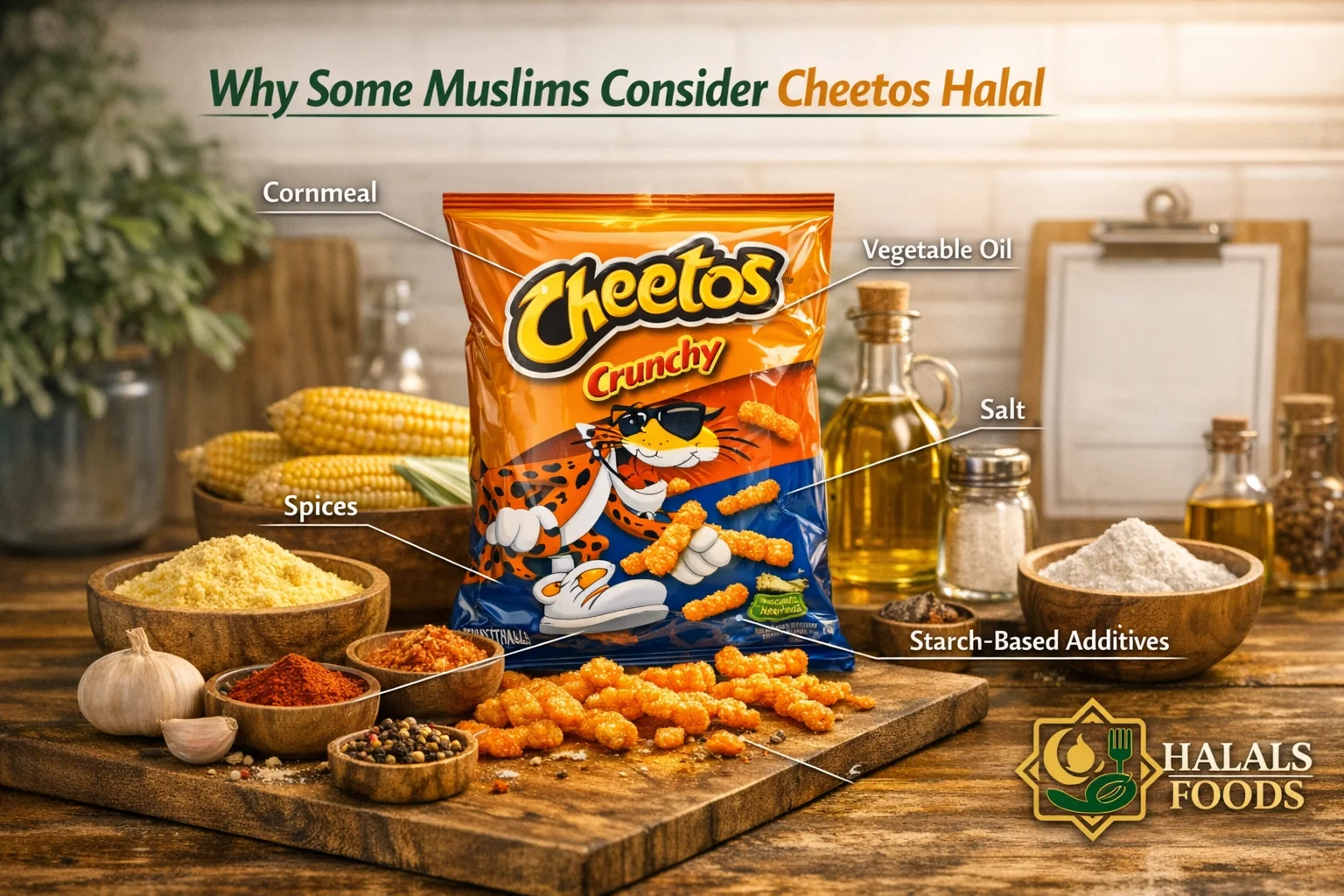
Here’s something interesting…
Most people eat cheese every single week without realizing how cheese is actually made.
To create cheese, milk must coagulate.
That process requires enzymes or rennet.
Historically, animal rennet came from the stomach lining of calves.
If those animals were not slaughtered according to Islamic law, many scholars would consider the cheese non-halal.
Today, things are more modern.
Many manufacturers now use:
- microbial enzymes
- fermentation-produced enzymes
- plant-based coagulants
But here’s the frustrating part:
Companies often do not clearly state WHICH type they use.
So Muslims are left trying to investigate ingredients themselves.
And honestly, this lack of transparency is one of the biggest reasons processed cheese snacks create so much confusion.
Are Hot Cheetos Haram?
This question gets searched constantly.
Especially by younger Muslims.
The answer depends on how strict someone is regarding doubtful ingredients.
Some Muslims say Hot Cheetos are halal enough because:
- no obvious pork appears in ingredients
- most additives are synthetic
- enzymes are likely microbial today
Others avoid them because:
- there is no halal certification
- natural flavors remain unclear
- enzyme sources are undisclosed
- manufacturing practices are not verified
So calling them completely halal or completely haram without nuance is honestly oversimplifying the issue.
For many scholars, the safer word is:
“Mashbooh” (doubtful)
Meaning the product contains uncertainty.
The Real Problem With Processed Snack Foods
Cheetos are not the only snack under scrutiny.
The same concerns appear with:
- Doritos
- Takis
- Pringles
- cheese crackers
- flavored popcorn
- instant noodles
Modern snack foods use extremely complex ingredient systems.
A single flavor powder may contain dozens of compounds.
And companies rarely publish full sourcing details publicly.
That creates a difficult situation for halal-conscious consumers.
Especially in non-Muslim countries where halal compliance is not the primary market focus.
Why Some Scholars Say Avoiding Doubtful Food Is Better
There’s an important Islamic principle many Muslims follow:
“Leave what makes you doubtful for what does not make you doubtful.”
This is why some Muslims avoid products like Cheetos entirely.
Not because they have confirmed haram ingredients…
But because uncertainty itself becomes uncomfortable.
For stricter halal consumers, peace of mind matters.
They prefer foods with:
- clear halal certification
- transparent sourcing
- verified production standards
And honestly, that approach has become easier today because halal options are expanding rapidly in America.
Are Vegan Cheetos Automatically Halal?
A lot of people assume vegan snacks are always halal.
That’s not completely true.
Vegan products remove animal ingredients, which solves many halal concerns.
But Muslims may still check for:
- alcohol-based flavor processing
- contamination
- certification reliability
Still, vegan cheese snacks are usually much safer from a halal perspective compared to traditional cheese snacks.
That’s why many Muslims now choose vegan alternatives instead of doubtful mainstream products.
The Country Difference Changes Everything
This is one of the most important points in the entire discussion.
Cheetos in one country may NOT be identical to Cheetos in another country.
For example:
United States
Most products are not halal certified.
Malaysia
Some versions may carry JAKIM halal approval.
Saudi Arabia
Imported products may require halal compliance.
Indonesia
Halal labeling regulations are stricter.
United Kingdom
Ingredient sourcing can differ from North America.
So when someone online confidently says:
“Cheetos are halal.”
You always need to ask:
“Which country?”
Because the answer can genuinely change.
Why Muslims Are More Careful Today Than Before
Ten or twenty years ago, many Muslims simply avoided pork and moved on.
Today, halal awareness is much deeper.
Consumers now investigate:
- E-numbers
- enzymes
- flavor carriers
- emulsifiers
- gelatin sources
- manufacturing methods
Social media also spread awareness quickly.
One viral TikTok or YouTube video discussing hidden ingredients can suddenly make millions of Muslims question a product overnight.
That’s partly why searches for Are Cheetos halal exploded recently.
People want certainty now.
Not assumptions.
Understanding E631, E627 & E635 Properly
These ingredients scare many Muslims online.
Sometimes unnecessarily.
Let’s simplify them.
These flavor enhancers can come from:
- plant starch
- tapioca
- sugarcane
- fermentation
- animal extraction
The issue is not the ingredient name itself.
The issue is the SOURCE.
Halal-certified manufacturers usually ensure these additives come from halal plant or microbial origins.
But when no certification exists, consumers cannot always verify the source independently.
This uncertainty creates caution.
Especially among stricter halal communities.
The Psychology Behind Flamin’ Hot Cheetos Popularity
Honestly, Flamin’ Hot Cheetos became bigger than just a snack.
They turned into a cultural obsession.
Schools.
Road trips.
Gas stations.
Movie nights.
The intense spice creates an addictive experience many people love.
But ironically, that same popularity made Muslims investigate the product more closely.
Because the more common a snack becomes, the more people ask questions about its halal status.
Especially parents.
A Muslim parent may not care much about regular salted chips…
But once children constantly ask for Hot Cheetos, the halal question suddenly matters a lot.
What Muslim Consumers Usually Do in Real Life
Most Muslims fall into one of three categories regarding products like Cheetos.
1. Strict Halal Consumers
They only eat halal-certified snacks.
If no certification exists, they avoid it completely.
2. Ingredient-Based Consumers
They check ingredients personally and decide based on available information.
3. Flexible Consumers
If no obvious haram ingredient appears, they eat it without concern.
This explains why debates around Are Cheetos halal never fully end.
Different Muslims apply different standards of caution.
Does Frito-Lay Ever Confirm Halal Status?
Frito-Lay mainly focuses on:
- allergens
- nutrition facts
- ingredient disclosure
They rarely provide detailed halal guarantees for North American products.
This creates frustration for Muslim consumers because many questions remain unanswered publicly.
For example:
- What kind of enzymes are used?
- Are flavor solvents alcohol-based?
- Is equipment shared with non-halal products?
- Are suppliers halal compliant?
Without certification, consumers often cannot verify these details fully.
Why Halal Certification Is Growing So Fast in America
The halal food market in the USA is now worth billions.
Muslim consumers are actively searching for:
- halal snacks
- halal candy
- halal fast food
- halal frozen meals
- halal chips
Brands are noticing this demand.
That’s why more companies now pursue:
- IFANCA certification
- ISA approval
- HFSAA verification
The future will likely bring more halal-certified mainstream snacks.
But right now, many popular brands still remain in the “uncertain” category.
Better Halal Snack Alternatives to Cheetos
If you want zero stress, halal-certified alternatives are the easiest solution.
Some Muslims prefer:
- halal cheese puffs
- certified vegan chips
- halal spicy corn snacks
- Muslim-owned snack brands
These options remove the ingredient guessing game entirely.
And honestly, many of them taste just as good today.
Sometimes even better.
A Simple Rule Many Muslims Follow
Here’s a practical approach many halal-conscious consumers use:
If the product is:
- halal certified → eat comfortably
- clearly haram → avoid
- doubtful → personal choice based on your level of caution
That’s honestly where Cheetos usually fall.
Into the doubtful category.
Not clearly haram.
Not clearly certified halal either.
So… Are Cheetos halal?
After reviewing ingredients, manufacturing concerns, enzyme sourcing, flavor systems, and halal certification status, here’s the clearest answer possible.
In the United States:
Most Cheetos products are NOT officially halal certified.
Main concerns include:
- unclear cheese enzymes
- vague natural flavors
- possible cross-contamination
- lack of sourcing transparency
However:
Most products also do NOT contain obvious pork ingredients directly on the label.
That’s why Muslim opinions differ.
Some Muslims consider them acceptable.
Others classify them as doubtful and avoid them.
Final Verdict on Are Cheetos halal
If you follow a strict halal lifestyle and prefer certainty, avoiding non-certified Cheetos is probably the safer option.
If you personally follow ingredient analysis and are comfortable with modern enzyme assumptions, you may consider certain flavors acceptable.
But the most honest conclusion is this:
Cheetos are not universally halal.
Their halal status depends on:
- country
- certification
- ingredient sourcing
- personal religious caution
And until manufacturers provide clearer transparency, the debate around Are Cheetos halal will probably continue for years.
Frequently Asked Questions About Are Cheetos halal
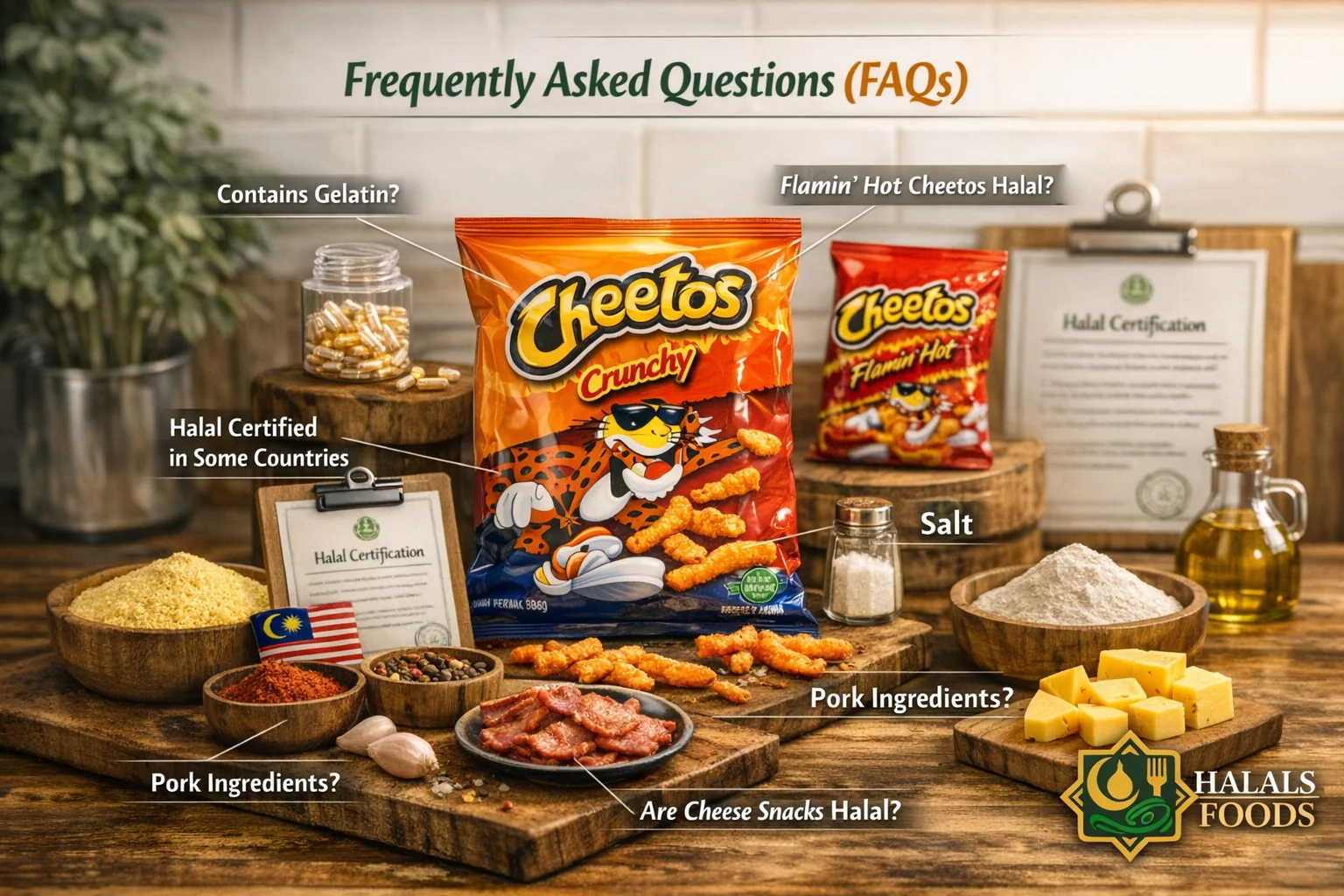
Do Cheetos contain pork?
Most ingredient lists do not directly list pork ingredients.
Are Flamin’ Hot Cheetos halal?
They are generally considered doubtful because they lack halal certification in many regions.
Why are cheese enzymes controversial?
Some enzymes may come from animals not slaughtered according to Islamic law.
Are Cheetos halal in Muslim countries?
Some international versions may carry halal certification depending on local regulations.
Is “natural flavor” always haram?
No. Many natural flavors are halal, but unclear sourcing creates uncertainty.
Are vegan cheese snacks safer for Muslims?
Usually yes, because they avoid animal-derived cheese enzymes.
Related Halal Food Guides You May Find Helpful
People searching for “ [Is Skittles Halal?]” are also curious about other foods and ingredients. Below, you’ll find related halal food articles that clearly explain ingredient sources, how products are made, and whether they meet halal requirements.
More Related Articles [ Halal Candies in USA ]
more [ Are Lays Halal in USA? ]
more [ Are Sour Patch Kids Halal? ]