A Sweet Question That Isn’t So Simple
Let’s be real for a moment…
You’re standing in a store, holding a pack of Starburst. It looks harmless. Bright colors, fruity smell, no obvious “haram” label anywhere.
But then that thought hits:
“Wait… Is Starburst Halal?”
And suddenly, it’s not just candy anymore.
For many Muslims, this small decision turns into confusion. Because unlike meat, candy doesn’t come with clear answers. No slaughter method, no obvious red flags—just ingredients that sound safe… but might not be.
That’s exactly why this question keeps coming up again and again.
So instead of giving you a quick yes/no, let’s actually break this down in a way that makes sense in real life.
Quick Answer (For Those in a Hurry)
Short answer:
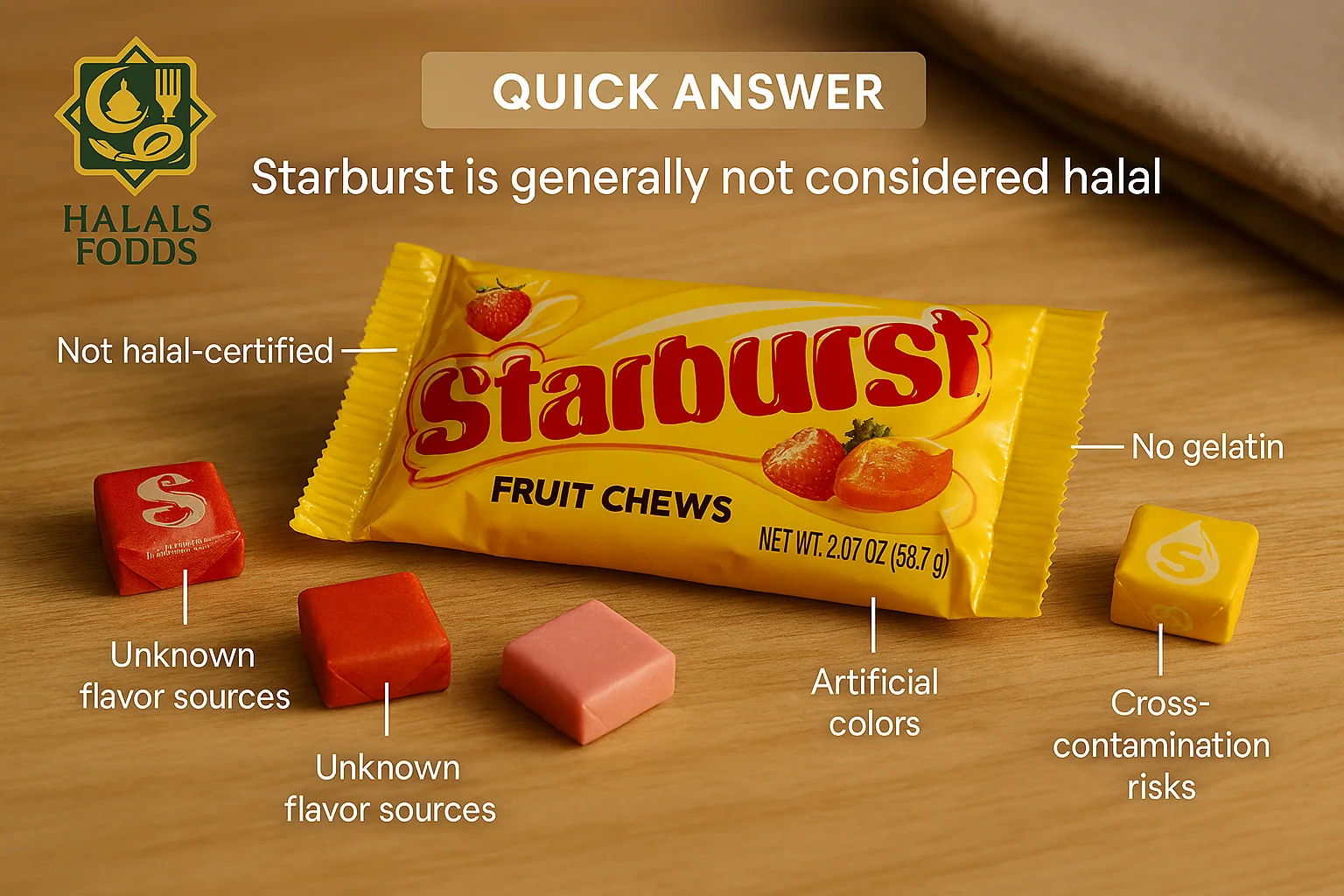
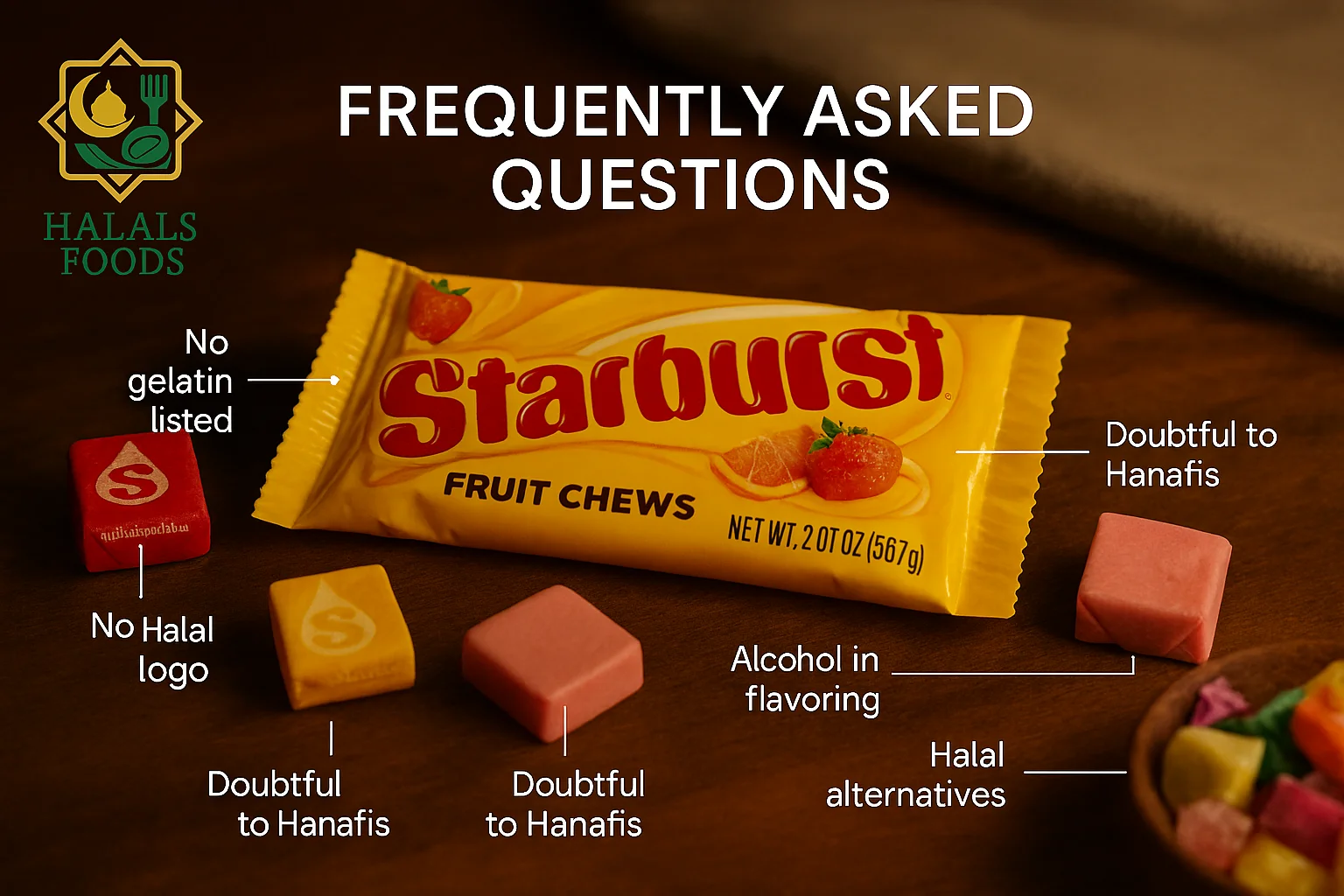
Is Starburst Halal is generally considered not halal or doubtful (mashbooh)—especially in countries like the USA.
Why?
- No halal certification
- Unknown sources of flavoring
- Produced in shared factories with non-halal items
👉 If you follow strict halal guidelines, it’s better to avoid it.
But here’s the part most people ignore…
That’s not the full story.
Why This Question Is So Confusing
You might be thinking:
“Wait… there’s no gelatin in Starburst, right? So why is it even a problem?”
Exactly. That’s where the confusion begins.
Most Muslims are taught one simple rule:
“If there’s no pork or gelatin, it should be fine.”
But modern food production doesn’t work that simply anymore.
Today, the real issues are hidden in:
- Flavoring systems
- Processing methods
- Supply chains
And this is where [[MAIN KEYWORD]] becomes a gray area.
Let’s Break Down What You’re Actually Eating
At first glance, Starburst looks completely plant-based.
Here are the main ingredients (especially in the USA):
- Sugar
- Corn syrup
- Palm oil
- Citric acid
- Modified starch
- Flavorings
- Artificial colors
Nothing scary, right?
But here’s the catch…
The Ingredient List Doesn’t Tell the Full Story
Food labels are designed for regulation, not for halal clarity.
So when you read:
“Natural flavors”
That could mean:
- Fruit extracts (halal)
- Dairy enzymes (sometimes halal)
- Animal-derived compounds (not halal)
And companies are not required to tell you the exact source.
That’s where things start getting uncomfortable.
The Gelatin Myth (What Most People Assume)
Let’s clear this up quickly:
👉 Does Is Starburst Halal contain gelatin?
No, in the USA version, it does not.
And honestly, that’s why many Muslims feel relaxed eating it.
But here’s the reality:
No gelatin does NOT automatically mean halal.
This is one of the biggest misunderstandings online.
Because halal isn’t just about what is removed…
It’s about what is unknown.
The Real Problem: “Natural Flavors”
This is the part most websites mention… but don’t explain properly.
So let’s make it simple.
“Natural flavors” are like a black box.
Inside that box could be:
- Plant extracts ✅
- Fermented ingredients ⚠️
- Animal-derived substances ❌
Now here’s the issue:
👉 Companies like Mars Wrigley (who make Starburst) do not disclose the source.
So from an Islamic perspective:
- If source = unknown → Mashbooh (doubtful)
And in Islam, when something is doubtful:
It’s better to avoid it.
A Small Detail Most People Miss
Here’s something interesting…
Even if the ingredients were 100% plant-based, there’s still another layer to consider:
👉 How it’s made
And this is where things get more serious.
Inside the Factory: What Really Happens
Let’s imagine how Is Starburst Halal is produced.
In large factories, the process looks something like this:
- Huge machines mix sugar, syrup, and oils
- Flavoring is added
- Candy is shaped, cooled, and packed
Sounds clean and simple.
But here’s the part most people ignore…
These Factories Don’t Make Only Starburst
The same company produces:
- Gummies (with gelatin)
- Chocolate (sometimes with alcohol-based flavoring)
- Other candies with animal ingredients
And often…
👉 The same machines are used
Why Cross-Contamination Matters in Islam
You might wonder:
“Okay, but if they clean the machines, isn’t that enough?”
From a general food safety perspective, yes.
But halal standards are stricter.
Islam doesn’t only care about cleanliness—
It cares about purity (taharah).
So if:
- A machine processes pork gelatin products
- Then processes Starburst
Even after cleaning…
👉 It may still not meet halal purification standards.
And here’s the key point:
Mars factories are NOT halal-certified facilities
Which means:
- No halal audits
- No guaranteed separation
- No religious cleaning process
So What Do Scholars Say About This?
This is where opinions split.
View 1: Strict Approach (More Common)
Many scholars say:
- Unknown ingredients = avoid
- Shared facilities = risky
- No certification = not reliable
👉 Conclusion: Is Starburst Halal is mashbooh or should be avoided
View 2: Lenient Approach
Some scholars and everyday Muslims say:
- No clear haram ingredient listed
- No gelatin present
- Default rule = halal unless proven haram
👉 Conclusion: It may be permissible
Let’s Be Honest… What Do Most People Actually Do?
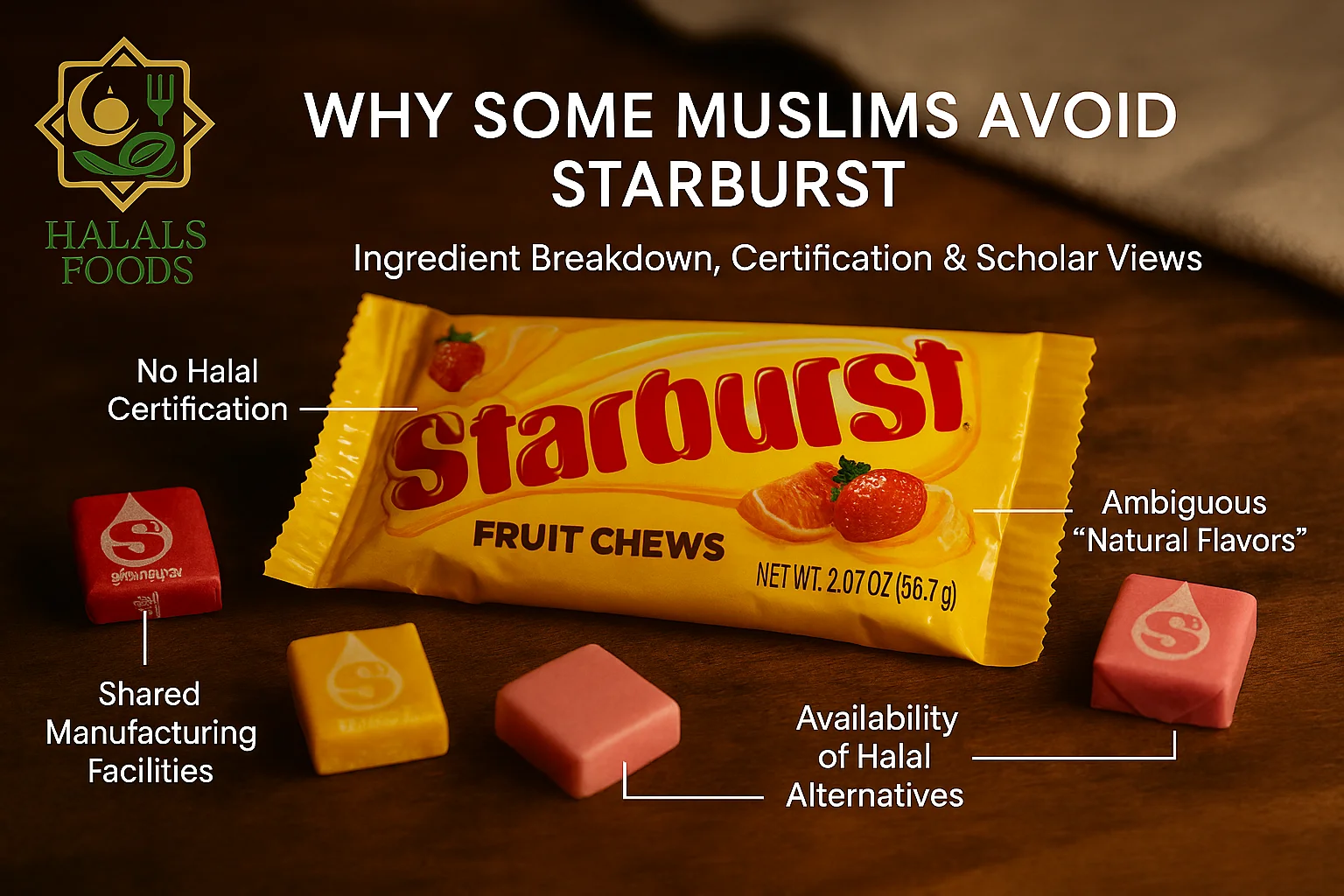
Here’s the real-world truth:
In countries like the USA, UK, or Canada:
- Some Muslims eat Starburst without thinking twice
- Others avoid it completely
- Many are just confused
And honestly…
👉 Both sides have reasoning
But the difference comes down to how strict you want to be with halal.
A Question You Should Ask Yourself
Instead of asking only:
“Is Starburst halal?”
Ask this:
👉 “Am I okay with uncertainty in my food?”
Because that’s what this really comes down to.
Not clear haram…
Not clearly halal…
Just somewhere in between.
What Most Websites Get Wrong
Let’s call this out clearly.
A lot of articles online do one of two things:
- Say “No gelatin = halal” (oversimplified ❌)
- Say “Contains chemicals = haram” (misleading ❌)
Both are incomplete.
The real issue is:
- Unknown sourcing
- Lack of certification
- Manufacturing complexity
And unless all three are addressed…
👉 You can’t give a 100% confident halal label
A Smarter Way to Think About It
Instead of chasing every ingredient, here’s a simpler rule many Muslims follow today:
👉 If it’s not halal-certified AND there are doubts → avoid when possible
Why?
Because today, halal alternatives are everywhere.
Which brings us to an important point…
Are There Better Halal Options?
Yes—and this changes everything.
Today, you can easily find:
- Halal-certified chewy candies
- Gelatin-free verified sweets
- Muslim-owned brands
So the real question becomes:
👉 If better options exist… why take the risk?
Before You Decide… One More Thing
There’s something important we haven’t fully explored yet:
- Is Starburst Halal different in the UK vs USA?
- Are ANY versions actually halal?
- What about alcohol in flavoring?
- And what do major halal authorities officially say?
Because this is where the answer becomes even more interesting…
Does Is Starburst Halal Have Different Ingredients in Different Countries?
This is where things start to get even more complicated—and honestly, more confusing for everyday Muslim consumers.
Many people assume that candy is the same worldwide. But global brands like Mars Wrigley often change formulations depending on the country due to:
- Local food laws
- Consumer preferences
- Cost and supply chain differences
So when someone says:
“I heard Is Starburst Halal is halal in the UK.”
That statement isn’t completely random. There are differences—but they’re often misunderstood.
Is Starburst Halal in the USA vs UK vs Middle East
Let’s look at the regional reality in simple terms.
United States
In the USA, Starburst is:
- Not halal-certified
- Made in shared facilities
- Contains “natural flavors” with undisclosed sources
This is why most U.S.-based halal organizations classify it as mashbooh (doubtful).
United Kingdom
In the UK, some people believe Starburst is halal because:
- Gelatin is not listed
- Some products use vegetarian-friendly formulations
However, here’s the key fact:
👉 UK Starburst is still NOT halal-certified
So while the ingredients may appear safer, the uncertainty still exists.
That means the ruling doesn’t automatically change just because the country changed.
Middle East and Muslim-Majority Markets
Now this is where things get interesting.
In certain Muslim-majority countries, companies sometimes produce:
- Special halal-certified versions
- Region-specific candy lines
- Products with clear halal logos
But here’s the catch most people miss:
These are often not the same exact products exported to the USA or UK.
So even if Starburst is halal-certified somewhere, it doesn’t mean the pack in your local store is halal too.
Why Halal Certification Matters More Than Ingredients Alone
Let’s pause here and talk about something critical:
Certification isn’t just a logo—it’s a system of accountability.
A halal-certified candy must pass audits that check:
- Ingredient sources
- Supply chain traceability
- Cross-contamination prevention
- Cleaning procedures
Without certification, you’re relying only on:
- Partial ingredient lists
- Marketing statements
- And assumptions
And assumptions are exactly what halal guidelines try to avoid.
The Hidden Alcohol Question in Flavorings
One of the most overlooked issues with Is Starburst Halal is not gelatin—it’s alcohol.
You might be thinking:
“But alcohol isn’t listed in the ingredients.”
That’s true. But here’s something most people don’t realize:
In food manufacturing, alcohol is often used as a carrier solvent for flavor extracts.
For example:
- Vanilla extract commonly contains alcohol
- Fruit flavor concentrates may use ethanol during processing
And in many countries, companies are not required to list this if the alcohol evaporates during production.
So the label can still legally say:
“Natural flavors”
Even if alcohol was used earlier in the process.
From an Islamic perspective, scholars differ:
- Some allow evaporated alcohol
- Others consider it problematic regardless
This adds another layer of uncertainty to Is Starburst Halal status.
Official Statements From Mars Wrigley (What the Company Actually Says)
It’s always better to go directly to the source rather than relying only on blogs or forums.
Mars Wrigley has repeatedly stated:
- They do not label products halal unless certified
- Ingredient sources may change
- Manufacturing lines are shared
This is important because it tells us two things:
- The company is not claiming Starburst is halal
- They are not guaranteeing that it is free from cross-contact with animal products
And from a halal decision-making perspective, that silence speaks loudly.
Why Some Muslims Still Choose to Eat Is Starburst Halal
Let’s be fair and balanced here.
Not every Muslim avoids Starburst—and that doesn’t automatically mean they are ignoring halal rules.
Many people rely on the principle of:
“Asl al-ibaha” – everything is permissible unless proven forbidden.
Their reasoning usually looks like this:
- No gelatin listed
- No pork listed
- No alcohol listed
- Widely sold in Muslim countries
So they feel comfortable consuming it occasionally, especially when halal options are limited.
For families living in non-Muslim countries, this becomes a practical decision, not just a theoretical one.
Why Many Scholars Recommend Avoiding It
On the other hand, scholars who take a stricter approach argue something very simple:
When halal alternatives exist, doubtful products should be avoided.
This is based on a famous hadith:
“Leave that which makes you doubt for that which does not make you doubt.”
And in today’s world, halal-certified candies are no longer rare or hard to find.
So from this perspective:
- There is no necessity (darurah)
- Therefore, avoiding mashbooh products is the safer Islamic choice
Real-Life Example: A Parent Buying Candy for Their Child
Let’s make this practical.
Imagine a Muslim parent buying candy for their child’s school party.
They have two options:
- A well-known brand like Is Starburst Halal with unclear halal status
- A halal-certified candy with verified ingredients
Even if Starburst might be permissible, many parents choose the second option simply for peace of mind.
Because when it comes to children, people naturally choose the safer route.
Common Myths About Is Starburst Halal
There are several myths that keep spreading online. Let’s clear them up quickly.
Myth 1: “No gelatin means halal”
Not true. Gelatin is just one of many halal concerns.
Myth 2: “If it’s sold in Muslim countries, it must be halal”
Also not always true. Some products are imported and not halal-certified locally.
Myth 3: “Artificial colors make it haram”
This is incorrect. Colors like:
- Red 40
- Yellow 5
are synthetic and generally considered halal.
What Major Halal Organizations Say
Organizations like:
- IFANCA
- HFSAA
- Halal Monitoring Services
have clear policies:
Products with ambiguous ingredients and no certification cannot be declared halal.
This doesn’t mean they officially label Starburst haram—but it means they won’t approve it as halal either.
And that places Is Starburst Halal squarely in the mashbooh category.
Featured Snippet Style Answer
Is Starburst Halal ?
Is Starburst Halal is not halal-certified and contains ingredients with undisclosed sources. Due to possible cross-contamination and uncertain flavoring origins, many scholars classify it as doubtful (mashbooh), and cautious Muslims are advised to avoid it.
How to Check Candy for Halal Status Yourself
If you don’t want to rely on articles or opinions, here’s a simple checklist you can use anytime you shop.
Ask these questions:
- Is there a halal certification logo?
- Are all ingredient sources clearly plant-based?
- Is the company transparent about manufacturing?
- Are there halal alternatives available?
If the answer to the first question is no, and others are unclear, you’re dealing with a doubtful product—just like Is Starburst Halal.
Better Halal Alternatives to Is Starburst Halal
The good news is that the halal candy market has grown massively in recent years.
You can now find:
- Halal-certified fruit chews
- Gelatin-free vegan candies
- Muslim-owned confectionery brands
These products:
- Clearly label their ingredients
- Use halal-certified flavorings
- Are produced in audited facilities
So you no longer have to rely on guesswork.
Final Verdict: Is Starburst Halal or Haram?
After looking at:
- Ingredients
- Flavoring sources
- Manufacturing practices
- Company statements
- Scholarly opinions
Here is the most accurate and balanced conclusion:
Is Starburst Halal is not confirmed halal and is generally considered mashbooh (doubtful).
It is not labeled haram because:
- No pork or gelatin is clearly listed
But it cannot be confidently labeled halal because:
- No certification
- Unknown flavoring sources
- Shared production facilities
So the ruling becomes:
👉 Permissible according to some, but safer to avoid according to many scholars.
A Simple Way to Make Your Own Decision
At the end of the day, halal decisions often come down to personal level of caution.
You can think of it like three levels:
Level 1 – Strict:
Only eat halal-certified products → avoid Is Starburst Halal
Level 2 – Moderate:
Avoid obvious haram, accept doubtful occasionally → may consume it
Level 3 – Lenient:
Follow ingredient list only → consider it halal
None of these people are trying to disobey Islam—they’re just applying different scholarly interpretations.
Conclusion (The Honest Truth)
Let’s end this in a very real, human way.
If you eat Is Starburst Halal occasionally because you didn’t know or had no other option, you shouldn’t panic.
But now that you understand:
- How modern food is made
- How halal certification works
- And why scholars classify it as doubtful
You’re in a better position to make a conscious decision.
And in Islam, making informed choices is always better than acting in uncertainty.
So next time you see that bright pink pack on a store shelf, you won’t just be guessing—you’ll actually know what you’re deciding.
Related Halal Food Guides You May Find Helpful
People searching for “Is [Is Skittles Halal?]” are also curious about other foods and ingredients. Below, you’ll find related halal food articles that clearly explain ingredient sources, how products are made, and whether they meet halal requirements.